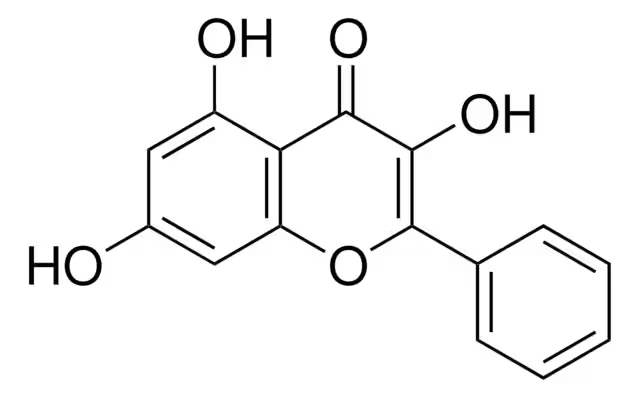
CAS Number548-83-4
SynonymsEINECS 208-960-4; 3,5,7-trihydroxyflavone; Galangin; teptochrysin; Galengin; 3,5,7-trihydroxy-2-phenyl-chromen-4-one; 3,5,7-trihydroxy-flavon; 3,5,7-Trihydroxy-2-phenyl-4H-chromen-4-one; 3,5,7-Trihydroxy-Flavone; galangine; 5,7-dihydroxyflavonol; NORIZALPININ; 3,5,7-trihydroxyfalvone; MFCD00006833; 3,5,7-Trihydroxy-2-phenyl-4H-1-benzopyran-4-one
Molecular FormulaC15H10O5
Molecular Weight270.24
Purity≥95 (HPLC)%
Density1.6±0.1 g/cm3
Boiling Point518.6±50.0 °C at 760 mmHg
Melting Point214-215 °C (lit.)
Appearancepowder
EINECS208-960-4
Symbol
Signal WordWarning
| Chemical & Physical Properties | |
|---|---|
| CAS Number | 548-83-4 |
| Catalog No. | 2A-9022818 |
| Chinese Name | 高良姜素; 3,5,7-三羟基黄酮 |
| Synonyms | EINECS 208-960-4; 3,5,7-trihydroxyflavone; Galangin; teptochrysin; Galengin; 3,5,7-trihydroxy-2-phenyl-chromen-4-one; 3,5,7-trihydroxy-flavon; 3,5,7-Trihydroxy-2-phenyl-4H-chromen-4-one; 3,5,7-Trihydroxy-Flavone; galangine; 5,7-dihydroxyflavonol; NORIZALPININ; 3,5,7-trihydroxyfalvone; MFCD00006833; 3,5,7-Trihydroxy-2-phenyl-4H-1-benzopyran-4-one |
| Molecular Formula | C15H10O5 |
| Molecular Weight | 270.24 |
| Purity | ≥95 (HPLC) |
| Density | 1.6±0.1 g/cm3 |
| Boiling Point | 518.6±50.0 °C at 760 mmHg |
| Melting Point | 214-215 °C (lit.) |
| Appearance | powder |
| Storage Condition | Ventilated, sealed, away from oxidants |
| Application | Galangin is a modulator of arylhydrocarbon receptors and also inhibits CYP1A1 activity. |
| EINECS | 208-960-4 |
| HTC | 2914400090 |
| PubChem ID | 57648294 |
| MDL Number | MFCD00006833 |
| SMILES | Oc1cc(O)c2C(=O)C(O)=C(Oc2c1)c3ccccc3 |
| InChI | 1S/C15H10O5/c16-9-6-10(17)12-11(7-9)20-15(14(19)13(12)18)8-4-2-1-3-5-8/h1-7,16-17,19H |
| InChI Key | VCCRNZQBSJXYJD-UHFFFAOYSA-N |
| Beilstein/REAXYS | 272179 |
| NACRES Code | NA.79 |
| UNSPSC | 41116107 |
| Hazard Symbols | Transport |
| MSDS | msds/22818_1_548_83_4.pdf |
| Bioactivity | Galangin is an agonist/antagonist of the arylhydrocarbon receptor, and also shows inhibition of CYP1A1 activity. Related Catalog Signaling Pathways >> Autophagy >> Autophagy Signaling Pathways >> Metabolic Enzyme/Protease >> Cytochrome P450 Research Areas >> Cancer Natural Products >> Flavonoids In Vitro Galangin inhibits the catabolic breakdown of DMBA, as measured by thin-layer chromatography, in a dose-dependent manner. Galangin also inhibits the formation of DMBA-DNA adducts, and prevents DMBA-induced inhibition of cell growth. Galangin causes a potent, dose-dependent inhibition of CYP1A1 activity, as measured by ethoxyresorufin-O-deethylase activity, in intact cells and in microsomes isolated from DMBA-treated cells. Analysis of the inhibition kinetics by double-reciprocal plot demonstrates that galangin inhibits CYP1A1 activity in a noncompetitive manner. Galangin causes an increase in the level of CYP1A1 mRNA, indicating that it may be an agonist of the aryl hydrocarbon receptor, but it inhibits the induction of CYP1A1 mRNA by DMBA or by 2,3,5,7-tetrachlorodibenzo-p-dioxin (TCDD). Galangin also inhibits the DMBA- or TCDD-induced transcription of a reporter vector containing the CYP1A1 promoter[1]. Galangin treatment inhibits cell proliferation and induced autophagy (130 μM) and apoptosis (370 μM). In particular, galangin treatment in HepG2 cells causes (1) an accumulation of autophagosomes, (2) elevated levels of microtubule-associated protein light chain 3, and (3) an increased percentage of cells with vacuoles. p53 expression is also increased. The galangin-induced autophagy is attenuated by the inhibition of p53 in HepG2 cells, and overexpression of p53 in Hep3B cells restored the galangin-induced higher percentage of cells with vacuoles to normal level[2]. Cell Assay Cells (5.0×10³) are seeded and treated with different concentrations of galangin for different periods of time in 96-well plates. The number of viable cells in each well is determined by adding 10 µL of 5 mg/mL MTT solution. Following the 4 hour incubation at 37°C, the cells are dissolved in a 100 µL solution containing 20% SDS and 50% dimethy formamide. The optical densities are quantified at a test wavelength of 570 nm with a reference wavelength of 630 nm using a Varioskan Flash Reader spectrophotometer. References [1]. Ciolino HP, et al. The flavonoid galangin is an inhibitor of CYP1A1 activity and an agonist/antagonist of the aryl hydrocarbon receptor. Br J Cancer. 1999 Mar;79(9-10):1340-6. [2]. Wen M, et al. Galangin induces autophagy through upregulation of p53 in HepG2 cells. Pharmacology. 2012;89(5-6):247-55. Chemical & Physical Properties Density 1.6±0.1 g/cm3 Boiling Point 518.6±50.0 °C at 760 mmHg Melting Point 214-215 °C(lit.) Molecular Formula C15H10O5 Molecular Weight 270.237 Flash Point 202.0±23.6 °C Exact Mass 270.052826 PSA 90.90000 LogP 2.83 Vapour Pressure 0.0±1.4 mmHg at 25°C Index of Refraction 1.748 |
| Use of | Galangin is an agonist/antagonist of the arylhydrocarbon receptor, and also shows inhibition of CYP1A1 activity. Properties Articles69 Name galangin Synonym More Synonyms Galangin Biological Activity Description Galangin is an agonist/antagonist of the arylhydrocarbon receptor, and also shows inhibition of CYP1A1 activity. Related Catalog Signaling Pathways >> Autophagy >> Autophagy Signaling Pathways >> Metabolic Enzyme/Protease >> Cytochrome P450 Research Areas >> Cancer Natural Products >> Flavonoids References [1]. Ciolino HP, et al. The flavonoid galangin is an inhibitor of CYP1A1 activity and an agonist/antagonist of the aryl hydrocarbon receptor. Br J Cancer. 1999 Mar;79(9-10):1340-6. Chemical & Physical Properties Molecular Formula C15H10O5 Exact Mass 270.052826 PSA 90.90000 Index of Refraction 1.748 |
| Tax Rebate | 9.0% |
| Supervision | none |
| Transport Info | Shipping Name: UN |
| MSDS Transport Info | Module 14. Shipping information 14.1 UN dangerous goods number European Land Transport Dangerous Regulations: -International Maritime Dangerous Regulations: -International Air Transport Dangerous Regulations: - 14.2 United Nations shipping name European Land Transport Dangerous Regulations: Non-dangerous goods IMDG Code: Non-dangerous goods International air transport dangerous goods regulations: non-dangerous goods 14.3 Transport hazard categories European Land Transport Dangerous Regulations: -International Maritime Dangerous Regulations: -International Air Transport Dangerous Regulations: - 14.4 Package group European Land Transport Dangerous Regulations: -International Maritime Dangerous Regulations: -International Air Transport Dangerous Regulations: - 14.5 Environmental hazards European Land Transport Danger Regulations: No International Maritime Danger Regulations International Air Transport Danger Regulations: No Marine pollutants (yes/no): No 14.6 Special reminder to users No data available |
| Related Products in Botanical Reference Standards | ||
|---|---|---|
| Genistin | 529-59-9 | 2A-9022548 |
| Rosmarinic acid | 537-15-5 | 2A-9022688 |
| Pterostilbene | 537-42-8 | 2A-9022689 |
| trans-Ferulic acid | 537-98-4 | 2A-9022697 |
| Hypericin | 548-04-9 | 2A-9022811 |
| 7-Hydroxy cholesterol | 566-27-8 | 2A-9022952 |
| Tanshinone IIA | 568-72-9 | 2A-9022960 |
| 2-Bromoanthraquinone | 572-83-8 | 2A-9022980 |
| Fraxetin | 574-84-5 | 2A-9022994 |
| Apigenin 7-glucoside | 578-74-5 | 2A-9023028 |
| Browse all Botanical Reference Standards products » | ||
Phone:
630-322-8886
630-322-8887
Email:
Office Locations:
Chicago, IL, USA
San Francisco, CA, USA


 EN
EN


 SDS
SDS