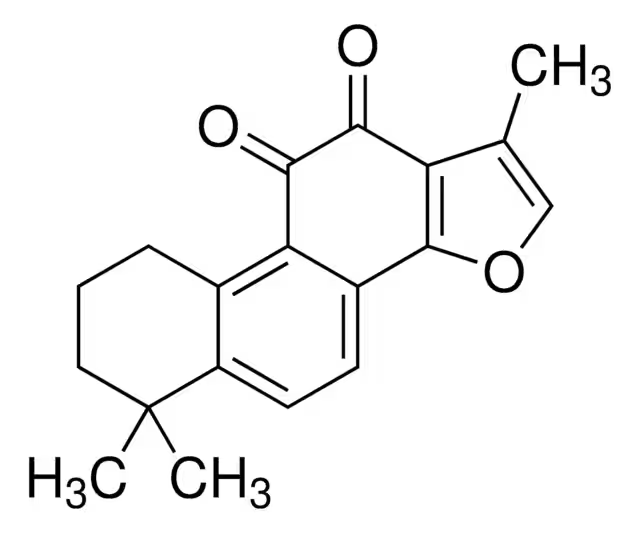
CAS Number568-72-9
SynonymsTanshinone IIA; tanshinone II-A; Dan Shen Ketone; Tanshionesiia; Tanshine II; TANSHION P.E; 1,6,6-Trimethyl-6,7,8,9-tetrahydrophenanthro[1,2-b]furan-10,11-dione; SweetOrange; MFCD00238692; QS-D-77-4-2; TANSHINONE A; tanshiones; Tanshinone II; TANSHINONES IIA
Molecular FormulaC19H18O3
Molecular Weight294.34
Purity≥97 (HPLC)%
Density1.2±0.1 g/cm3
Boiling Point480.7±44.0 °C at 760 mmHg
Melting Point205-207ºC
Appearancepowder
Symbol
Signal WordWarning
| Chemical & Physical Properties | |
|---|---|
| CAS Number | 568-72-9 |
| Catalog No. | 2A-9022960 |
| Chinese Name | 丹参酮IIA |
| Synonyms | Tanshinone IIA; tanshinone II-A; Dan Shen Ketone; Tanshionesiia; Tanshine II; TANSHION P.E; 1,6,6-Trimethyl-6,7,8,9-tetrahydrophenanthro[1,2-b]furan-10,11-dione; SweetOrange; MFCD00238692; QS-D-77-4-2; TANSHINONE A; tanshiones; Tanshinone II; TANSHINONES IIA |
| Molecular Formula | C19H18O3 |
| Molecular Weight | 294.34 |
| Purity | ≥97 (HPLC) |
| Density | 1.2±0.1 g/cm3 |
| Boiling Point | 480.7±44.0 °C at 760 mmHg |
| Melting Point | 205-207ºC |
| Appearance | powder |
| Storage Condition | 2-8°C |
| Application | Tanshinone IIA (Tan IIA) is one of the major fat-soluble compounds in the roots of red root salvia miltiorrhiza. Tanshinone IIA inhibits angiogenesis by targeting the protein kinase domain of VEGF/VEG |
| PubChem ID | 329826804 |
| MDL Number | MFCD00238692 |
| SMILES | Cc1coc2-c3ccc4c(CCCC4(C)C)c3C(=O)C(=O)c12 |
| InChI | 1S/C19H18O3/c1-10-9-22-18-12-6-7-13-11(5-4-8-19(13,2)3)15(12)17(21)16(20)14(10)18/h6-7,9H,4-5,8H2,1-3H3 |
| InChI Key | HYXITZLLTYIPOF-UHFFFAOYSA-N |
| NACRES Code | NA.25 |
| UNSPSC | 12352212 |
| Hazard Symbols | Transport |
| MSDS | msds/22960_1_568_72_9.pdf |
| Bioactivity | Tanshinone IIA (Tan IIA) is one of the main fat-soluble compositions in the root of red-rooted salvia. Tanshinone IIA may suppress angiogenesis by targeting the protein kinase domains of VEGF/VEGFR2. Related Catalog Research Areas >> Cardiovascular Disease Natural Products >> Quinones Target VEGF/VEGFR2[1] In Vitro The anti-tumor effect of Tanshinone IIA includes inhibiting tumor cell proliferation, disturbing tumor cell cycle, promoting tumor cell apoptosis, and inhibiting tumor cell invasion and transfer. Tanshinone IIA has anti-proliferative effects on A549 cells: the IC50 of Tanshinone IIA after 24, 48 and 72 h are 145.3, 30.95 and 11.49 μM, respectively. The CCK-8 assay is used to evaluate the proliferative activity of A549 cells treated with Tanshinone IIA (2.5-80 μM) for 24, 48 and 72 h, respectively. The CCK-8 results show that Tanshinone IIA can significantly inhibit A549 cell proliferation in a dose- and time-dependent manner. Obvious apoptosis and cell growth inhibition of A549 cells are observed after drug treatment for 48 h (concentrations used are approximately IC50 values: Tanshinone IIA 31 μM on A549). Western blotting finds that 48 h exposures to Tanshinone IIA (31 μM) in A549 cells, downregulates expression of VEGF and VEGFR2 protein in both drug treatment groups vs. vehicle[1]. Tanshinone IIA, one of the most abundant constituents of the root of Salvia miltiorrhiza, protects rat myocardium-derived H9C2 cells against apoptosis. Treatment of H9C2 cells with Tanshinone IIA inhibits angiotensin II-induced apoptosis by downregulating the expression of PTEN (phosphatase and tensin homolog), a tumor suppressor that plays a critical role in apoptosis. Tanshinone IIA inhibits angiotensin II (AngII)-induced apoptosis by downregulating the expression of phosphatase and tensin homolog (PTEN)[2]. Tanshinone IIA decreases the protein expression of EGFR, and IGFR blocking the PI3K/Akt/mTOR pathway in gastric carcinoma AGS cells[3]. Cell Assay A549 cells are counted in logarithmic phase and 6000 cells (90 μL volume) are placed in 96-well plates. 10 μL varying concentrations of Tanshinone IIA (final concentrations 80, 60, 40, 30, 20, 15, 10, 5 and 2.5 μM) and ADM (final concentrations 8, 4, 2, 1, 0.5 and 0.25 μM) are added into drug groups, while negative control group (vehicle group) is only added 10 μL DMSO or normal saline without Tanshinone IIA or ADM. Cells are incubated for an additional 2 h with CCK-8 reagent (100 μL/mL medium) and the absorbance is read at 450 nm using a microplate reader. Cell proliferation inhibition rates are calculated according to the following formula: the proliferation inhibition ratio (%)=1-[(A1-A4)/(A2-A3)]×100, where, A1 is the OD value of drug experimental group, A2 is the OD value of blank control group, A3 is the OD value of the RPMI1640 medium without cells, and A4 is the OD value of drugs with the same concentration as A1 but without cells. The IC50 value, which represents the concentration of the drug that demonstrates 50% of cell growth inhibition, is calculated by nonlinear regression analysis using GraphPad Prism software[1]. References [1]. Xie J, et al. The antitumor effect of tanshinone IIA on anti-proliferation and decreasing VEGF/VEGFR2 expression on the human non-small cell lung cancer A549 cell line. Acta Pharm Sin B. 2015 Nov;5(6):554-63. [2]. Zhang Z, et al. Tanshinone IIA inhibits apoptosis in the myocardium by inducing microRNA-152-3p expression and thereby downregulating PTEN. Am J Transl Res. 2016 Jul 15;8(7):3124-32. [3]. Su CC, et al. Tanshinone IIA decreases the protein expression of EGFR, and IGFR blocking the PI3K/Akt/mTOR pathway in gastric carcinoma AGS cells both in vitro and in vivo. Oncol Rep. 2016 Aug;36(2):1173-9. Chemical & Physical Properties Density 1.2±0.1 g/cm3 Boiling Point 480.7±44.0 °C at 760 mmHg Melting Point 205-207ºC Molecular Formula C19H18O3 Molecular Weight 294.344 Flash Point 236.4±21.1 °C Exact Mass 294.125580 PSA 47.28000 LogP 5.47 Vapour Pressure 0.0±1.2 mmHg at 25°C Index of Refraction 1.588 InChIKey HYXITZLLTYIPOF-UHFFFAOYSA-N SMILES Cc1coc2c1C(=O)C(=O)c1c-2ccc2c1CCCC2(C)C Storage condition 2-8°C |
| Use of | Tanshinone IIA (Tan IIA) is one of the main fat-soluble compositions in the root of red-rooted salvia. Tanshinone IIA may suppress angiogenesis by targeting the protein kinase domains of VEGF/VEGFR2. Properties Articles57 Name Tanshinone IIA Synonym More Synonyms Tanshinone IIA Biological Activity Description Tanshinone IIA (Tan IIA) is one of the main fat-soluble compositions in the root of red-rooted salvia. Tanshinone IIA may suppress angiogenesis by targeting the protein kinase domains of VEGF/VEGFR2. Related Catalog Research Areas >> Cardiovascular Disease Natural Products >> Quinones VEGF/VEGFR2[1] References [2]. Zhang Z, et al. Tanshinone IIA inhibits apoptosis in the myocardium by inducing microRNA-152-3p expression and thereby downregulating PTEN. Am J Transl Res. 2016 Jul 15;8(7):3124-32. [3]. Su CC, et al. Tanshinone IIA decreases the protein expression of EGFR, and IGFR blocking the PI3K/Akt/mTOR pathway in gastric carcinoma AGS cells both in vitro and in vivo. Oncol Rep. 2016 Aug;36(2):1173-9. Chemical & Physical Properties Molecular Formula C19H18O3 Exact Mass 294.125580 PSA 47.28000 Index of Refraction 1.588 InChIKey HYXITZLLTYIPOF-UHFFFAOYSA-N |
| Transport Info | Shipping Name: UN |
| MSDS Transport Info | Module 14. Shipping information 14.1 UN dangerous goods number European Land Transport Dangerous Regulations: -International Maritime Dangerous Regulations: -International Air Transport Dangerous Regulations: - 14.2 United Nations shipping name European Land Transport Dangerous Regulations: Non-dangerous goods IMDG Code: Non-dangerous goods International air transport dangerous goods regulations: non-dangerous goods 14.3 Transport hazard categories European Land Transport Dangerous Regulations: -International Maritime Dangerous Regulations: -International Air Transport Dangerous Regulations: - 14.4 Package group European Land Transport Dangerous Regulations: -International Maritime Dangerous Regulations: -International Air Transport Dangerous Regulations: - 14.5 Environmental hazards European Land Transport Danger Regulations: No International Maritime Danger Regulations International Air Transport Danger Regulations: No Marine pollutants (yes/no): No 14.6 Special reminder to users No data available |
| Related Products in Botanical Reference Standards | ||
|---|---|---|
| Pterostilbene | 537-42-8 | 2A-9022689 |
| trans-Ferulic acid | 537-98-4 | 2A-9022697 |
| Hypericin | 548-04-9 | 2A-9022811 |
| Galangin | 548-83-4 | 2A-9022818 |
| 7-Hydroxy cholesterol | 566-27-8 | 2A-9022952 |
| 2-Bromoanthraquinone | 572-83-8 | 2A-9022980 |
| Fraxetin | 574-84-5 | 2A-9022994 |
| Apigenin 7-glucoside | 578-74-5 | 2A-9023028 |
| Liquiritigenin | 578-86-9 | 2A-9023030 |
| Rhodiola Rosea | 97404-52-9 | 2A-9024152 |
| Browse all Botanical Reference Standards products » | ||
Phone:
630-322-8886
630-322-8887
Email:
Office Locations:
Chicago, IL, USA
San Francisco, CA, USA


 EN
EN


 SDS
SDS