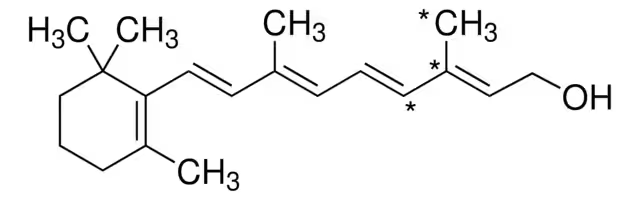
CAS Number68-26-8
SynonymsAlphalin; Lard-factor; Vitamin A1; (2E,4E,6E,8E)-3,7-dimethyl-9-(2,6,6-trimethylcyclohexen-1-yl)nona-2,4,6,8-tetraen-1-ol; 3,7-Dimethyl-9-(2,6,6-trimethyl-1-cyclohexen-1-yl)-2,4,6,8-nonatetraen-1-ol; Vitamin A (USP); trans-retinol; Vitamine A; Vitaminum A; Retinol; VI-a; Vitamin A; (2E,4E,6E,8E)-3,7-Diméthyl-9-(2,6,6-triméthyl-1-cyclohexén-1-yl)-2,4,6,8-nonatétraén-1-ol; TRANS-VITAMIN A ALCOHOL; all-trans-retinol; (2E,4E,6E,8E)-3,7-diméthyl-9-(2,6,6-triméthylcyclohex-1-én-1-yl)nona-2,4,6,8-tétraén-1-ol; EINECS 200-683-7; (2E,4E,6E,8E)-3,7-Dimethyl-9-(2,6,6-trimethyl-1-cyclohexen-1-yl)-2,4,6,8-nonatetraen-1-ol; MFCD00001552
Molecular FormulaC20H30O
Molecular Weight286.45
Purity≥95 (HPLC)%
Density1.0±0.1 g/cm3
Boiling Point421.2±14.0 °C at 760 mmHg
Melting Point61-63 °C (lit.)
Appearance(Powder or Powder with Lumps)
EINECS200-683-7
Symbol
Signal WordWarning
| Chemical & Physical Properties | |
|---|---|
| CAS Number | 68-26-8 |
| Catalog No. | 2A-9008904 |
| Chinese Name | 视黄醇 |
| Synonyms | Alphalin; Lard-factor; Vitamin A1; (2E,4E,6E,8E)-3,7-dimethyl-9-(2,6,6-trimethylcyclohexen-1-yl)nona-2,4,6,8-tetraen-1-ol; 3,7-Dimethyl-9-(2,6,6-trimethyl-1-cyclohexen-1-yl)-2,4,6,8-nonatetraen-1-ol; Vitamin A (USP); trans-retinol; Vitamine A; Vitaminum A; Retinol; VI-a; Vitamin A; (2E,4E,6E,8E)-3,7-Diméthyl-9-(2,6,6-triméthyl-1-cyclohexén-1-yl)-2,4,6,8-nonatétraén-1-ol; TRANS-VITAMIN A ALCOHOL; all-trans-retinol; (2E,4E,6E,8E)-3,7-diméthyl-9-(2,6,6-triméthylcyclohex-1-én-1-yl)nona-2,4,6,8-tétraén-1-ol; EINECS 200-683-7; (2E,4E,6E,8E)-3,7-Dimethyl-9-(2,6,6-trimethyl-1-cyclohexen-1-yl)-2,4,6,8-nonatetraen-1-ol; MFCD00001552 |
| Molecular Formula | C20H30O |
| Molecular Weight | 286.45 |
| Purity | ≥95 (HPLC) |
| Density | 1.0±0.1 g/cm3 |
| Boiling Point | 421.2±14.0 °C at 760 mmHg |
| Melting Point | 61-63 °C (lit.) |
| Appearance | (Powder or Powder with Lumps) |
| Storage Condition | This product should be sealed and stored in a cool |
| Application | Retinol, also known as vitamin A1, has pleiotropic functions including vision, immunity, hematopoiesis, reproduction, cell differentiation/growth and development. |
| EINECS | 200-683-7 |
| HTC | 3004500000 |
| PubChem ID | 24899395 |
| MDL Number | MFCD00001552 |
| SMILES | CC1(C)C(/C=C/C(C)=C/C=C/C(C)=C/CO)=C(C)CCC1 |
| InChI | 1S/C20H30O/c1-16(8-6-9-17(2)13-15-21)11-12-19-18(3)10-7-14-20(19,4)5/h6,8-9,11-13,21H,7,10,14-15H2,1-5H3/b9-6+,12-11+,16-8+,17-13+ |
| InChI Key | FPIPGXGPPPQFEQ-OVSJKPMPSA-N |
| Beilstein/REAXYS | 403040 |
| NACRES Code | NA.79 |
| eCl@ss | 34058018 |
| UNSPSC | 12352205 |
| Hazard Symbols | 3.0 |
| Risk Codes | R22;R38 |
| MSDS | msds/8904_1_68_26_8.pdf |
| Bioactivity | Retinol, also known as Vitamin A1, has pleiotropic functions including vison, immunity, hematopoiesis, reproduction, cell differentiation/growth, and development. Related Catalog Natural Products >> Others Research Areas >> Inflammation/Immunology Research Areas >> Metabolic Disease Target Human Endogenous Metabolite In Vitro It is found that contribution of hepatic microsomes (RDHs) to Retinol metabolism is greater than that of cytosol (ADHs), evidenced by higher Clint (Vmax/Km) of Retinol formation in microsomes than in cytosol[1]. In Vivo The results show that compare with control (CON) rats, high-fat diet (HFD) significantly lowers basal level of Retinol in plasma, but markedly elevates basal levels of Retinol in kidney, adipose tissue and liver. The results show that Retinol absorption in HFD rats is faster than that in CON rats, evidenced by significantly shorter Tmax (3.0±0.0 h for HFD rats vs 5.8±1.1 h for CON rats, p<0.05)[1]. The plasma Retinol levels in methionine-choline deficient diet (MCD) rats are significantly lower than in the controls while the hepatic Retinol levels in MCD rats are markedly higher. The hepatic expression of Retinol-metabolizing enzymes and binding proteins (GRBP-I, ALDH1A1, and ALDH1A2) in MCD rats is significantly higher than that in control rats[2]. Kinase Assay Activity of alcohol dehydrogenases (ADHs)/retinol dehydrogenases (RDHs) and retinal dehydrogenases (RALDHs) are assessed. Briefly, hepatic ADHs/RDHs and RALDHs activities are evaluated with Retinal formation in the presence of β-nicotinamide adenine dinucleotide (β-NAD+) and β-Nicotinamide adenine dinucleotide phosphate (β-NADP+), respectively. The incubation mixture consists of hepatic cytosol/microsomes (at the final concentration of 0.5 mg/mL), and a series concentrations of Retinol, 4.0 mM co-factor, 5 mM MgCl2, 91 μM butylated hydroxytoluene in a total volume of 500 μL. The reaction is initiated by the addition of Retinol pre-incubated for 5 min at 37°C. Following 15 min incubation, the reaction is quenched by extraction with equal volume of n-butanol/methanol, 95:5 (v:v) containing 0.005% butylated hydroxytoluene[1]. Animal Admin Wistar rats (male, aged 4 wk) are used in this study. Two groups of 6 rats are given free access to the following diets: the standard diet (control group) and the methionine-choline deficient diet (MCD) group. Each diet contains Retinol (1000 IU/100g). After 6 wk, the rats are sacrificed by exsanguination under isoflurane anesthesia after an overnight fast. Blood is collected in heparinized tubes, and plasma is separated for storage at -80°C. The liver, intestine, testes, and kidneys are removed, immediately frozen in liquid nitrogen, and stored at -80°C[2]. References [1]. Zhang M, et al. High-fat diet enhanced retinal dehydrogenase activity, but suppressed retinol dehydrogenase activity in liver of rats. J Pharmacol Sci. 2015 Apr;127(4):430-8. [2]. Miyazaki H, et al. Retinol status and expression of retinol-related proteins in methionine-choline deficient rats. J Nutr Sci Vitaminol (Tokyo). 2014;60(2):78-85. Chemical & Physical Properties Density 1.0±0.1 g/cm3 Boiling Point 421.2±14.0 °C at 760 mmHg Melting Point 61-63 °C(lit.) Molecular Formula C20H30O Molecular Weight 286.452 Flash Point 147.3±16.4 °C Exact Mass 286.229675 PSA 20.23000 LogP 6.84 Vapour Pressure 0.0±2.3 mmHg at 25°C Index of Refraction 1.549 Storage condition 2-8°C Stability Stable, but light and air sensitive. Incompatible with strong acids, strong oxidizing agents. |
| Use of | Retinol, also known as Vitamin A1, has pleiotropic functions including vison, immunity, hematopoiesis, reproduction, cell differentiation/growth, and development. Properties Articles346 Name all-trans-Retinol Synonym More Synonyms Vitamin A Biological Activity Description Retinol, also known as Vitamin A1, has pleiotropic functions including vison, immunity, hematopoiesis, reproduction, cell differentiation/growth, and development. Related Catalog Natural Products >> Others Research Areas >> Inflammation/Immunology Research Areas >> Metabolic Disease Human Endogenous Metabolite In Vitro It is found that contribution of hepatic microsomes (RDHs) to Retinol metabolism is greater than that of cytosol (ADHs), evidenced by higher Clint (Vmax/Km) of Retinol formation in microsomes than in cytosol[1]. References [1]. Zhang M, et al. High-fat diet enhanced retinal dehydrogenase activity, but suppressed retinol dehydrogenase activity in liver of rats. J Pharmacol Sci. 2015 Apr;127(4):430-8. [2]. Miyazaki H, et al. Retinol status and expression of retinol-related proteins in methionine-choline deficient rats. J Nutr Sci Vitaminol (Tokyo). 2014;60(2):78-85. Chemical & Physical Properties Molecular Formula C20H30O Exact Mass 286.229675 PSA 20.23000 Index of Refraction 1.549 Stability Stable, but light and air sensitive. Incompatible with strong acids, strong oxidizing agents. |
| Transport Info | Shipping Name: UN |
| MSDS Transport Info | Module 14. Shipping information 14.1 UN dangerous goods number European Land Transport Dangerous Regulations: -International Maritime Dangerous Regulations: -International Air Transport Dangerous Regulations: - 14.2 United Nations shipping name European Land Transport Dangerous Regulations: Non-dangerous goods IMDG Code: Non-dangerous goods International air transport dangerous goods regulations: non-dangerous goods 14.3 Transport hazard categories European Land Transport Dangerous Regulations: -International Maritime Dangerous Regulations: -International Air Transport Dangerous Regulations: - 14.4 Package group European Land Transport Dangerous Regulations: -International Maritime Dangerous Regulations: -International Air Transport Dangerous Regulations: - 14.5 Environmental hazards European Land Transport Danger Regulations: No International Maritime Danger Regulations International Air Transport Danger Regulations: No Marine pollutants (yes/no): No 14.6 Special reminder to users No data available |
| Related Products in Nutritional Ingredients | ||
|---|---|---|
| Neohesperidine | 20702-77-6 | 2A-9008535 |
| Phospho creatine sodium | 67-07-2 | 2A-9008672 |
| Pyridoxal hydrochloride | 65-22-5 | 2A-9008715 |
| Pyridoxal-5-phosphate; Pyridoxal 5-phosphate monohydrate | 41468-25-1 | 2A-9008716 |
| R-alpha-Lipoic acid | 62-46-4 | 2A-0201794 |
| Vitamin A palmitate | 79-81-2 | 2A-9008905 |
| Vitamin B12 | 68-19-9 | 2A-9008906 |
| Vitamin D3; cholecalciferol | 67-97-0 | 2A-0200198 |
| Vitamin E succinate | 4345-03-3 | 2A-9008908 |
| Vitamin K1; PHYTONADIONE | 84-80-0 | 2A-9008909 |
| Browse all Nutritional Ingredients products » | ||
Phone:
630-322-8886
630-322-8887
Email:
Office Locations:
Chicago, IL, USA
San Francisco, CA, USA


 EN
EN


 SDS
SDS