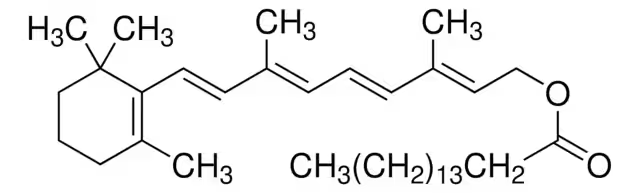
CAS Number79-81-2
SynonymsEINECS 201-228-5; O-hexadecanoylretinol; Retinyl palmitate; all-trans-retinyl palmitate; O-Palmitoylretinol; Retinol hexadecanoate; VITAMIN A PALMITATE; [(2E,4E,6E,8E)-3,7-dimethyl-9-(2,6,6-trimethylcyclohexen-1-yl)nona-2,4,6,8-tetraenyl] hexadecanoate; MFCD00019414
Molecular FormulaC36H60O2
Molecular Weight524.86
Purity98%
Density0.9±0.1 g/cm3
Boiling Point607.5±24.0 °C at 760 mmHg
Melting Point41678ºC
Appearanceoil
EINECS201-228-5
Symbol
Signal WordWarning
| Chemical & Physical Properties | |
|---|---|
| CAS Number | 79-81-2 |
| Catalog No. | 2A-9008905 |
| Chinese Name | 维生素A棕榈酸酯 |
| Synonyms | EINECS 201-228-5; O-hexadecanoylretinol; Retinyl palmitate; all-trans-retinyl palmitate; O-Palmitoylretinol; Retinol hexadecanoate; VITAMIN A PALMITATE; [(2E,4E,6E,8E)-3,7-dimethyl-9-(2,6,6-trimethylcyclohexen-1-yl)nona-2,4,6,8-tetraenyl] hexadecanoate; MFCD00019414 |
| Molecular Formula | C36H60O2 |
| Molecular Weight | 524.86 |
| Purity | 98 |
| Density | 0.9±0.1 g/cm3 |
| Boiling Point | 607.5±24.0 °C at 760 mmHg |
| Melting Point | 41678ºC |
| Appearance | oil |
| Storage Condition | This product should be sealed with argon and store |
| Application | Retinyl palmitate is an ester of retinol, the predominant form of vitamin A in the epidermis. Retinyl palmitate has been widely used in pharmaceuticals and cosmetics. |
| EINECS | 201-228-5 |
| HTC | 2936210000 |
| PubChem ID | 329823240 |
| MDL Number | MFCD00019414 |
| SMILES | CC1=C(/C=C/C(C)=C/C=C/C(C)=C/COC(CCCCCCCCCCCCCCC)=O)C(C)(C)CCC1 |
| InChI | 1S/C36H60O2/c1-7-8-9-10-11-12-13-14-15-16-17-18-19-25-35(37)38-30-28-32(3)23-20-22-31(2)26-27-34-33(4)24-21-29-36(34,5)6/h20,22-23,26-28H,7-19,21,24-25,29-30H2,1-6H3/b23-20+,27-26+,31-22+,32-28+ |
| InChI Key | VYGQUTWHTHXGQB-FFHKNEKCSA-N |
| Beilstein/REAXYS | 1917366 |
| NACRES Code | NA.24 |
| UNSPSC | 41116107 |
| Hazard Symbols | Transport |
| Risk Codes | R63 |
| Safety Description | S36/37 |
| MSDS | msds/8905_1_79_81_2.pdf |
| Bioactivity | Retinyl palmitate is an ester of Retinol and is the major form of vitamin A found in the epidermis. Retinyl palmitate has been widely used in pharmaceutical and cosmetic formulations. Related Catalog Natural Products >> Others Research Areas >> Others Target Human Endogenous Metabolite In Vitro Retinyl palmitate has a high molecular weight and a stable formulation. To be active, Retinyl palmitate should be enzymatically converted in the skin to retinol by cleavage of the ester linkage and must then be converted to tretinoin via oxidative processes[1]. In Vivo The topical administration of Retinyl palmitate in rats results in increased protein and collagen and an epidermal thickening[1]. References [1]. Oliveira MB, et al. Topical application of retinyl palmitate-loaded nanotechnology-based drug delivery systems for the treatment of skin aging. Biomed Res Int. 2014;2014:632570. Chemical & Physical Properties Density 0.9±0.1 g/cm3 Boiling Point 607.5±24.0 °C at 760 mmHg Melting Point 41678ºC Molecular Formula C36H60O2 Molecular Weight 524.860 Flash Point 79.7±21.2 °C Exact Mass 524.459351 PSA 26.30000 LogP 14.83 Appearance of Characters oil Vapour Pressure 0.0±1.7 mmHg at 25°C Index of Refraction 1.508 InChIKey VYGQUTWHTHXGQB-FFHKNEKCSA-N SMILES CCCCCCCCCCCCCCCC(=O)OCC=C(C)C=CC=C(C)C=CC1=C(C)CCCC1(C)C Storage condition 2-8°C |
| Use of | Retinyl palmitate is an ester of Retinol and is the major form of vitamin A found in the epidermis. Retinyl palmitate has been widely used in pharmaceutical and cosmetic formulations. Properties Articles73 Name all-trans-retinyl palmitate Synonym More Synonyms Retinyl palmitate Biological Activity Description Retinyl palmitate is an ester of Retinol and is the major form of vitamin A found in the epidermis. Retinyl palmitate has been widely used in pharmaceutical and cosmetic formulations. Related Catalog Natural Products >> Others Research Areas >> Others Human Endogenous Metabolite In Vitro Retinyl palmitate has a high molecular weight and a stable formulation. To be active, Retinyl palmitate should be enzymatically converted in the skin to retinol by cleavage of the ester linkage and must then be converted to tretinoin via oxidative processes[1]. In Vivo The topical administration of Retinyl palmitate in rats results in increased protein and collagen and an epidermal thickening[1]. References [1]. Oliveira MB, et al. Topical application of retinyl palmitate-loaded nanotechnology-based drug delivery systems for the treatment of skin aging. Biomed Res Int. 2014;2014:632570. Chemical & Physical Properties Molecular Formula C36H60O2 Exact Mass 524.459351 PSA 26.30000 LogP 14.83 Appearance of Characters oil Index of Refraction 1.508 InChIKey VYGQUTWHTHXGQB-FFHKNEKCSA-N SMILES CCCCCCCCCCCCCCCC(=O)OCC=C(C)C=CC=C(C)C=CC1=C(C)CCCC1(C)C |
| Transport Info | Shipping Name: UN |
| MSDS Transport Info | Module 14. Shipping information 14.1 UN dangerous goods number European Land Transport Dangerous Regulations: -International Maritime Dangerous Regulations: -International Air Transport Dangerous Regulations: - 14.2 United Nations shipping name European Land Transport Dangerous Regulations: Non-dangerous goods IMDG Code: Non-dangerous goods International air transport dangerous goods regulations: non-dangerous goods 14.3 Transport hazard categories European Land Transport Dangerous Regulations: -International Maritime Dangerous Regulations: -International Air Transport Dangerous Regulations: - 14.4 Package group European Land Transport Dangerous Regulations: -International Maritime Dangerous Regulations: -International Air Transport Dangerous Regulations: - 14.5 Environmental hazards European Land Transport Danger Regulations: No International Maritime Danger Regulations International Air Transport Danger Regulations: No Marine pollutants (yes/no): No 14.6 Special reminder to users No data available |
| Related Products in Nutritional Ingredients | ||
|---|---|---|
| Phospho creatine sodium | 67-07-2 | 2A-9008672 |
| Pyridoxal hydrochloride | 65-22-5 | 2A-9008715 |
| Pyridoxal-5-phosphate; Pyridoxal 5-phosphate monohydrate | 41468-25-1 | 2A-9008716 |
| R-alpha-Lipoic acid | 62-46-4 | 2A-0201794 |
| Vitamin A | 68-26-8 | 2A-9008904 |
| Vitamin B12 | 68-19-9 | 2A-9008906 |
| Vitamin D3; cholecalciferol | 67-97-0 | 2A-0200198 |
| Vitamin E succinate | 4345-03-3 | 2A-9008908 |
| Vitamin K1; PHYTONADIONE | 84-80-0 | 2A-9008909 |
| (+)-Cyclazocine | 3572-80-3 | 2A-9008928 |
| Browse all Nutritional Ingredients products » | ||
Phone:
630-322-8886
630-322-8887
Email:
Office Locations:
Chicago, IL, USA
San Francisco, CA, USA


 EN
EN


 SDS
SDS