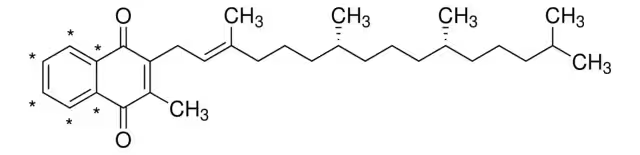
CAS Number84-80-0
SynonymsKONAKION; Rac-Phytonadione-D7; Phylloquinone-d3; VITAMIN K1 (PHYTONADIONE); Veda K1; 2-Methyl-3-[(2E,7R,11R)-3,7,11,15-tetramethyl-2-hexadecen-1-yl]-1,4-naphthoquinone; Kephton; Antihemorrhagic vitamin; 2-METHYL-3-PHYTYL-1,4-NAPHTHOQUINONE; 2-methyl-3-[(2E,7R,11R)-3,7,11,15-tetramethylhexadec-2-en-1-yl]naphthalene-1,4-dione; 2',3'-trans-Vitamin K1; AQUAMEPHYTON; Combinal K1; Orakay; 2-méthyl-3-[(2E,7R,11R)-3,7,11,15-tétraméthylhexadéc-2-én-1-yl]naphtalène-1,4-dione; EINECS 201-564-2; Vitamin K1; Veta K1; [R-[R*,R*-(E)]]-2-Methyl-3-(3,7,11,15-tetramethyl-2-hexadecenyl)-1,4-naphthalenedione; VITAMIN K1-[2H7] (PHYTONADIONE); Phyllochinonum; Phytonadione, K1; VITAMIN K/PHYLLOQUINONE; phytomenadione; Kaywan; 2-Methyl-3-[(2E,7R,11R)-3,7,11,15-tetramethylhexadec-2-en-1-yl]naphthalen-1,4-dion; 2-M
Molecular FormulaC31H46O2
Molecular Weight450.70
Purity97%
Density1.0±0.1 g/cm3
Boiling Point546.4±50.0 °C at 760 mmHg
Melting Point−20 °C (lit.)
Appearanceviscous liquid
EINECS201-564-2
Symbol
Signal WordWarning
| Chemical & Physical Properties | |
|---|---|
| CAS Number | 84-80-0 |
| Catalog No. | 2A-9008909 |
| Chinese Name | 维生素 K1 |
| Synonyms | KONAKION; Rac-Phytonadione-D7; Phylloquinone-d3; VITAMIN K1 (PHYTONADIONE); Veda K1; 2-Methyl-3-[(2E,7R,11R)-3,7,11,15-tetramethyl-2-hexadecen-1-yl]-1,4-naphthoquinone; Kephton; Antihemorrhagic vitamin; 2-METHYL-3-PHYTYL-1,4-NAPHTHOQUINONE; 2-methyl-3-[(2E,7R,11R)-3,7,11,15-tetramethylhexadec-2-en-1-yl]naphthalene-1,4-dione; 2',3'-trans-Vitamin K1; AQUAMEPHYTON; Combinal K1; Orakay; 2-méthyl-3-[(2E,7R,11R)-3,7,11,15-tétraméthylhexadéc-2-én-1-yl]naphtalène-1,4-dione; EINECS 201-564-2; Vitamin K1; Veta K1; [R-[R*,R*-(E)]]-2-Methyl-3-(3,7,11,15-tetramethyl-2-hexadecenyl)-1,4-naphthalenedione; VITAMIN K1-[2H7] (PHYTONADIONE); Phyllochinonum; Phytonadione, K1; VITAMIN K/PHYLLOQUINONE; phytomenadione; Kaywan; 2-Methyl-3-[(2E,7R,11R)-3,7,11,15-tetramethylhexadec-2-en-1-yl]naphthalen-1,4-dion; 2-M |
| Molecular Formula | C31H46O2 |
| Molecular Weight | 450.70 |
| Purity | 97 |
| Density | 1.0±0.1 g/cm3 |
| Boiling Point | 546.4±50.0 °C at 760 mmHg |
| Melting Point | −20 °C (lit.) |
| Appearance | viscous liquid |
| Storage Condition | This product should be sealed and stored in a cool |
| Application | Vitamin K1 is a fat-soluble, naturally occurring vitamin. It is necessary for blood coagulation, bone and blood vessel metabolism. |
| EINECS | 201-564-2 |
| HTC | 2936290090 |
| PubChem ID | 24900741 |
| MDL Number | MFCD00214063 |
| SMILES | O=C(C1=CC=CC=C21)C(C)=C(C/C=C(CCC[C@@H](CCC[C@H](C)CCCC(C)C)C)\C)C2=O |
| InChI | 1S/C31H46O2/c1-22(2)12-9-13-23(3)14-10-15-24(4)16-11-17-25(5)20-21-27-26(6)30(32)28-18-7-8-19-29(28)31(27)33/h7-8,18-20,22-24H,9-17,21H2,1-6H3/b25-20+/t23-,24-/m1/s1 |
| InChI Key | MBWXNTAXLNYFJB-NKFFZRIASA-N |
| Beilstein/REAXYS | 2568816 |
| NACRES Code | NA.28 |
| eCl@ss | 34058015 |
| UNSPSC | 12352205 |
| Hazard Symbols | Transport |
| MSDS | msds/8909_1_84_80_0.pdf |
| Bioactivity | Vitamin K1 a fat-soluble, naturally occurring vitamin required for blood coagulation and bone and vascular metabolism. Related Catalog Signaling Pathways >> Others >> Others Research Areas >> Cardiovascular Disease Natural Products >> Quinones In Vitro Phylloquinone (Vitamin K1) is a prenylated naphthoquinone that is synthesized exclusively by plants, green algae, and some species of cyanobacteria, where it serves as a vital electron carrier in photosystem I and as an electron acceptor for the formation of protein disulfide bonds. In humans and other vertebrates, phylloquinone plays the role of a vitamin (vitamin K1) that is required for blood coagulation and bone and vascular metabolism. Phylloquinone from green leafy vegetables and vegetable oil represents the major dietary source of vitamin K for humans[1]. Vitamin K1 treatment causes a significant antiproliferative effect and induces apoptosis in Caco-2, HT-29, and SW480 cell lines, with the involvement of the MAPK pathway. A concomitant and significant decrease in the polyamine biosynthesis occurr[2]. In Vivo Subjects who increase their dietary intake of vitamin K during the follow-up had a 51% reduced risk of incident diabetes compared with subjects who decrease or does not change the amount of phylloquinone intake[3]. Vitamin K supplementation reverses the high fat diet induced bone deterioration by modulating osteoblast and osteoclast activities and prevent bone loss in a high-fat diet-induced obese mice[4]. Application of vitamin K1 to the skin has been used for suppression of pigmentation and resolution of bruising. The effects produced by the topical vitamin K1 shows significant healing when compared with control group in parameters such as wound contraction, epithelialization period, hydroxyproline content and tensile strength[5]. Cell Assay Caco-2, HT-29, and SW480 cells are treated with increasing concentrations of vitamin K1 (10, 50, 100, and 200 μM) for 24 h, 48 h, and 72 h. MTT is added to each dish and incubated for 2 h at 37°C. At the end of the incubation period, the medium is removed. The plate is read at 570 nM[2]. Animal Admin Rats: For inducing full-thickness wound in rats, the excisional wound model is used. Five groups consisting of 8 rats each are used. Vitamin K cream (1% and 2%, w/w) is prepared in eucerin base and applied on the wound once a day until complete healing had occurred. Healing is defined by decreased wound margin (wound contraction), re-epithelialization, tensile strength and hydroxyproline content. Histopathological examination is also done[5]. Mice: Four-week-old C57BL/6J male mice are fed a 10% fat normal diet group or a 45% kcal high-fat diet group, with or without 200 mg/1000 g vitamin K1 (Normal diet + K1, high-fat diet + K1) and 200 mg/1000 g vitamin K2 (Normal diet + K2, high-fat diet + K2) for 12 weeks[4]. References [1]. Basset GJ, et al. Phylloquinone (Vitamin K1): Occurrence, Biosynthesis and Functions. Mini Rev Med Chem. 2016 Jun 22. [2]. Orlando A, et al. Vitamin K1 exerts antiproliferative effects and induces apoptosis in three differently graded human colon cancer cell lines. Biomed Res Int. 2015;2015:296721. [3]. Ibarrola-Jurado N, et al. Dietary phylloquinone intake and risk of type 2 diabetes in elderly subjects at high risk of cardiovascular disease. Am J Clin Nutr. 2012 Nov;96(5):1113-8. [4]. Kim M, et al. Vitamin K1 (phylloquinone) and K2 (menaquinone-4) supplementation improves bone formation in a high-fat diet-induced obese mice. J Clin Biochem Nutr. 2013 Sep;53(2):108-13. [5]. Hemmati AA, et al. Topical vitamin K1 promotes repair of full thickness wound in rat. Indian J Pharmacol. 2014 Jul-Aug;46(4):409-12. Chemical & Physical Properties Density 1.0±0.1 g/cm3 Boiling Point 546.4±50.0 °C at 760 mmHg Melting Point −20 °C(lit.) Molecular Formula C31H46O2 Molecular Weight 450.696 Flash Point 200.4±27.1 °C Exact Mass 450.349792 PSA 34.14000 LogP 12.25 Vapour Pressure 0.0±1.5 mmHg at 25°C Index of Refraction 1.511 Storage condition 2-8°C |
| Use of | Vitamin K1 a fat-soluble, naturally occurring vitamin required for blood coagulation and bone and vascular metabolism. Properties Articles96 Name phylloquinone Synonym More Synonyms Vitamin K1 Biological Activity Description Vitamin K1 a fat-soluble, naturally occurring vitamin required for blood coagulation and bone and vascular metabolism. Related Catalog Signaling Pathways >> Others >> Others Research Areas >> Cardiovascular Disease Natural Products >> Quinones In Vivo Subjects who increase their dietary intake of vitamin K during the follow-up had a 51% reduced risk of incident diabetes compared with subjects who decrease or does not change the amount of phylloquinone intake[3]. Vitamin K supplementation reverses the high fat diet induced bone deterioration by modulating osteoblast and osteoclast activities and prevent bone loss in a high-fat diet-induced obese mice[4]. Application of vitamin K1 to the skin has been used for suppression of pigmentation and resolution of bruising. The effects produced by the topical vitamin K1 shows significant healing when compared with control group in parameters such as wound contraction, epithelialization period, hydroxyproline content and tensile strength[5]. References [1]. Basset GJ, et al. Phylloquinone (Vitamin K1): Occurrence, Biosynthesis and Functions. Mini Rev Med Chem. 2016 Jun 22. [2]. Orlando A, et al. Vitamin K1 exerts antiproliferative effects and induces apoptosis in three differently graded human colon cancer cell lines. Biomed Res Int. 2015;2015:296721. [3]. Ibarrola-Jurado N, et al. Dietary phylloquinone intake and risk of type 2 diabetes in elderly subjects at high risk of cardiovascular disease. Am J Clin Nutr. 2012 Nov;96(5):1113-8. [4]. Kim M, et al. Vitamin K1 (phylloquinone) and K2 (menaquinone-4) supplementation improves bone formation in a high-fat diet-induced obese mice. J Clin Biochem Nutr. 2013 Sep;53(2):108-13. [5]. Hemmati AA, et al. Topical vitamin K1 promotes repair of full thickness wound in rat. Indian J Pharmacol. 2014 Jul-Aug;46(4):409-12. Chemical & Physical Properties Molecular Formula C31H46O2 Exact Mass 450.349792 PSA 34.14000 LogP 12.25 Index of Refraction 1.511 |
| Transport Info | Product name: Purity: 98.0% |
| MSDS Transport Info | Module 14. Shipping information 14.1 UN dangerous goods number European Land Transport Dangerous Regulations: -International Maritime Dangerous Regulations: -International Air Transport Dangerous Regulations: - 14.2 Names specified by the United Nations (UN) European Land Transport Dangerous Regulations: Non-dangerous goods IMDG Code: Non-dangerous goods International air transport dangerous goods regulations: non-dangerous goods 14.3 Transport hazard categories European Land Transport Dangerous Regulations: -International Maritime Dangerous Regulations: -International Air Transport Dangerous Regulations: - 14.4 Package group European Land Transport Dangerous Regulations: -International Maritime Dangerous Regulations: -International Air Transport Dangerous Regulations: - 14.5 Environmental hazards European Land Transport Dangerous Regulations: No International Maritime Transport Dangerous Regulations Maritime Pollutants: No International Air Transport Risk Regulations: No 14.6 Special reminder to users No data available The above information is believed to be correct, but is not all-inclusive and should be used as a guide only. The information in this document is based on our current knowledge and is Correct safety instructions apply to this product. This information does not represent a warranty as to the properties of this product. See reverse side of invoice or packing slip. |
| Related Products in Nutritional Ingredients | ||
|---|---|---|
| Vitamin A | 68-26-8 | 2A-9008904 |
| Vitamin A palmitate | 79-81-2 | 2A-9008905 |
| Vitamin B12 | 68-19-9 | 2A-9008906 |
| Vitamin D3; cholecalciferol | 67-97-0 | 2A-0200198 |
| Vitamin E succinate | 4345-03-3 | 2A-9008908 |
| (+)-Cyclazocine | 3572-80-3 | 2A-9008928 |
| (+/-)-Naringenin | 93602-28-9 | 2A-9008932 |
| Acidum foscolicum | 2398-95-0 | 2A-9009046 |
| Aclarubicin | 57576-44-0 | 2A-9009049 |
| Alaproclate | 60719-82-6 | 2A-9009087 |
| Browse all Nutritional Ingredients products » | ||
Phone:
630-322-8886
630-322-8887
Email:
Office Locations:
Chicago, IL, USA
San Francisco, CA, USA


 EN
EN


 SDS
SDS