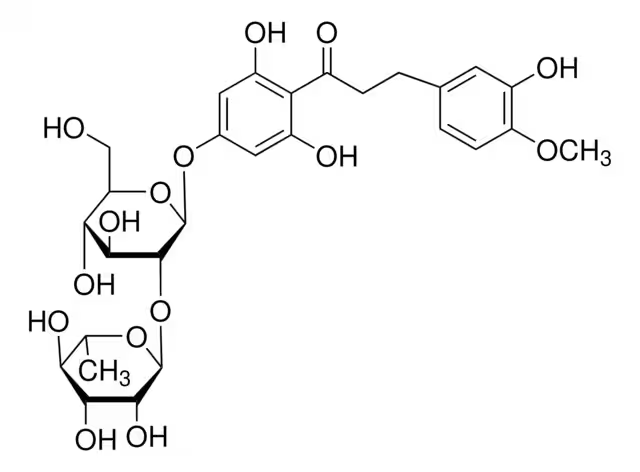
CAS Number20702-77-6
SynonymsNeosperidin Dihydro halcone; NEOHESPERIDINE DC; Neohesperidine hydrate; neohesperidine dihydrochalcone; Neohesperidin Dihydrochalcone Hydrate; EINECS 243-978-6; Neohesperidin dc; Dihydrohesperetin-7-O-neohesperidoside; E-959; UNII-3X476D83QV; MFCD03840557; Neohesperidin dihydrochalcone; NEOHESPERIDIN DIHYDROCHALONE; Nhdc; Neohesperidin DHC; Neosperidin dihydrochalcone; FEMA 3811
Molecular FormulaC28H36O15
Molecular Weight612.58
Purity≥96%
Density1.6±0.1 g/cm3
Boiling Point927.1±65.0 °C at 760 mmHg
Melting Point156-158 °C (lit.)
Appearancewhite powder
EINECS243-978-6
| Chemical & Physical Properties | |
|---|---|
| CAS Number | 20702-77-6 |
| Catalog No. | 2A-9008535 |
| Chinese Name | 新橙皮苷二氢查尔酮 |
| Synonyms | Neosperidin Dihydro halcone; NEOHESPERIDINE DC; Neohesperidine hydrate; neohesperidine dihydrochalcone; Neohesperidin Dihydrochalcone Hydrate; EINECS 243-978-6; Neohesperidin dc; Dihydrohesperetin-7-O-neohesperidoside; E-959; UNII-3X476D83QV; MFCD03840557; Neohesperidin dihydrochalcone; NEOHESPERIDIN DIHYDROCHALONE; Nhdc; Neohesperidin DHC; Neosperidin dihydrochalcone; FEMA 3811 |
| Molecular Formula | C28H36O15 |
| Molecular Weight | 612.58 |
| Purity | ≥96 |
| Density | 1.6±0.1 g/cm3 |
| Boiling Point | 927.1±65.0 °C at 760 mmHg |
| Melting Point | 156-158 °C (lit.) |
| Appearance | white powder |
| Water Solubility | Insoluble |
| Storage Condition | -20℃ |
| Application | Neohesperidin dihydrochalcone is a synthetic glycoside chalcone that is added to a variety of foods and beverages as a low-calorie artificial sweetener. |
| EINECS | 243-978-6 |
| HTC | 2932999099 |
| PubChem ID | 24901889 |
| MDL Number | MFCD00017711 |
| SMILES | COc1ccc(CCC(=O)c2c(O)cc(O[C@@H]3O[C@H](CO)[C@@H](O)[C@H](O)[C@H]3O[C@@H]4O[C@@H](C)[C@H](O)[C@@H](O)[C@H]4O)cc2O)cc1O |
| InChI | 1S/C28H36O15/c1-11-21(34)23(36)25(38)27(40-11)43-26-24(37)22(35)19(10-29)42-28(26)41-13-8-16(32)20(17(33)9-13)14(30)5-3-12-4-6-18(39-2)15(31)7-12/h4,6-9,11,19,21-29,31-38H,3,5,10H2,1-2H3/t11-,19+,21-,22+,23+,24-,25+,26+,27-,28+/m0/s1 |
| InChI Key | ITVGXXMINPYUHD-CUVHLRMHSA-N |
| NACRES Code | NA.21 |
| UNSPSC | 12164502 |
| MSDS | msds/8535_2_20702_77_6.pdf |
| Bioactivity | Neohesperidin dihydrochalcone is a synthetic glycoside chalcone, is added to various foods and beverages as a low caloric artificial sweetener. Related Catalog Signaling Pathways >> Protein Tyrosine Kinase/RTK >> ROS Natural Products >> Flavonoids Research Areas >> Inflammation/Immunology In Vitro Neohesperidin dihydrochalcone shows remarkable radical scavenging activity against stable radical and reactive oxygen species (ROS) in concentration dependent manner. Especially, neohesperidin dihydrochalcone is the most potent inhibitor of H2O2 and HOCl. Neohesperidin dihydrochalcone shows HOCl scavenging activity of 93.5% and H2O2 scavenging property of 73.5%. Neohesperidin dihydrochalcone shows extensive inhibitory effect especially on non-radical ROS H2O2 and HOCl with IC50 values of 205.1, 25.5 μM[1]. Neohesperidin dihydrochalcone is found to be an activator of porcine pancreatic alpha-amylase (PPA) with an IC50 of 389 μM[2]. In Vivo Neohesperidin dihydrochalcone administration results in significant reduction in activities of two useful markers of liver damage, AST and ALT. The relative levels of NF-κB, IL-6, IL-1β and TNF-α protein in the liver of PQ-treated mice are inhibited by neohesperidin dihydrochalcone[3]. The embryotoxicity/teratogenicity of neohesperidin dihydrochalcone is examined in Wistar Crl:(WI)WU BR rats. No adverse effects are observed at neohesperidin dihydrochalcone levels of up to 5% of the diet, the highest dose level tested, at which the rats consumed about 3.3 g/kg body weight/day[4]. Cell Assay WST-8 dye is used in the cell viability assay. HIT-T15 and HUVEC cells are grown and maintained in Dulbecco's modified Eagle's medium, supplemented with 10% fetal bovine calf serum. 1000 cells in each well are incubated with various concentrations of neohesperidin dihydrochalcone (50, 100, 500 μM, 1 mM) and other compounds. After treating HIT-T15 and HUVEC cells with 500 μM HOCl, WST-8 dye is added to each well, and the absorbance is detected at 420 nm with microplate reader[1]. Animal Admin Rats: The embryotoxicity/teratogenicity of neohesperidin dihydrochalcone is examined in Wistar Crl:(WI)WU BR rats. The study is comprised of four groups of 28 mated female rats each, i.e., a control group (0% neohesperidin dihydrochalcone) and three treatment groups (1.25, 2.5, and 5% neohesperidin dihydrochalcone). The general condition and behavior of the animals are observed twice daily. Body weight is determined on days 0, 7, 14, and 21 of gestation. Food consumption is determined during three consecutive periods (days 0-7, 7-14, and 14-21 of gestation)[4]. [3]Mice: Neohesperidin dihydrochalcone is dissolved in a 0.5% CMC vehicle. Mice are randomized into four groups. The control group receives equal volume of vehicles throughout. The PQ group receives saline once daily for 6 consecutive days. One hour after final saline treatment, mice are injected with PQ (75 mg/kg body weight). The neohesperidin dihydrochalcone group receives a daily dose of 200 mg/kg body weight by oral gavage for 6 consecutive days. One hour after final neohesperidin dihydrochalcone treatment, mice are injected with PQ (75 mg/kg body weight)[3]. References [1]. Choi JM, et al. Antioxidant properties of neohesperidin dihydrochalcone: inhibition of hypochlorous acid-induced DNA strand breakage, protein degradation, and cell death. Biol Pharm Bull. 2007 Feb;30(2):324-30. [2]. Kashani-Amin E, et al. Neohesperidin dihydrochalcone: presentation of a small molecule activator of mammalian alpha-amylase as an allosteric effector. FEBS Lett. 2013 Mar 18;587(6):652-8. [3]. Shi Q, et al. Artificial sweetener neohesperidin dihydrochalcone showed antioxidative, anti-inflammatory and anti-apoptosis effects against paraquat-induced liver injury in mice. Int Immunopharmacol. 2015 Dec;29(2):722-9. [4]. Waalkens-Berendsen DH, et al. Embryotoxicity and teratogenicity study with neohesperidin dihydrochalcone in rats. Regul Toxicol Pharmacol. 2004 Aug;40(1):74-9. Chemical & Physical Properties Density 1.6±0.1 g/cm3 Boiling Point 927.1±65.0 °C at 760 mmHg Melting Point 156-158 °C(lit.) Molecular Formula C28H36O15 Molecular Weight 612.576 Flash Point 302.6±27.8 °C Exact Mass 612.205444 PSA 245.29000 LogP 3.09 Vapour Pressure 0.0±0.3 mmHg at 25°C Index of Refraction 1.684 InChIKey ITVGXXMINPYUHD-CUVHLRMHSA-N SMILES COc1ccc(CCC(=O)c2c(O)cc(OC3OC(CO)C(O)C(O)C3OC3OC(C)C(O)C(O)C3O)cc2O)cc1O Storage condition −20°C Water Solubility Insoluble |
| Use of | Neohesperidin dihydrochalcone is a synthetic glycoside chalcone, is added to various foods and beverages as a low caloric artificial sweetener. Properties Articles27 Name Neohesperidin dihydrochalcone Synonym More Synonyms Neosperidin dihydrochalcone Biological Activity Description Neohesperidin dihydrochalcone is a synthetic glycoside chalcone, is added to various foods and beverages as a low caloric artificial sweetener. Related Catalog Signaling Pathways >> Protein Tyrosine Kinase/RTK >> ROS Natural Products >> Flavonoids Research Areas >> Inflammation/Immunology In Vitro Neohesperidin dihydrochalcone shows remarkable radical scavenging activity against stable radical and reactive oxygen species (ROS) in concentration dependent manner. Especially, neohesperidin dihydrochalcone is the most potent inhibitor of H2O2 and HOCl. Neohesperidin dihydrochalcone shows HOCl scavenging activity of 93.5% and H2O2 scavenging property of 73.5%. Neohesperidin dihydrochalcone shows extensive inhibitory effect especially on non-radical ROS H2O2 and HOCl with IC50 values of 205.1, 25.5 μM[1]. Neohesperidin dihydrochalcone is found to be an activator of porcine pancreatic alpha-amylase (PPA) with an IC50 of 389 μM[2]. References [1]. Choi JM, et al. Antioxidant properties of neohesperidin dihydrochalcone: inhibition of hypochlorous acid-induced DNA strand breakage, protein degradation, and cell death. Biol Pharm Bull. 2007 Feb;30(2):324-30. [2]. Kashani-Amin E, et al. Neohesperidin dihydrochalcone: presentation of a small molecule activator of mammalian alpha-amylase as an allosteric effector. FEBS Lett. 2013 Mar 18;587(6):652-8. [3]. Shi Q, et al. Artificial sweetener neohesperidin dihydrochalcone showed antioxidative, anti-inflammatory and anti-apoptosis effects against paraquat-induced liver injury in mice. Int Immunopharmacol. 2015 Dec;29(2):722-9. [4]. Waalkens-Berendsen DH, et al. Embryotoxicity and teratogenicity study with neohesperidin dihydrochalcone in rats. Regul Toxicol Pharmacol. 2004 Aug;40(1):74-9. Chemical & Physical Properties Molecular Formula C28H36O15 Exact Mass 612.205444 PSA 245.29000 Index of Refraction 1.684 InChIKey ITVGXXMINPYUHD-CUVHLRMHSA-N Water Solubility Insoluble |
| Tax Rebate | 13.0% |
| Supervision | None. MFN tariff: 6.5%. Ordinary tariff: 20.0% |
| Transport Info | Product name: Purity: 98.0% |
| MSDS Transport Info | Module 14. Shipping information United Nations classification: inconsistent with United Nations classification standards UN number: not specified |
| Related Products in Nutritional Ingredients | ||
|---|---|---|
| N-Acetyl-L-tryptophan | 1218-34-4 | 2A-9008464 |
| N-Acetyl-L-tyrosine | 537-55-3 | 2A-9008465 |
| N-alpha-Acetyl-glycine | 543-24-8 | 2A-9008467 |
| N-Butylsulfonyl-O-(4-(4-pyridinyl)butyl)-L-tyrosine | 149490-61-9 | 2A-9008517 |
| N-delta-Benzyloxycarbonyl-L-ornithine | 3304-51-6 | 2A-9008533 |
| Phospho creatine sodium | 67-07-2 | 2A-9008672 |
| Pyridoxal hydrochloride | 65-22-5 | 2A-9008715 |
| Pyridoxal-5-phosphate; Pyridoxal 5-phosphate monohydrate | 41468-25-1 | 2A-9008716 |
| R-alpha-Lipoic acid | 62-46-4 | 2A-0201794 |
| Vitamin A | 68-26-8 | 2A-9008904 |
| Browse all Nutritional Ingredients products » | ||
Phone:
630-322-8886
630-322-8887
Email:
Office Locations:
Chicago, IL, USA
San Francisco, CA, USA


 EN
EN


 SDS
SDS