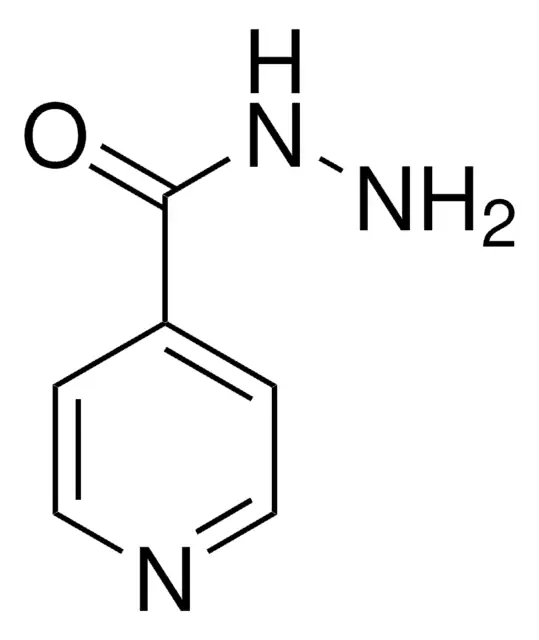
CAS Number54-85-3
SynonymsINH; RIMIFON; Isonicotinyl hydrazide; Isoniazide; 4-pyridine-carbonic acid hydrazide; LANIAZID; Pyridine-4-carboxylic hydrazide; In-73; pyridine-4-carbohydrazide; 4-pyridinecarbohydrazide; Cedin; pyridine-4-carboxylic acid hydrazide; Hyzyd; MFCD00006426; Isoniazid; HIA; 4-Pyridinecarboxylic acid, hydrazide; isonicotinic acid hydrazid; Isonicotinate hydrazide; INAH; Isonicotinohydrazide; Isonicotinic acid hydrazide; isonicotinoyl hydrazide; EINECS 200-214-6; fsr3; GINK; NYDRAZID
Molecular FormulaC6H7N3O
Molecular Weight137.14
Purity≥99 (TLC)%
Density1.2±0.1 g/cm3
Melting Point171-173 °C (lit.)
AppearanceWhite crystalline powder
EINECS200-214-6
Symbol
Signal WordWarning
| Chemical & Physical Properties | |
|---|---|
| CAS Number | 54-85-3 |
| Catalog No. | 2A-9016669 |
| Chinese Name | 异烟肼 |
| Synonyms | INH; RIMIFON; Isonicotinyl hydrazide; Isoniazide; 4-pyridine-carbonic acid hydrazide; LANIAZID; Pyridine-4-carboxylic hydrazide; In-73; pyridine-4-carbohydrazide; 4-pyridinecarbohydrazide; Cedin; pyridine-4-carboxylic acid hydrazide; Hyzyd; MFCD00006426; Isoniazid; HIA; 4-Pyridinecarboxylic acid, hydrazide; isonicotinic acid hydrazid; Isonicotinate hydrazide; INAH; Isonicotinohydrazide; Isonicotinic acid hydrazide; isonicotinoyl hydrazide; EINECS 200-214-6; fsr3; GINK; NYDRAZID |
| Molecular Formula | C6H7N3O |
| Molecular Weight | 137.14 |
| Purity | ≥99 (TLC) |
| Density | 1.2±0.1 g/cm3 |
| Melting Point | 171-173 °C (lit.) |
| Appearance | White crystalline powder |
| Water Solubility | 14 g/100 mL (25 ºC) |
| Storage Condition | This product should be sealed and stored away from |
| Packaging | III |
| Application | Isoniazid is an antibiotic with anti-tuberculosis properties. |
| EINECS | 200-214-6 |
| HTC | 29333999 |
| PubChem ID | 329815370 |
| MDL Number | MFCD00006426 |
| SMILES | NNC(=O)c1ccncc1 |
| InChI | 1S/C6H7N3O/c7-9-6(10)5-1-3-8-4-2-5/h1-4H,7H2,(H,9,10) |
| InChI Key | QRXWMOHMRWLFEY-UHFFFAOYSA-N |
| Beilstein/REAXYS | 119374 |
| NACRES Code | NA.24 |
| UNSPSC | 41116107 |
| Hazard Symbols | 6.1 |
| Risk Codes | R22;R36/37/38;R40 |
| Safety Description | S26;S36/37/39 |
| MSDS | msds/16669_1_54_85_3.pdf |
| Bioactivity | Isoniazid is an antibacterial agent used primarily as a tuberculostatic.Target: AntibacterialIsoniazid is a prodrug and must be activated by a bacterial catalase-peroxidase enzyme that in M. tuberculosis is called KatG [1]. KatG couples the isonicotinic acyl with NADH to form isonicotinic acyl-NADH complex. This complex binds tightly to the enoyl-acyl carrier protein reductase known as InhA, thereby blocking the natural enoyl-AcpM substrate and the action of fatty acid synthase. This process inhibits the synthesis of mycolic acid, required for the mycobacterial cell wall. A range of radicals are produced by KatG activation of isoniazid, including nitric oxide, which has also been shown to be important in the action of another antimycobacterial prodrug PA-824 [2, 3]. Isoniazid is bactericidal to rapidly dividing mycobacteria, but is bacteriostatic if the mycobacteria are slow-growing [4]. Related Catalog Signaling Pathways >> Autophagy >> Autophagy Signaling Pathways >> Anti-infection >> Bacterial Signaling Pathways >> Autophagy >> Mitophagy Research Areas >> Infection References [1]. Suarez, J., et al., An oxyferrous heme/protein-based radical intermediate is catalytically competent in the catalase reaction of Mycobacterium tuberculosis catalase-peroxidase (KatG). J Biol Chem, 2009. 284(11): p. 7017-29. [2]. Timmins, G.S., et al., Nitric oxide generated from isoniazid activation by KatG: source of nitric oxide and activity against Mycobacterium tuberculosis. Antimicrob Agents Chemother, 2004. 48(8): p. 3006-9. [3]. Singh, R., et al., PA-824 kills nonreplicating Mycobacterium tuberculosis by intracellular NO release. Science, 2008. 322(5906): p. 1392-5. [4]. Ahmad, Z., et al., Biphasic kill curve of isoniazid reveals the presence of drug-tolerant, not drug-resistant, Mycobacterium tuberculosis in the guinea pig. J Infect Dis, 2009. 200(7): p. 1136-43. Chemical & Physical Properties Density 1.2±0.1 g/cm3 Melting Point 171-173 °C(lit.) Molecular Formula C6H7N3O Molecular Weight 137.139 Flash Point >250°C Exact Mass 137.058914 PSA 68.01000 LogP -0.89 Index of Refraction 1.584 InChIKey QRXWMOHMRWLFEY-UHFFFAOYSA-N SMILES NNC(=O)c1ccncc1 Storage condition Refrigerator Stability Stability Stable, but may be air or light sensitive. Combustible. Incompatible with strong oxidizing agents, chloral, aldehydes, iodine, ferric salts, hypochlorites. Water Solubility 14 g/100 mL (25 ºC) |
| Use of | Isoniazid is an antibacterial agent used primarily as a tuberculostatic.Target: AntibacterialIsoniazid is a prodrug and must be activated by a bacterial catalase-peroxidase enzyme that in M. tuberculosis is called KatG [1]. KatG couples the isonicotinic acyl with NADH to form isonicotinic acyl-NADH complex. This complex binds tightly to the enoyl-acyl carrier protein reductase known as InhA, thereby blocking the natural enoyl-AcpM substrate and the action of fatty acid synthase. This process inhibits the synthesis of mycolic acid, required for the mycobacterial cell wall. A range of radicals are produced by KatG activation of isoniazid, including nitric oxide, which has also been shown to be important in the action of another antimycobacterial prodrug PA-824 [2, 3]. Isoniazid is bactericidal to rapidly dividing mycobacteria, but is bacteriostatic if the mycobacteria are slow-growing [4]. Properties Articles426 Name isoniazide Synonym More Synonyms Isoniazid Biological Activity Description Isoniazid is an antibacterial agent used primarily as a tuberculostatic.Target: AntibacterialIsoniazid is a prodrug and must be activated by a bacterial catalase-peroxidase enzyme that in M. tuberculosis is called KatG [1]. KatG couples the isonicotinic acyl with NADH to form isonicotinic acyl-NADH complex. This complex binds tightly to the enoyl-acyl carrier protein reductase known as InhA, thereby blocking the natural enoyl-AcpM substrate and the action of fatty acid synthase. This process inhibits the synthesis of mycolic acid, required for the mycobacterial cell wall. A range of radicals are produced by KatG activation of isoniazid, including nitric oxide, which has also been shown to be important in the action of another antimycobacterial prodrug PA-824 [2, 3]. Isoniazid is bactericidal to rapidly dividing mycobacteria, but is bacteriostatic if the mycobacteria are slow-growing [4]. Related Catalog Signaling Pathways >> Autophagy >> Autophagy Signaling Pathways >> Anti-infection >> Bacterial Signaling Pathways >> Autophagy >> Mitophagy Research Areas >> Infection References [1]. Suarez, J., et al., An oxyferrous heme/protein-based radical intermediate is catalytically competent in the catalase reaction of Mycobacterium tuberculosis catalase-peroxidase (KatG). J Biol Chem, 2009. 284(11): p. 7017-29. [2]. Timmins, G.S., et al., Nitric oxide generated from isoniazid activation by KatG: source of nitric oxide and activity against Mycobacterium tuberculosis. Antimicrob Agents Chemother, 2004. 48(8): p. 3006-9. [3]. Singh, R., et al., PA-824 kills nonreplicating Mycobacterium tuberculosis by intracellular NO release. Science, 2008. 322(5906): p. 1392-5. [4]. Ahmad, Z., et al., Biphasic kill curve of isoniazid reveals the presence of drug-tolerant, not drug-resistant, Mycobacterium tuberculosis in the guinea pig. J Infect Dis, 2009. 200(7): p. 1136-43. Chemical & Physical Properties Molecular Formula C6H7N3O Exact Mass 137.058914 PSA 68.01000 LogP -0.89 Index of Refraction 1.584 InChIKey QRXWMOHMRWLFEY-UHFFFAOYSA-N Storage condition Refrigerator Stability Stability Stable, but may be air or light sensitive. Combustible. Incompatible with strong oxidizing agents, chloral, aldehydes, iodine, ferric salts, hypochlorites. |
| Tax Rebate | 13.0% |
| Supervision | None. MFN tariff: 6.5%. Ordinary tariff: 20.0% |
| Transport Info | Product name: Purity: 98.0% |
| MSDS Transport Info | Module 14. Shipping information 14.1 UN dangerous goods number European Land Transport Dangerous Regulations: -International Maritime Dangerous Regulations: -International Air Transport Dangerous Regulations: - 14.2 Names specified by the United Nations (UN) European Land Transport Dangerous Regulations: Non-dangerous goods IMDG Code: Non-dangerous goods International air transport dangerous goods regulations: non-dangerous goods 14.3 Transport hazard categories European Land Transport Dangerous Regulations: -International Maritime Dangerous Regulations: -International Air Transport Dangerous Regulations: - 14.4 Package group European Land Transport Dangerous Regulations: -International Maritime Dangerous Regulations: -International Air Transport Dangerous Regulations: - 14.5 Environmental hazards European Land Transport Dangerous Regulations: No International Maritime Transport Dangerous Regulations Maritime Pollutants: No International Air Transport Risk Regulations: No 14.6 Special reminder to users No data available |
| Related Products in API & Advanced Intermediates | ||
|---|---|---|
| Prednisolone acetate | 52-21-1 | 2A-9016627 |
| Haloperidol | 52-86-8 | 2A-9016637 |
| Prednisone | 53-03-2 | 2A-9016641 |
| Estrone | 53-16-7 | 2A-9016642 |
| Fluprednisolone | 53-34-9 | 2A-9016645 |
| Levothyroxine sodium | 55-03-8 | 2A-9016672 |
| Liothyronine sodium | 55-06-1 | 2A-9016673 |
| Vincristine | 57-22-7 | 2A-9016735 |
| Ethynyl estradiol | 57-63-6 | 2A-9016751 |
| Progesterone | 57-83-0 | 2A-9016756 |
| Browse all API & Advanced Intermediates products » | ||
Phone:
630-322-8886
630-322-8887
Email:
Office Locations:
Chicago, IL, USA
San Francisco, CA, USA


 EN
EN


 SDS
SDS