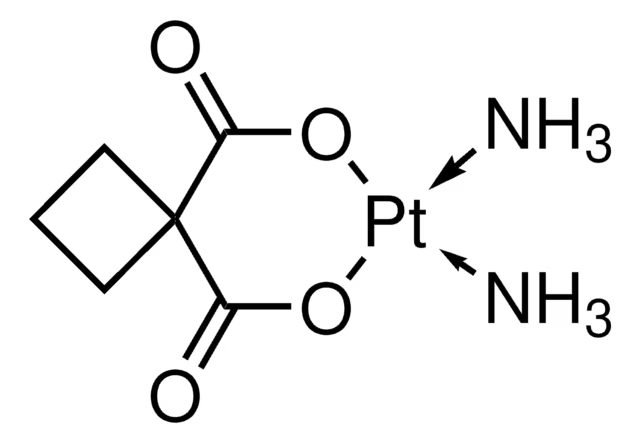
CAS Number41575-94-4
SynonymsDiammine[1,1-cyclobutanedicarboxylato(2-)-κO,O]platinum; cis-Diammine(1,1-cyclobutanedicarboxylato) platinum; Platinum(2+) 1,1-cyclobutanedicarboxylate diammoniate; cbdca; MFCD00070464; (SP-4-2)-diammine(1,1-cyclobutanedicarboxylato)platinum(II); [Cyclobutane-1,1-dicarboxylato(2-)-κO,O]platinum diammoniate; cis-diammine(1,1-cyclobutanedicarboxylato)platinum(II); [1,1-Cyclobutanedicarboxylato(2-)-κO,O]platinum diammoniate; Platinum, [1,1-cyclobutanedicarboxylato(2-)-κO,κO]-, ammoniate (1:2); JM-8; PARAPLATIN; cis-diammine(cyclobutane-1,1-dicarboxylato)platinum(II); PARAPLATIN(R); CARBONPLATIN; cis-Diamine(1,1-cyclobutanedicarboxylato)platinum(II); CARBOPLATINUM; diammine[cyclobutane-1,1-dicarboxylato(2-)-κ2O1,O1]platinum; cis-diammmine(1,1-cyclobutanedicarboxylato)platinum(II); EINECS 255-4
Molecular Formula[C4H6(CO2)2]Pt(NH3)2
Molecular Weight371.25
Purity98%
Boiling Point366.4ºCat 760 mmHg
Melting Point228-230ºC
Appearancepowder
EINECS255-446-0
| Chemical & Physical Properties | |
|---|---|
| CAS Number | 41575-94-4 |
| Catalog No. | 2A-9009587 |
| Chinese Name | 卡铂 |
| Synonyms | Diammine[1,1-cyclobutanedicarboxylato(2-)-κO,O]platinum; cis-Diammine(1,1-cyclobutanedicarboxylato) platinum; Platinum(2+) 1,1-cyclobutanedicarboxylate diammoniate; cbdca; MFCD00070464; (SP-4-2)-diammine(1,1-cyclobutanedicarboxylato)platinum(II); [Cyclobutane-1,1-dicarboxylato(2-)-κO,O]platinum diammoniate; cis-diammine(1,1-cyclobutanedicarboxylato)platinum(II); [1,1-Cyclobutanedicarboxylato(2-)-κO,O]platinum diammoniate; Platinum, [1,1-cyclobutanedicarboxylato(2-)-κO,κO]-, ammoniate (1:2); JM-8; PARAPLATIN; cis-diammine(cyclobutane-1,1-dicarboxylato)platinum(II); PARAPLATIN(R); CARBONPLATIN; cis-Diamine(1,1-cyclobutanedicarboxylato)platinum(II); CARBOPLATINUM; diammine[cyclobutane-1,1-dicarboxylato(2-)-κ2O1,O1]platinum; cis-diammmine(1,1-cyclobutanedicarboxylato)platinum(II); EINECS 255-4 |
| Molecular Formula | [C4H6(CO2)2]Pt(NH3)2 |
| Molecular Weight | 371.25 |
| Purity | 98 |
| Boiling Point | 366.4ºCat 760 mmHg |
| Melting Point | 228-230ºC |
| Appearance | powder |
| Water Solubility | Sparingly soluble in water, very slightly soluble |
| Storage Condition | Sealed, cool, dry storage |
| Application | Carboplatin (NSC 241240) is a DNA synthesis inhibitor that binds to DNA, inhibits replication and transcription, and induces cell death. Carboplatin (NSC 241240) is a derivative of cisplatin and is a |
| EINECS | 255-446-0 |
| HTC | 2843900030 |
| UN(IATA) | NA |
| PubChem ID | 24278303 |
| MDL Number | MFCD00070464 |
| SMILES | N.N.O=C1O[Pt]OC(=O)C12CCC2 |
| InChI | 1S/C6H8O4.2H3N.Pt/c7-4(8)6(5(9)10)2-1-3-6;;;/h1-3H2,(H,7,8)(H,9,10);2*1H3;/q;;;+2/p-2 |
| InChI Key | OLESAACUTLOWQZ-UHFFFAOYSA-L |
| NACRES Code | NA.77 |
| UNSPSC | 12352200 |
| MSDS | msds/9587_1_41575_94_4.pdf |
| Bioactivity | Carboplatin (NSC 241240) is a DNA synthesis inhibitor which binds to DNA, inhibits replication and transcription and induces cell death. Carboplatin (NSC 241240) is a derivative of cisplatin and a potent anti-cancer agent. Related Catalog Signaling Pathways >> Autophagy >> Autophagy Signaling Pathways >> Cell Cycle/DNA Damage >> DNA Alkylator/Crosslinker Signaling Pathways >> Cell Cycle/DNA Damage >> DNA/RNA Synthesis Research Areas >> Cancer Target DNA Alkylator[1] In Vitro Carboplatin is an antitumor agent, with an increased DNA-binding activity in the presence of nucleophiles and human breast cancer MCF-7 cell cytoplasmic extracts[1]. Carboplatin is less cytotoxic to human ovarian cells such as A2780, SKOV3, IGROV1 and HX62 than 17-AAG, with IC50s of 6.177, 12.442, 2.233 and 116.068 μM, respectively. Moreover, Carboplatin does not affect HSP90 or change the activity of 17-AAG to inhibit HSP90[2]. Carboplatin reduces the viability of Brca1 (IC50, 3.4 μM) and Brca2 cells (IC50, 1.9 μM). Carboplatin (25 μM) combined with ABT-888 also shows an apoptotic effect in BRCA1 cells[3]. In Vivo Carboplatin (60 mg/kg, i.p.) shows a modest effect on the tumor, but significantly inhibits tumor growth in combination with 17-AAG in mice bearing A2780 human ovarian cancer xenografts[2]. Carboplatin (25 mg/kg, p.o.) combined with ABT-888 delays tumor growth in Brca2 xenografts[3]. Cell Assay Exponentially growing A2780 cells are plated in 96 well microtitre plates. For experiments studying the effect of sequence of exposure to 17-AAG or Carboplatin, cells are exposed to increasing concentrations of 17-AAG or Carboplatin for 24 h. A period of 24-h exposure to the first agent is chosen so that the A2780 cells will be exposed to the first drug for at least one doubling time (18-24 h). The cells are then washed with sterile phosphate buffered saline and the medium is replenished. Following this, the second drug (to which the cells are not exposed to in the first 24 h) or medium is added for 96 h. SRB assays are carried out. All experiments are carried out in triplicate[2]. Animal Admin Mice[2] The A2780 human ovarian cancer cell line is grown as a subcutaneous xenograft in female athymic NCr nude mice (nu/nu) by injecting 4 × 10⁶ cells in each flank. Mice with established tumors corresponding to a mean volume of 0.69 mm3 are randomized into groups (six animals each) for treatment with either control vehicle (43% ethanol, 33% polypropylene glycol and 24% cremaphor diluted 1:7 with sterile water) days 1-4, 17-AAG (80 mg/kg intraperitonially, days 1-4), Carboplatin (60 mg/kg IP day 0) or a combination of 17-AAG (80 mg/kg IP days 1-4) and Carboplatin (60 mg/kg IP day 0). Tumor growth is assessed three times weekly and tumor volumes are calculated according to a validated formula: volume = 4.19 × (a/4 + b/4)3, where a is the longer and b the shorter diameter. Tumor volumes are then expressed as a proportion of the volume at the start of treatment (relative tumor volume)[2]. References [1]. Natarajan G, et al. Increased DNA-binding activity of cis-1,1-cyclobutanedicarboxylatodiammineplatinum(II) (carboplatin) in the presence of nucleophiles and human breast cancer MCF-7 cell cytoplasmic extracts: activation theory revisited. Biochem Pharmacol. 1999 Nov 15;58(10):1625-9. [2]. Banerji U, et al. An in vitro and in vivo study of the combination of the heat shock protein inhibitor 17-allylamino-17-demethoxygeldanamycin and carboplatin in human ovarian cancer models. Cancer Chemother Pharmacol. 2008 Oct;62(5):769-78. [3]. Clark CC, et al. Enhancement of synthetic lethality via combinations of ABT-888, a PARP inhibitor, and carboplatin in vitro and in vivo using BRCA1 and BRCA2 isogenic models. Mol Cancer Ther. 2012 Sep;11(9):1948-58. [4]. Dela Cruz FS, et al. A case study of an integrative genomic and experimental therapeutic approach for rare tumors: identification of vulnerabilities in a pediatric poorly differentiated carcinoma. Genome Med. 2016 Oct 31;8(1):116. Chemical & Physical Properties Boiling Point 366.4ºCat 760 mmHg Melting Point 228-230ºC Molecular Formula C6H12N2O4Pt Molecular Weight 371.254 Flash Point 189.6ºC Exact Mass 371.044495 PSA 59.08000 LogP 0.81700 InChIKey VSRXQHXAPYXROS-UHFFFAOYSA-N SMILES O=C(O)C1(C(=O)O)CCC1.[NH2-].[NH2-].[Pt+2] Storage condition Store at RT Stability Stable. Incompatible with strong oxidizing agents. Water Solubility Sparingly soluble in water, very slightly soluble in acetone and in ethanol (96 per cent). | Soluble in water. |
| Use of | Carboplatin (NSC 241240) is a DNA synthesis inhibitor which binds to DNA, inhibits replication and transcription and induces cell death. Carboplatin (NSC 241240) is a derivative of cisplatin and a potent anti-cancer agent. Properties Articles207 Name carboplatin Synonym More Synonyms Carboplatin Biological Activity Description Carboplatin (NSC 241240) is a DNA synthesis inhibitor which binds to DNA, inhibits replication and transcription and induces cell death. Carboplatin (NSC 241240) is a derivative of cisplatin and a potent anti-cancer agent. Related Catalog Signaling Pathways >> Autophagy >> Autophagy Signaling Pathways >> Cell Cycle/DNA Damage >> DNA Alkylator/Crosslinker Signaling Pathways >> Cell Cycle/DNA Damage >> DNA/RNA Synthesis Research Areas >> Cancer DNA Alkylator[1] References [2]. Banerji U, et al. An in vitro and in vivo study of the combination of the heat shock protein inhibitor 17-allylamino-17-demethoxygeldanamycin and carboplatin in human ovarian cancer models. Cancer Chemother Pharmacol. 2008 Oct;62(5):769-78. [3]. Clark CC, et al. Enhancement of synthetic lethality via combinations of ABT-888, a PARP inhibitor, and carboplatin in vitro and in vivo using BRCA1 and BRCA2 isogenic models. Mol Cancer Ther. 2012 Sep;11(9):1948-58. [4]. Dela Cruz FS, et al. A case study of an integrative genomic and experimental therapeutic approach for rare tumors: identification of vulnerabilities in a pediatric poorly differentiated carcinoma. Genome Med. 2016 Oct 31;8(1):116. Chemical & Physical Properties Molecular Formula C6H12N2O4Pt Exact Mass 371.044495 PSA 59.08000 LogP 0.81700 InChIKey VSRXQHXAPYXROS-UHFFFAOYSA-N SMILES O=C(O)C1(C(=O)O)CCC1.[NH2-].[NH2-].[Pt+2] Storage condition Store at RT Stability Stable. Incompatible with strong oxidizing agents. Water Solubility Sparingly soluble in water, very slightly soluble in acetone and in ethanol (96 per cent). | Soluble in water. |
| Transport Info | Product name: Purity: 98.0% |
| MSDS Transport Info | Module 14. Shipping information United Nations classification: inconsistent with United Nations classification standards UN number: not specified |
| Related Products in API & Advanced Intermediates | ||
|---|---|---|
| Candesartan | 139481-59-7 | 2A-0201366 |
| Candesartan cilexetil | 145040-37-5 | 2A-9009558 |
| Capecitabine | 154361-50-9 | 2A-9009561 |
| Captopril | 62571-86-2 | 2A-9009567 |
| Carbamazepine | 298-46-4 | 2A-9009570 |
| Carvedilol | 72956-09-3 | 2A-9009611 |
| Cefaclor | 70356-03-5 | 2A-9009620 |
| Cefaclor monohydrate | 53994-73-3 | 2A-9009621 |
| Cefazolin | 25953-19-9 | 2A-9009627 |
| Cefdinir | 91832-40-5 | 2A-9009631 |
| Browse all API & Advanced Intermediates products » | ||
Phone:
630-322-8886
630-322-8887
Email:
Office Locations:
Chicago, IL, USA
San Francisco, CA, USA


 EN
EN


 SDS
SDS