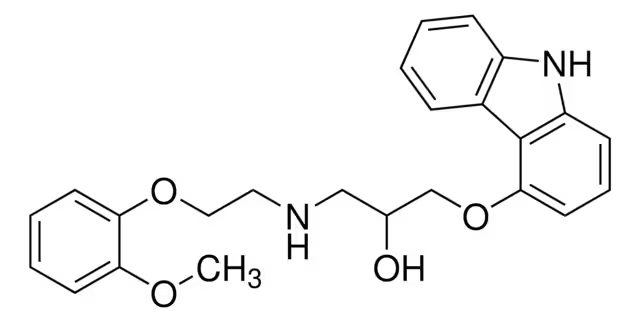
CAS Number72956-09-3
Synonyms(±)-1-(9H-Carbazol-4-yloxy)-3-[[2-(2-methoxyphenoxy)ethyl]amino]-2-propanol; Coropress; 1-(9H-Carbazol-4-yloxy)-3-{[2-(2-methoxyphenoxy)ethyl]amino}-2-propanol; Dilatrend; Carvedilolum; 1-(9H-carbazol-4-yloxy)-3-{[2-(2-methoxyphenoxy)ethyl]amino}propan-2-ol; Kredex; 1-(9H-carbazol-4-yloxy)-3-{[2-(2-méthoxyphénoxy)éthyl]amino}propan-2-ol; Coreg; 1-(9H-carbazol-4-yloxy)-3-[[2-(2-methoxyphenoxy)ethyl]amino]-2-propanol; 1-(9H-carbazol-4-yloxy)-3-[(2-{[2-(methyloxy)phenyl]oxy}ethyl)amino]propan-2-ol; Dimitone; Carvedilolum [Latin]; MFCD00864692; 1-(9H-carbazol-4-yloxy)-3-[2-(2-methoxyphenoxy)ethylamino]propan-2-ol; 1-[carbazolyl-(4)-oxy]-3-[(2-methoxyphenoxyethyl)amino]-propanol-(2); Querto; 1-(9H-carbazol-4-yloxy)-3-{2-(2-methoxyphenoxy)ethylamino}propan-2-ol; 1-(9H-carbazol-4-yloxy)-3-[2-(2-m
Molecular FormulaC24H26N2O4
Molecular Weight406.47
Purity98%
Density1.3±0.1 g/cm3
Boiling Point655.2±55.0 °C at 760 mmHg
Melting Point113-117ºC
AppearanceColorless crystalline powder
Symbol
Signal WordWarning
| Chemical & Physical Properties | |
|---|---|
| CAS Number | 72956-09-3 |
| Catalog No. | 2A-9009611 |
| Chinese Name | 卡维地洛 |
| Synonyms | (±)-1-(9H-Carbazol-4-yloxy)-3-[[2-(2-methoxyphenoxy)ethyl]amino]-2-propanol; Coropress; 1-(9H-Carbazol-4-yloxy)-3-{[2-(2-methoxyphenoxy)ethyl]amino}-2-propanol; Dilatrend; Carvedilolum; 1-(9H-carbazol-4-yloxy)-3-{[2-(2-methoxyphenoxy)ethyl]amino}propan-2-ol; Kredex; 1-(9H-carbazol-4-yloxy)-3-{[2-(2-méthoxyphénoxy)éthyl]amino}propan-2-ol; Coreg; 1-(9H-carbazol-4-yloxy)-3-[[2-(2-methoxyphenoxy)ethyl]amino]-2-propanol; 1-(9H-carbazol-4-yloxy)-3-[(2-{[2-(methyloxy)phenyl]oxy}ethyl)amino]propan-2-ol; Dimitone; Carvedilolum [Latin]; MFCD00864692; 1-(9H-carbazol-4-yloxy)-3-[2-(2-methoxyphenoxy)ethylamino]propan-2-ol; 1-[carbazolyl-(4)-oxy]-3-[(2-methoxyphenoxyethyl)amino]-propanol-(2); Querto; 1-(9H-carbazol-4-yloxy)-3-{2-(2-methoxyphenoxy)ethylamino}propan-2-ol; 1-(9H-carbazol-4-yloxy)-3-[2-(2-m |
| Molecular Formula | C24H26N2O4 |
| Molecular Weight | 406.47 |
| Purity | 98 |
| Density | 1.3±0.1 g/cm3 |
| Boiling Point | 655.2±55.0 °C at 760 mmHg |
| Melting Point | 113-117ºC |
| Appearance | Colorless crystalline powder |
| Storage Condition | Store in a sealed container in a cool, dry place. |
| Application | Carvedilol (BM14190) is a non-selective β and α1 blocker that can inhibit the oxidation of LDL with an IC50 of 3.8 μM. |
| HTC | 2933990090 |
| MDL Number | MFCD00864692 |
| SMILES | [nH]1c2c(c4c1cccc4)c(ccc2)OCC(O)CNCCOc3c(cccc3)OC |
| InChI | 1S/C24H26N2O4/c1-28-21-10-4-5-11-22(21)29-14-13-25-15-17(27)16-30-23-12-6-9-20-24(23)18-7-2-3-8-19(18)26-20/h2-12,17,25-27H,13-16H2,1H3 |
| InChI Key | OGHNVEJMJSYVRP-UHFFFAOYSA-N |
| NACRES Code | NA.24 |
| UNSPSC | 41116107 |
| Hazard Symbols | Transport |
| MSDS | msds/9611_1_72956_09_3.pdf |
| Bioactivity | Carvedilol(BM14190) is a non-selective beta blocker/alpha-1 blocker with an IC50 of 3.8 μM for inhibition of LDL oxidation.IC50 Value: 3.8 μM ( inhibition of LDL oxidation)Target: beta Adrenergic ReceptorCarvedilol is a nonselective-blocking agent and is used in the treatment of hypertension and angina pectoris. As a third-generation β-adrenergic blocker (β-blocker), Carvedilol is able to reverse cardiac structural remodeling. Recentresults demonstrated that the effect caused by Carvedilol on cardiac remodeling is largely dependent on endogenous NO. Related Catalog Signaling Pathways >> GPCR/G Protein >> Adrenergic Receptor Research Areas >> Endocrinology References [1]. Chen J, Huang C, Zhang B, et al. The effects of carvedilol on cardiac structural remodeling: The role of endogenous nitric oxide in the activity of carvedilol. Mol Med Rep. 2013 Apr;7(4):1155-8. [2]. Stafylas PC, Sarafidis PA. Carvedilol in hypertension treatment. Vasc Health Risk Manag. 2008;4(1):23-30. [3]. Othman AA, Tenero DM, Boyle DA et al. Population pharmacokinetics of S(-)-carvedilol in healthy volunteers after administration of the immediate-release (IR) and the new controlled-release (CR) dosage forms of the racemate. AAPS J. 2007 Jun 15;9(2):E208-1 [4]. Koshimizu TA, Tsujimoto G, Hirasawa A et al. Carvedilol selectively inhibits oscillatory intracellular calcium changes evoked by human alpha1D- and alpha1B-adrenergic receptors. Cardiovasc Res. 2004 Sep 1;63(4):662-72. Chemical & Physical Properties Density 1.3±0.1 g/cm3 Boiling Point 655.2±55.0 °C at 760 mmHg Melting Point 113-117ºC Molecular Formula C24H26N2O4 Molecular Weight 406.474 Flash Point 350.1±31.5 °C Exact Mass 406.189270 PSA 75.74000 LogP 4.11 Vapour Pressure 0.0±2.1 mmHg at 25°C Index of Refraction 1.657 InChIKey OGHNVEJMJSYVRP-UHFFFAOYSA-N SMILES COc1ccccc1OCCNCC(O)COc1cccc2[nH]c3ccccc3c12 Storage condition Store at +4°C |
| Use of | Carvedilol(BM14190) is a non-selective beta blocker/alpha-1 blocker with an IC50 of 3.8 μM for inhibition of LDL oxidation.IC50 Value: 3.8 μM ( inhibition of LDL oxidation)Target: beta Adrenergic ReceptorCarvedilol is a nonselective-blocking agent and is used in the treatment of hypertension and angina pectoris. As a third-generation β-adrenergic blocker (β-blocker), Carvedilol is able to reverse cardiac structural remodeling. Recentresults demonstrated that the effect caused by Carvedilol on cardiac remodeling is largely dependent on endogenous NO. Properties Articles59 Name carvedilol Synonym More Synonyms Carvedilol Biological Activity Description Carvedilol(BM14190) is a non-selective beta blocker/alpha-1 blocker with an IC50 of 3.8 μM for inhibition of LDL oxidation.IC50 Value: 3.8 μM ( inhibition of LDL oxidation)Target: beta Adrenergic ReceptorCarvedilol is a nonselective-blocking agent and is used in the treatment of hypertension and angina pectoris. As a third-generation β-adrenergic blocker (β-blocker), Carvedilol is able to reverse cardiac structural remodeling. Recentresults demonstrated that the effect caused by Carvedilol on cardiac remodeling is largely dependent on endogenous NO. Related Catalog Signaling Pathways >> GPCR/G Protein >> Adrenergic Receptor Research Areas >> Endocrinology References [1]. Chen J, Huang C, Zhang B, et al. The effects of carvedilol on cardiac structural remodeling: The role of endogenous nitric oxide in the activity of carvedilol. Mol Med Rep. 2013 Apr;7(4):1155-8. [2]. Stafylas PC, Sarafidis PA. Carvedilol in hypertension treatment. Vasc Health Risk Manag. 2008;4(1):23-30. [3]. Othman AA, Tenero DM, Boyle DA et al. Population pharmacokinetics of S(-)-carvedilol in healthy volunteers after administration of the immediate-release (IR) and the new controlled-release (CR) dosage forms of the racemate. AAPS J. 2007 Jun 15;9(2):E208-1 [4]. Koshimizu TA, Tsujimoto G, Hirasawa A et al. Carvedilol selectively inhibits oscillatory intracellular calcium changes evoked by human alpha1D- and alpha1B-adrenergic receptors. Cardiovasc Res. 2004 Sep 1;63(4):662-72. Chemical & Physical Properties Molecular Formula C24H26N2O4 Exact Mass 406.189270 PSA 75.74000 Index of Refraction 1.657 InChIKey OGHNVEJMJSYVRP-UHFFFAOYSA-N |
| Tax Rebate | 13.0% |
| Supervision | None. MFN tariff: 6.5%. Ordinary tariff: 20.0% |
| Transport Info | Product name: Purity: 98.0% |
| MSDS Transport Info | Module 14. Shipping information 14.1 UN dangerous goods number European Land Transport Danger Regulations: 3077 International Maritime Transport Danger Regulations: 3077 International Air Transport Danger Regulations: 3077 14.2 Names specified by the United Nations (UN) European land transport hazard regulations: ENVIRONMENTALLY HAZARDOUS SUBSTANCE, SOLID, N.O.S. (Carvedilol) IMDG: ENVIRONMENTALLY HAZARDOUS SUBSTANCE, SOLID, N.O.S. (Carvedilol) International Air Transport Hazardous Regulations: Environmentally hazardous substance, solid, n.o.s. (Carvedilol) 14.3 Transport hazard categories European land transport Dangerous Regulations: 9 International sea transport Dangerous Regulations: 9 International air transport Dangerous Regulations: 9 14.4 Package group European Land Transport Danger Regulations: III International Maritime Transport Danger Regulations: III International Air Transport Danger Regulations: III 14.5 Environmental hazards European Land Transport Dangerous Regulations: Yes International Maritime Transport Dangerous Regulations Maritime Pollutants: Yes International Air Transport Dangerous Regulations: Yes 14.6 Special reminder to users further information Dangerous goods are individually packaged, with liquids exceeding 5 liters or solids exceeding 5 kilograms. The outer packaging of each independent package and the combined independent inner package must have EHS on it. Identification (according to European ADR Regulation 2.2.9.1.10, IMDG Regulation 2.10.3), |
| Related Products in API & Advanced Intermediates | ||
|---|---|---|
| Candesartan cilexetil | 145040-37-5 | 2A-9009558 |
| Capecitabine | 154361-50-9 | 2A-9009561 |
| Captopril | 62571-86-2 | 2A-9009567 |
| Carbamazepine | 298-46-4 | 2A-9009570 |
| Carboplatin | 41575-94-4 | 2A-9009587 |
| Cefaclor | 70356-03-5 | 2A-9009620 |
| Cefaclor monohydrate | 53994-73-3 | 2A-9009621 |
| Cefazolin | 25953-19-9 | 2A-9009627 |
| Cefdinir | 91832-40-5 | 2A-9009631 |
| Cefepime | 88040-23-7 | 2A-9009633 |
| Browse all API & Advanced Intermediates products » | ||
Phone:
630-322-8886
630-322-8887
Email:
Office Locations:
Chicago, IL, USA
San Francisco, CA, USA


 EN
EN


 SDS
SDS