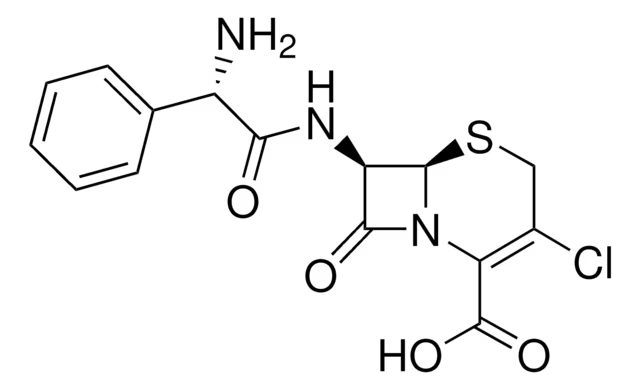
CAS Number53994-73-3
Synonyms7-{[Amino(phenyl)acetyl]amino}-3-chloro-8-oxo-5-thia-1-azabicyclo[4.2.0]oct-2-ene-2-carboxylic acid; Cephaclor; Alfacet; S 6472; EINECS 258-909-5; panoral; Kefral; MFCD00151471; Cefaclor
Molecular FormulaC15H14ClN3O4S
Molecular Weight367.81
Purity98%
Density1.6±0.1 g/cm3
Boiling Point713.4±60.0 °C at 760 mmHg
Appearancepowder or crystals
EINECS258-909-5
Symbol
Signal WordWarning
| Chemical & Physical Properties | |
|---|---|
| CAS Number | 53994-73-3 |
| Catalog No. | 2A-9009621 |
| Chinese Name | 头孢克罗 |
| Synonyms | 7-{[Amino(phenyl)acetyl]amino}-3-chloro-8-oxo-5-thia-1-azabicyclo[4.2.0]oct-2-ene-2-carboxylic acid; Cephaclor; Alfacet; S 6472; EINECS 258-909-5; panoral; Kefral; MFCD00151471; Cefaclor |
| Molecular Formula | C15H14ClN3O4S |
| Molecular Weight | 367.81 |
| Purity | 98 |
| Density | 1.6±0.1 g/cm3 |
| Boiling Point | 713.4±60.0 °C at 760 mmHg |
| Appearance | powder or crystals |
| Water Solubility | 1 M HCl: 50 mg/mL, clear to very faintly turbid, y |
| Storage Condition | Sealed in a cool, dry environment |
| Application | Cefaclor is a second-generation cephalosporin antibiotic that can be used to treat pneumonia and ear, skin, urinary tract and other infections caused by bacteria. |
| EINECS | 258-909-5 |
| HTC | 3003201500 |
| PubChem ID | 24278331 |
| MDL Number | MFCD00151471 |
| SMILES | N[C@@H](C(=O)N[C@H]1[C@H]2SCC(Cl)=C(N2C1=O)C(O)=O)c3ccccc3 |
| InChI | 1S/C15H14ClN3O4S/c16-8-6-24-14-10(13(21)19(14)11(8)15(22)23)18-12(20)9(17)7-4-2-1-3-5-7/h1-5,9-10,14H,6,17H2,(H,18,20)(H,22,23)/t9-,10-,14-/m1/s1 |
| InChI Key | QYIYFLOTGYLRGG-GPCCPHFNSA-N |
| Beilstein/REAXYS | 8176092 |
| NACRES Code | NA.85 |
| UNSPSC | 51283701 |
| Hazard Symbols | Transport |
| MSDS | msds/9621_1_53994_73_3.pdf |
| Bioactivity | Cefaclor, is a second-generation cephalosporin antibiotic used to treat certain infections caused by bacteria such as pneumonia and infections of the ear, lung, skin, throat, and urinary tract.Target: AntibacterialCefaclor belongs to the family of antibiotics known as the cephalosporins (cefalosporins). The cephalosporins are broad-spectrum antibiotics that are used for the treatment of septicaemia, pneumonia, meningitis, biliary tract infections, peritonitis, and urinary tract infections. The pharmacology of the cephalosporins is similar to that of the penicillins, excretion being principally renal. Cephalosporins penetrate the cerebrospinal fluid poorly unless the meninges are inflamed; cefotaxime is a more suitable cephalosporin than cefaclor for infections of the central nervous system, e.g. meningitis. Cefaclor is active against many bacteria, including both Gram-negative and Gram-positive organisms.Cefaclor is frequently used against bacteria responsible for causing skin infections, otitis media, urinary tract infections, and others. The following represents MIC susceptibility data for a few medically significant microorganisms. Cefaclor is passed into the breast milk in small quantities, but is generally accepted to be safe to take during breastfeeding. Cefaclor is not known to be harmful in pregnancy. Cefaclor has also been reported to cause a serum sickness-like reaction in children. Related Catalog Signaling Pathways >> Anti-infection >> Bacterial Natural Products >> Alkaloid Research Areas >> Infection References [1]. King BA, et al. Adverse skin and joint reactions associated with oral antibiotics in children: the role of cefaclor in serum sickness-like reactions. J Paediatr Child Health. 2003 Dec;39(9):677-81. [2]. Ito S, et al. Prospective follow-up of adverse reactions in breast-fed infants exposed to maternal medication. Am J Obstet Gynecol. 1993 May;168(5):1393-9. Chemical & Physical Properties Density 1.6±0.1 g/cm3 Boiling Point 713.4±60.0 °C at 760 mmHg Molecular Formula C15H14ClN3O4S Molecular Weight 367.807 Flash Point 385.2±32.9 °C Exact Mass 367.039368 PSA 138.03000 LogP 0.10 Vapour Pressure 0.0±2.4 mmHg at 25°C Index of Refraction 1.722 InChIKey QYIYFLOTGYLRGG-GPCCPHFNSA-N SMILES NC(C(=O)NC1C(=O)N2C(C(=O)O)=C(Cl)CSC12)c1ccccc1 Water Solubility 1 M HCl: 50 mg/mL, clear to very faintly turbid, yellow |
| Use of | Cefaclor, is a second-generation cephalosporin antibiotic used to treat certain infections caused by bacteria such as pneumonia and infections of the ear, lung, skin, throat, and urinary tract.Target: AntibacterialCefaclor belongs to the family of antibiotics known as the cephalosporins (cefalosporins). The cephalosporins are broad-spectrum antibiotics that are used for the treatment of septicaemia, pneumonia, meningitis, biliary tract infections, peritonitis, and urinary tract infections. The pharmacology of the cephalosporins is similar to that of the penicillins, excretion being principally renal. Cephalosporins penetrate the cerebrospinal fluid poorly unless the meninges are inflamed; cefotaxime is a more suitable cephalosporin than cefaclor for infections of the central nervous system, e.g. meningitis. Cefaclor is active against many bacteria, including both Gram-negative and Gram-positive organisms.Cefaclor is frequently used against bacteria responsible for causing skin infections, otitis media, urinary tract infections, and others. The following represents MIC susceptibility data for a few medically significant microorganisms. Cefaclor is passed into the breast milk in small quantities, but is generally accepted to be safe to take during breastfeeding. Cefaclor is not known to be harmful in pregnancy. Cefaclor has also been reported to cause a serum sickness-like reaction in children. Properties Articles87 Name cefaclor Synonym More Synonyms cefaclor Biological Activity Description Cefaclor, is a second-generation cephalosporin antibiotic used to treat certain infections caused by bacteria such as pneumonia and infections of the ear, lung, skin, throat, and urinary tract.Target: AntibacterialCefaclor belongs to the family of antibiotics known as the cephalosporins (cefalosporins). The cephalosporins are broad-spectrum antibiotics that are used for the treatment of septicaemia, pneumonia, meningitis, biliary tract infections, peritonitis, and urinary tract infections. The pharmacology of the cephalosporins is similar to that of the penicillins, excretion being principally renal. Cephalosporins penetrate the cerebrospinal fluid poorly unless the meninges are inflamed; cefotaxime is a more suitable cephalosporin than cefaclor for infections of the central nervous system, e.g. meningitis. Cefaclor is active against many bacteria, including both Gram-negative and Gram-positive organisms.Cefaclor is frequently used against bacteria responsible for causing skin infections, otitis media, urinary tract infections, and others. The following represents MIC susceptibility data for a few medically significant microorganisms. Cefaclor is passed into the breast milk in small quantities, but is generally accepted to be safe to take during breastfeeding. Cefaclor is not known to be harmful in pregnancy. Cefaclor has also been reported to cause a serum sickness-like reaction in children. Related Catalog Signaling Pathways >> Anti-infection >> Bacterial Natural Products >> Alkaloid Research Areas >> Infection References [1]. King BA, et al. Adverse skin and joint reactions associated with oral antibiotics in children: the role of cefaclor in serum sickness-like reactions. J Paediatr Child Health. 2003 Dec;39(9):677-81. [2]. Ito S, et al. Prospective follow-up of adverse reactions in breast-fed infants exposed to maternal medication. Am J Obstet Gynecol. 1993 May;168(5):1393-9. Chemical & Physical Properties Exact Mass 367.039368 PSA 138.03000 Index of Refraction 1.722 InChIKey QYIYFLOTGYLRGG-GPCCPHFNSA-N |
| Transport Info | Shipping Name: UN |
| MSDS Transport Info | Module 14. Shipping information 14.1 UN dangerous goods number European Land Transport Dangerous Regulations: -International Maritime Dangerous Regulations: -International Air Transport Dangerous Regulations: - 14.2 United Nations shipping name European Land Transport Dangerous Regulations: Non-dangerous goods IMDG Code: Non-dangerous goods International air transport dangerous goods regulations: non-dangerous goods 14.3 Transport hazard categories European Land Transport Dangerous Regulations: -International Maritime Dangerous Regulations: -International Air Transport Dangerous Regulations: - 14.4 Package group European Land Transport Dangerous Regulations: -International Maritime Dangerous Regulations: -International Air Transport Dangerous Regulations: - 14.5 Environmental hazards European Land Transport Danger Regulations: No International Maritime Danger Regulations International Air Transport Danger Regulations: No Marine pollutants (yes/no): No 14.6 Special reminder to users No data available |
| Related Products in API & Advanced Intermediates | ||
|---|---|---|
| Captopril | 62571-86-2 | 2A-9009567 |
| Carbamazepine | 298-46-4 | 2A-9009570 |
| Carboplatin | 41575-94-4 | 2A-9009587 |
| Carvedilol | 72956-09-3 | 2A-9009611 |
| Cefaclor | 70356-03-5 | 2A-9009620 |
| Cefazolin | 25953-19-9 | 2A-9009627 |
| Cefdinir | 91832-40-5 | 2A-9009631 |
| Cefepime | 88040-23-7 | 2A-9009633 |
| Cefepime hydrochloride | 123171-59-5 | 2A-9009634 |
| Cefixime | 79350-37-1 | 2A-9009638 |
| Browse all API & Advanced Intermediates products » | ||
Phone:
630-322-8886
630-322-8887
Email:
Office Locations:
Chicago, IL, USA
San Francisco, CA, USA


 EN
EN


 SDS
SDS