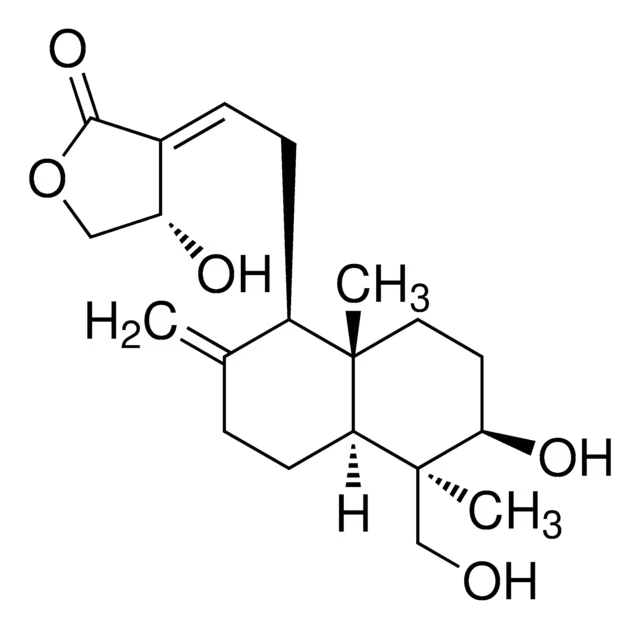
CAS Number5508-58-7
SynonymsANDROGRAPHIS; Rhizoma Sparganii; EINECS 226-852-5; Andrographolid; MFCD07778082; ANDRO; Andrographalide; Andrographolide
Molecular FormulaC20H30O5
Molecular Weight350.45
Purity98%
Density1.2±0.1 g/cm3
Boiling Point557.3±50.0 °C at 760 mmHg
Melting Point229-232 °C (lit.)
Appearancepowder
EINECS226-852-5
| Chemical & Physical Properties | |
|---|---|
| CAS Number | 5508-58-7 |
| Catalog No. | 2A-9009198 |
| Chinese Name | 穿心莲内酯 |
| Synonyms | ANDROGRAPHIS; Rhizoma Sparganii; EINECS 226-852-5; Andrographolid; MFCD07778082; ANDRO; Andrographalide; Andrographolide |
| Molecular Formula | C20H30O5 |
| Molecular Weight | 350.45 |
| Purity | 98 |
| Density | 1.2±0.1 g/cm3 |
| Boiling Point | 557.3±50.0 °C at 760 mmHg |
| Melting Point | 229-232 °C (lit.) |
| Appearance | powder |
| Storage Condition | Packed in brown glass bottles with light seal and |
| Application | Andrographolide is an NF-κB inhibitor that inhibits NF-κB activation by covalently modifying cysteine residues of p50 in endothelial cells without affecting IκBα degradation or p50/p65 nuclear trans |
| EINECS | 226-852-5 |
| HTC | 29322980 |
| PubChem ID | 24862550 |
| MDL Number | MFCD07778082 |
| SMILES | C[C@@]1(CO)[C@H](O)CC[C@@]2(C)[C@H](C\C=C3/[C@H](O)COC3=O)C(=C)CC[C@H]12 |
| InChI | 1S/C20H30O5/c1-12-4-7-16-19(2,9-8-17(23)20(16,3)11-21)14(12)6-5-13-15(22)10-25-18(13)24/h5,14-17,21-23H,1,4,6-11H2,2-3H3/b13-5+/t14-,15-,16+,17-,19+,20+/m1/s1 |
| InChI Key | BOJKULTULYSRAS-OTESTREVSA-N |
| Beilstein/REAXYS | 42762 |
| NACRES Code | NA.22 |
| UNSPSC | 12352005 |
| MSDS | msds/9198_1_5508_58_7.pdf |
| Bioactivity | Andrographolide is a NF-κB inhibitor, which inhibits NF-κB activation through covalent modification of a cysteine residue on p50 in endothelial cells without affecting IκBα degradation or p50/p65 nuclear translocation. Related Catalog Natural Products >> Terpenoids and Glycosides Research Areas >> Cancer Target p50 In Vitro Andrographolide (AP) concentration-dependently suppresses receptor activator of nuclear factor kappa B ligand (RANKL)-mediated osteoclast differentiation and bone resorption in vitro and reduces the expression of osteoclast-specific markers. Andrographolide attenuates inflammation by inhibition of TNFα-induced NF-κB activation through covalent modification of reduced Cys62 of p50, without affecting IκBα degradation or p50/p65 nuclear translocation. Andrographolide also inhibits the ERK/MAPK signalling pathway without affecting p38 or JNK signalling. Andrographolide inhibits osteoclast differentiation of RAW 264.7 cells in a concentration-dependent manner. Andrographolide suppresses osteoclast formation in a concentration-dependent manner without any obvious cytotoxic effects, in both BMMs and RAW 264.7 cells. Andrographolide treatment substantially reduces the area of bone resorption. Only approximately 30% of the bone resorption observed in the control group is achieved after treatment with 2.5 μM Andrographolide. Osteoclastic bone resorption is almost completely inhibited after treatment with 10 μM Andrographolide[1]. In Vivo Treatment with Andrographolide (5 or 30 mg/kg) reduces the extent of bone loss induced by LPS. Moreover, Andrographolide slightly increases the BMD and cortex thickness compared to LPS treatment. Histological examination confirms the protective effects of Andrographolide on LPS-induced bone loss. LPS injection leads to inflammatory bone erosion and increased numbers of TRAP-positive osteoclasts[1]. Kinase Assay In vitro osteoclastogenesis assays are preformed to examine the effects of Andrographolide on osteoclast differentiation. Bone marrow macrophages (BMM) cells are prepared. Briefly, cells extracted from the femur and tibiae of a 6-week-old C57/BL6 mouse are incubated in complete cell culture media and 30 ng/mL M-CSF in a T-75 cm2 flask for proliferation. When changing the medium, the cells are washed in order to deplete residual stromal cells. After reaching 90% confluence, cells are washed with PBS three times and trypsinized for 30 min to harvest BMMs. Cells adhering to the bottom of the dish are classified as BMMs; these BMMs are plated in 96-well plates at a density of 8×10³ cells per well in triplicate and incubated in a humidified incubator containing 5% CO2 at 37°C for 24 h. The cells are then treated with various concentrations of Andrographolide (0, 2.5, 5, or 10 μM) plus M-CSF (30 ng/mL) and RANKL (50 ng/mL). After 5 days, cells are fixed and stained for tartrate-resistant acid phosphatase (TRAP) activity. TRAP-positive multinucleated cells with more than five nuclei are counted as osteoclasts[1]. Cell Assay Effects of Andrographolide on cell proliferation are determined with a CCK-8. BMMs are plated in 96-well plates at a density of 3×10³ cells per well in triplicate. Twenty-four hours later, the cells are treated with increasing concentrations of Andrographolide (0, 2.5, 5, 10 or 20 μM) for 2 days. Next, 10 μL CCK-8 is added to each well, and the plates are then incubated at 37°C for an additional 2 h. The optical density (OD) is then measured with an ELX800 absorbance microplate reader at a wavelength of 450 nm (650 nm reference). The cell viability is calculated[1]. Animal Admin Mice[1] C57BL/6 mice (8 weeks old) are divided into four groups of seven mice each. Mice are injected i.p. with Andrographolide (5 or 30 mg/kg body weight) or PBS as a control 1 day before injection of LPS (5 μg/g body weight). Andrographolide or PBS is injected intraperitoneally every other day for 8 days. LPS is injected intraperitoneally on days one and four. All mice are killed 8 days after the initial LPS injection, and the left femurs of all animals are scanned with a high-resolution micro-CT at a resolution of 9 μm. References [1]. Zhai ZJ, et al. Andrographolide suppresses RANKL-induced osteoclastogenesis in vitro and prevents inflammatory bone loss in vivo. Br J Pharmacol. 2014 Feb;171(3):663-75. Chemical & Physical Properties Density 1.2±0.1 g/cm3 Boiling Point 557.3±50.0 °C at 760 mmHg Melting Point 229-232ºC Molecular Formula C20H30O5 Molecular Weight 350.449 Flash Point 195.5±23.6 °C Exact Mass 350.209320 PSA 86.99000 LogP 1.62 Vapour Pressure 0.0±3.4 mmHg at 25°C Index of Refraction 1.568 InChIKey BOJKULTULYSRAS-OTESTREVSA-N SMILES C=C1CCC2C(C)(CO)C(O)CCC2(C)C1CC=C1C(=O)OCC1O |
| Use of | Properties Articles39 Name andrographolide Synonym More Synonyms Andrographolide Biological Activity Related Catalog Natural Products >> Terpenoids and Glycosides Research Areas >> Cancer References [1]. Zhai ZJ, et al. Andrographolide suppresses RANKL-induced osteoclastogenesis in vitro and prevents inflammatory bone loss in vivo. Br J Pharmacol. 2014 Feb;171(3):663-75. Chemical & Physical Properties Molecular Formula C20H30O5 Exact Mass 350.209320 PSA 86.99000 Index of Refraction 1.568 InChIKey BOJKULTULYSRAS-OTESTREVSA-N |
| Transport Info | Product name: Purity: 98.0% |
| MSDS Transport Info | Module 14. Shipping information United Nations classification: inconsistent with United Nations classification standards UN number: not specified |
| Related Products in Botanical Reference Standards | ||
|---|---|---|
| Acacetin | 480-44-4 | 2A-9009027 |
| Actein | 18642-44-9 | 2A-9009058 |
| Agnuside | 11027-63-7 | 2A-9009080 |
| Aloenin | 38412-46-3 | 2A-9009120 |
| Panax Ginseng extract | 50647-08-0 | 2A-9009147 |
| Aristolochic acid | 313-67-7 | 2A-9009235 |
| Artemether | 71963-77-4 | 2A-9009242 |
| Artesunate | 88495-63-0 | 2A-9009243 |
| Asiatic Acid | 464-92-6 | 2A-9009245 |
| Asiaticoside | 16830-15-2 | 2A-9009246 |
| Browse all Botanical Reference Standards products » | ||
Phone:
630-322-8886
630-322-8887
Email:
Office Locations:
Chicago, IL, USA
San Francisco, CA, USA


 EN
EN


 SDS
SDS