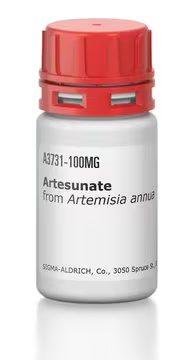
CAS Number88495-63-0
SynonymsCosunate; Qinghaozhi; Saphnate; Arteannuinum; AsuMax; PlasMotriM; MFCD00866204; PlasMotrin; vARTESUNATE
Molecular FormulaC19H28O8
Molecular Weight384.42
Purity98%
Density1.3±0.1 g/cm3
Boiling Point507.1±50.0 °C at 760 mmHg
Melting Point132-135ºC
Appearancecrystalline powder
| Chemical & Physical Properties | |
|---|---|
| CAS Number | 88495-63-0 |
| Catalog No. | 2A-9009243 |
| Chinese Name | 青蒿琥酯; 青蒿脂 |
| Synonyms | Cosunate; Qinghaozhi; Saphnate; Arteannuinum; AsuMax; PlasMotriM; MFCD00866204; PlasMotrin; vARTESUNATE |
| Molecular Formula | C19H28O8 |
| Molecular Weight | 384.42 |
| Purity | 98 |
| Density | 1.3±0.1 g/cm3 |
| Boiling Point | 507.1±50.0 °C at 760 mmHg |
| Melting Point | 132-135ºC |
| Appearance | crystalline powder |
| Water Solubility | acetone: soluble33.4mg/mL |
| Storage Condition | Room temp |
| Application | Artesunate is an inhibitor of STAT-3 and exportin 1 (EXP1). |
| HTC | 29419090 |
| MDL Number | MFCD00866204 |
| SMILES | O1OC2(O[C@H]3O[C@@H]([C@@H]([C@H]4[C@]31[C@H]([C@@H](CC4)C)CC2)C)OC(=O)CCC(=O)O)C |
| InChI | 1S/C19H28O8/c1-10-4-5-13-11(2)16(23-15(22)7-6-14(20)21)24-17-19(13)12(10)8-9-18(3,25-17)26-27-19/h10-13,16-17H,4-9H2,1-3H3,(H,20,21)/t10-,11-,12+,13+,16+,17-,18?,19-/m1/s1 |
| InChI Key | FIHJKUPKCHIPAT-JQXDXKTESA-N |
| NACRES Code | NA.85 |
| UNSPSC | 51101914 |
| MSDS | msds/9243_1_88495_63_0.pdf |
| Bioactivity | Artesunate is an inhibitor of both STAT-3 and exported protein 1 (EXP1). Related Catalog Signaling Pathways >> JAK/STAT Signaling >> STAT Signaling Pathways >> Stem Cell/Wnt >> STAT Research Areas >> Cancer Target Stat-3 EXP1 In Vitro Artesunate is an inhibitor of both STAT-3[1] and exported protein 1 (EXP1)[2]. Artesunate treatment for 24 h causes a significant increase in the levels of reactive oxygen species (ROS) in a dose-dependent manner in both cell lines. Moreover, Western blotting shows that the levels ofγ-H2AX are significantly elevated when cancer cells are treated with Artesunate in the higher dose range for 24 h. Artesunate also shows a time-dependent effect on the level of RAD51 in A2780 and HO8910 cells. In two types of non-malignant cells, normal human fibroblasts and immortalized epithelial cells, FTE-187, the level of RAD51 is not altered by Artesunate. In A2780 cells, the level of RAD51 mRNA is indeed decreased by the addition of Artesunate, in a dose-dependent manner. Correspondingly, the promoter activity of RAD51 is significantly inhibited by Artesunate. In contrast, the RAD51 mRNA level in H8910 cells is not affected by Artesunate[3]. In Vivo Tumor growth is significantly reduced in the group receiving combined treatment of Artesunate and cisplatin (P<0.01). In comparison, Artesunate alone has no significant effect on the growth of tumor xenografts for both cell lines[3]. Kinase Assay After treatment with Artesunate for 24 h, cells are harvested and lysed in 1×cell lysis buffer. Total proteins of 15 to 25 μg are separated by SDS-PAGE and transferred to polyvinylidenedifluoride (PVDF) membranes. Membranes are blocked with 5% non-fat milk for 1 to 2 h at room temperature and then probed with primary antibodies and incubated at 4°C overnight. After extensive washing with TBS-T, membranes are incubated with appropriate HRP-conjugated secondary antibody for 1 h at room temperature, and then are detected by Western ECL-enhanced luminol reagent [3]. Cell Assay A2780 and HO8910 cells are cultured in RPMI 1640, Normal human fibroblasts (NHF) in DMEM, and FTE-187 in M199, supplemented with 10% fetal bovine serum, 100 units/mL penicillin, and 100 mg/mL streptomycin. All the cells are incubated in a humidified atmosphere of 95% air and 5% CO2. Artesunate is applied to the cultured cells at the concentration of 0, 5, 10, 25, or 50 µg/mL for various periods. The reactive oxygen species (ROS) production following Artesunate treatment is determined. Briefly, cells are loaded with 5 μM of CM-H2DCFDA and incubated at 37°C for 20 min after treatment with Artesunate. Cells are resuspended using preserving fluid and analyzed with a FACSCanto II. The peak excitation wavelength for oxidized CM-H2DCFDA is 490 nm and emission is 530 nm[3]. Animal Admin Four to six weeks old female athymic nude mice (BALB/c, nu/nu) are used. A2780 and HO8910 cells are harvested and resuspended in 0.1 ml of PBS, 5×10⁶ cells/0.2 mL are injected subcutaneously into the left inguinal area of the mice. Two weeks later, mice bearing tumors (~70 mm3 for A2780 and HO8910) are randomly divided into 4 groups. Artesunate is administered daily via i.p. injection at doses of 50 mg/kg alone for 16 days. The tumor growth is monitored every other day. Tumor volume is determined by the formula 1/2a×b2 where a is the long diameter (mm) and b is the short diameter (mm)[3]. References [1]. Ilamathi M, et al. Artesunate as an Anti-Cancer Agent Targets Stat-3 and Favorably Suppresses Hepatocellular Carcinoma. Curr Top Med Chem. 2016;16(22):2453-63. [2]. Lisewski AM, et al. Supergenomic network compression and the discovery of EXP1 as a glutathione transferase inhibited by artesunate. Cell. 2014 Aug 14;158(4):916-928. [3]. Wang B, et al. Artesunate sensitizes ovarian cancer cells to cisplatin by downregulating RAD51. Cancer Biol Ther. 2015;16(10):1548-56. Chemical & Physical Properties Density 1.3±0.1 g/cm3 Boiling Point 507.1±50.0 °C at 760 mmHg Melting Point 132-135ºC Molecular Formula C19H28O8 Molecular Weight 384.421 Flash Point 175.6±23.6 °C Exact Mass 384.178406 PSA 100.52000 LogP 2.94 Vapour Pressure 0.0±2.8 mmHg at 25°C Index of Refraction 1.544 InChIKey FIHJKUPKCHIPAT-RLQWWVEOSA-N SMILES CC1CCC2C(C)C(OC(=O)CCC(=O)O)OC3OC4(C)CCC1C32OO4 Storage condition Room temp Water Solubility acetone: soluble33.4mg/mL |
| Use of | Artesunate is an inhibitor of both STAT-3 and exported protein 1 (EXP1). Properties Name Artesunate Synonym More Synonyms Artesunate Biological Activity Description Artesunate is an inhibitor of both STAT-3 and exported protein 1 (EXP1). Related Catalog Signaling Pathways >> JAK/STAT Signaling >> STAT Signaling Pathways >> Stem Cell/Wnt >> STAT Research Areas >> Cancer In Vivo Tumor growth is significantly reduced in the group receiving combined treatment of Artesunate and cisplatin (P<0.01). In comparison, Artesunate alone has no significant effect on the growth of tumor xenografts for both cell lines[3]. References [1]. Ilamathi M, et al. Artesunate as an Anti-Cancer Agent Targets Stat-3 and Favorably Suppresses Hepatocellular Carcinoma. Curr Top Med Chem. 2016;16(22):2453-63. [2]. Lisewski AM, et al. Supergenomic network compression and the discovery of EXP1 as a glutathione transferase inhibited by artesunate. Cell. 2014 Aug 14;158(4):916-928. Chemical & Physical Properties Molecular Formula C19H28O8 Exact Mass 384.178406 PSA 100.52000 Index of Refraction 1.544 InChIKey FIHJKUPKCHIPAT-RLQWWVEOSA-N Storage condition Room temp |
| Transport Info | Product name: Purity: 98.0% |
| MSDS Transport Info | Module 14. Shipping information United Nations classification: inconsistent with United Nations classification standards UN number: not specified |
| Related Products in Botanical Reference Standards | ||
|---|---|---|
| Aloenin | 38412-46-3 | 2A-9009120 |
| Panax Ginseng extract | 50647-08-0 | 2A-9009147 |
| Andrographolide | 5508-58-7 | 2A-9009198 |
| Aristolochic acid | 313-67-7 | 2A-9009235 |
| Artemether | 71963-77-4 | 2A-9009242 |
| Asiatic Acid | 464-92-6 | 2A-9009245 |
| Asiaticoside | 16830-15-2 | 2A-9009246 |
| Astragalin | 480-10-4 | 2A-9009253 |
| Astragaloside | 17429-69-5 | 2A-9009254 |
| Aucubin | 479-98-1 | 2A-9009265 |
| Browse all Botanical Reference Standards products » | ||
Phone:
630-322-8886
630-322-8887
Email:
Office Locations:
Chicago, IL, USA
San Francisco, CA, USA


 EN
EN


 SDS
SDS