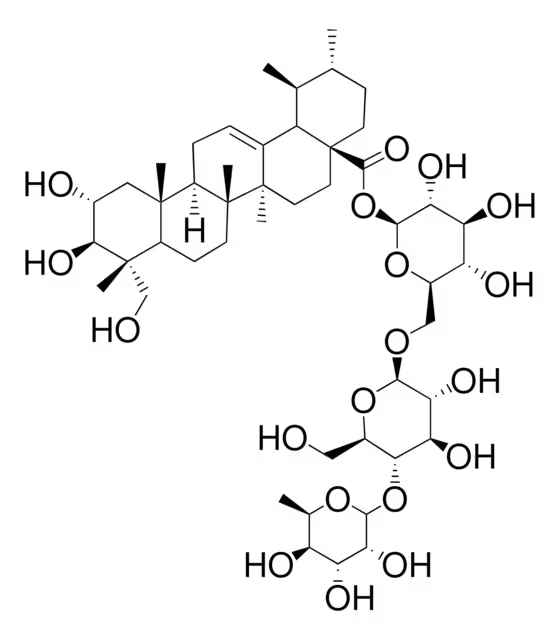
CAS Number16830-15-2
Synonymsdermatologico; MADESOL; Ba-2742; CENTELASE; asiaticosid; MFCD06642601; EMdesol; MADEOL; EINECS 240-851-7; Martisol; scheffursoside F
Molecular FormulaC48H78O19
Molecular Weight959.12
Purity≥98.5 (HPLC)%
Density1.4±0.1 g/cm3
Boiling Point949.4±65.0 °C at 760 mmHg
Melting Point235-238ºC
Appearancewhite powder
EINECS240-851-7
Symbol
Signal WordWarning


Please Login or Create an Account to: See VlP prices and availability
US Stock: ship in 0-1 business day
Global Stock: ship in 5-7 days
| Chemical & Physical Properties | |
|---|---|
| CAS Number | 16830-15-2 |
| Catalog No. | 2A-9009246 |
| Chinese Name | 积雪草苷 |
| Synonyms | dermatologico; MADESOL; Ba-2742; CENTELASE; asiaticosid; MFCD06642601; EMdesol; MADEOL; EINECS 240-851-7; Martisol; scheffursoside F |
| Molecular Formula | C48H78O19 |
| Molecular Weight | 959.12 |
| Purity | ≥98.5 (HPLC) |
| Density | 1.4±0.1 g/cm3 |
| Boiling Point | 949.4±65.0 °C at 760 mmHg |
| Melting Point | 235-238ºC |
| Appearance | white powder |
| Storage Condition | Ventilated low-temperature drying |
| Application | Asiaticoside is a triterpene saponin compound isolated from Centella asiatica. In keloid fibroblasts, it inhibits TGF-βRI and TGF-βRII and the TGF-β/Smad signaling pathway by activating Smad7. Asiatic |
| EINECS | 240-851-7 |
| PubChem ID | 329756318 |
| MDL Number | MFCD06642601 |
| SMILES | [H][C@]12CC=C3C4[C@@H](C)[C@H](C)CC[C@@]4(CC[C@@]3(C)[C@]1(C)CCC5[C@](C)(CO)[C@@H](O)[C@H](O)C[C@]25C)C(=O)O[C@@H]6O[C@H](CO[C@@H]7O[C@H](CO)[C@@H](O[C@@H]8O[C@H](C)[C@H](O)[C@@H](O)[C@H]8O)[C@H](O)[C@H]7O)[C@@H](O)[C@H](O)[C@H]6O |
| InChI | 1S/C48H78O19/c1-20-10-13-48(15-14-46(6)23(29(48)21(20)2)8-9-28-44(4)16-24(51)39(60)45(5,19-50)27(44)11-12-47(28,46)7)43(61)67-42-36(58)33(55)31(53)26(65-42)18-62-40-37(59)34(56)38(25(17-49)64-40)66-41-35(57)32(54)30(52)22(3)63-41/h8,20-22,24-42,49-60H,9-19H2,1-7H3/t20-,21+,22-,24-,25-,26-,27?,28-,29?,30+,31-,32-,33+,34-,35-,36-,37-,38-,39+,40-,41+,42+,44+,45+,46-,47-,48+/m1/s1 |
| InChI Key | WYQVAPGDARQUBT-TZXSXNIFSA-N |
| NACRES Code | NA.24 |
| UNSPSC | 85151701 |
| Hazard Symbols | Transport |
| MSDS | msds/9246_1_16830_15_2.pdf |
| Bioactivity | Asiaticoside, a trisaccaride triterpene from Centella asiatica, suppresses TGF-β/Smad signaling through inducing Smad7 and inhibiting TGF-βRI and TGF-βRII in keloid fibroblasts; Asiaticoside shows antioxidant, anti-inflammatory, and anti-ulcer properties. Related Catalog Signaling Pathways >> Stem Cell/Wnt >> TGF-beta/Smad Signaling Pathways >> TGF-beta/Smad >> TGF-beta/Smad Research Areas >> Inflammation/Immunology Research Areas >> Neurological Disease Research Areas >> Cardiovascular Disease Natural Products >> Terpenoids and Glycosides Target TGF-beta/Smad[1] In Vitro Asiaticoside (0, 100, 250, and 500 mg/L) dose-dependently inhibits keloid fibroblasts proliferation. Asiaticoside (100, 250, and 500 mg/L) decreases the expression of collagen protein and mRNA, reduces the expression of TGF-bRI, TGF-bRII protein, and mRNA, increases the expression of Smad7, but does not affect Smad2, Smad3, Smad4, phosphorylated Smad2, and phosphorylated Smad3 in keloid fibroblasts[1]. Asiaticoside (12.5 and 50, and 25 and 50 µg/mL) prevents endothelial cells from hypoxia-induced inhibition of cell viability and NO production. Asiaticoside (50 µg/mL) also protects endothelial cells from hypoxia-induced apoptosis and upregulates and phosphorylation of AKT/eNOS in hypoxia-exposed HPAECs[2]. In Vivo Asiaticoside (50 mg/kg daily) blocks the development of hypoxic pulmonary hypertension (PH), cardiovascular remodeling and endothelial cell injury in rats with pulmonary hypertension[2]. Asiaticoside (5, 15 or 45 mg/kg, p.o.) improves the learning and memory deficit, protects hippocampi against the impairment, decreases Aβ deposits in the hippocampus, and ameliorates impaired subcellular structure in rats treated with Aβ oligomers[3]. Cell Assay Cells are seeded at a density of 2-9 × 10⁴ cells/mL into 24-well plates for cell viability, 60-mm plates for RNA and protein analysis in DMEM containing 10% FBS (DMEM/10% FBS). After 24 h, medium is removed and cells are placed in serum-free DMEM. After 48 h, different concentrations of Asiaticoside in DMEM/10% FBS are added simultaneously to cells. Control cells are grown in DMEM/10% FBS without the addition of Asiaticoside. At different time points, the fibroblasts are harvested for analysis[1]. Animal Admin Rats[3]Sprague-Dawley rats are used to establish the Alzheimer's disease (AD) model. Asiaticoside is administered orally at 5, 15 or 45 mg/kg body weight per day for 7 days. The learning and memory function of the rats are evaluated by the MWM test 7 days after surgery. The swimming pool (180 cm in diameter) is maintained at 22-24°C, and divided into four quadrants with equal size. A hidden platform is placed in the center of one quadrant. Each of the cardinal points of these four quadrants is randomLy selected as the start location. On the pre-test day, rats are allowed to swim freely for 120 sec. During the test (days 1-4), each rat is subjected to 8 trials each day. The trial begins when a rat is placed in the pool, and ended when the rat finds the platform. The escape latency is recorded. If a rat fails to find the platform within 120 sec, the trial is terminated and the escape latency is recorded as 120 sec, and the rat is guided to the platform. On day 5, the swimming path is recorded by a video recording system, and the digital images are analyzed by the water maze software. In addition, the probe test is performed, in which the platform is removed, and the rat is allowed to swim freely in the pool for 120 sec. The swimming time in the target quadrant is recorded[3]. References [1]. Tang B, et al. Asiaticoside suppresses collagen expression and TGF-β/Smad signaling through inducing Smad7 and inhibiting TGF-βRI and TGF-βRII in keloid fibroblasts. h Dermatol Res. 2011 Oct;303(8):563-72. [2]. Wang X, et al. Effect of asiaticoside on endothelial cells in hypoxia‑induced pulmonary hypertension. Mol Med Rep. 2018 Feb;17(2):2893-2900. [3]. Zhang Z, et al. Asiaticoside ameliorates β-amyloid-induced learning and memory deficits in rats by inhibiting mitochondrial apoptosis and reducing inflammatory factors. Exp Ther Med. 2017 Feb;13(2):413-420. Chemical & Physical Properties Density 1.4±0.1 g/cm3 Boiling Point 949.4±65.0 °C at 760 mmHg Melting Point 235-238ºC Molecular Formula C48H78O19 Molecular Weight 959.12 Flash Point 268.4±27.8 °C PSA 315.21000 LogP 8.34 Vapour Pressure 0.0±0.6 mmHg at 25°C Index of Refraction 1.606 InChIKey WYQVAPGDARQUBT-ANFANCPGSA-N SMILES CC1CCC2(C(=O)OC3OC(COC4OC(CO)C(OC5OC(C)C(O)C(O)C5O)C(O)C4O)C(O)C(O)C3O)CCC3(C)C(=CCC4C5(C)CC(O)C(O)C(C)(CO)C5CCC43C)C2C1C |
| Use of | Asiaticoside, a trisaccaride triterpene from Centella asiatica, suppresses TGF-β/Smad signaling through inducing Smad7 and inhibiting TGF-βRI and TGF-βRII in keloid fibroblasts; Asiaticoside shows antioxidant, anti-inflammatory, and anti-ulcer properties. Properties Articles28 Name Asiaticoside Synonym More Synonyms Asiaticoside Biological Activity Description Asiaticoside, a trisaccaride triterpene from Centella asiatica, suppresses TGF-β/Smad signaling through inducing Smad7 and inhibiting TGF-βRI and TGF-βRII in keloid fibroblasts; Asiaticoside shows antioxidant, anti-inflammatory, and anti-ulcer properties. Related Catalog Signaling Pathways >> Stem Cell/Wnt >> TGF-beta/Smad Signaling Pathways >> TGF-beta/Smad >> TGF-beta/Smad Research Areas >> Inflammation/Immunology Research Areas >> Neurological Disease Research Areas >> Cardiovascular Disease Natural Products >> Terpenoids and Glycosides TGF-beta/Smad[1] References [1]. Tang B, et al. Asiaticoside suppresses collagen expression and TGF-β/Smad signaling through inducing Smad7 and inhibiting TGF-βRI and TGF-βRII in keloid fibroblasts. h Dermatol Res. 2011 Oct;303(8):563-72. [2]. Wang X, et al. Effect of asiaticoside on endothelial cells in hypoxia‑induced pulmonary hypertension. Mol Med Rep. 2018 Feb;17(2):2893-2900. [3]. Zhang Z, et al. Asiaticoside ameliorates β-amyloid-induced learning and memory deficits in rats by inhibiting mitochondrial apoptosis and reducing inflammatory factors. Exp Ther Med. 2017 Feb;13(2):413-420. Chemical & Physical Properties Molecular Formula C48H78O19 PSA 315.21000 Index of Refraction 1.606 InChIKey WYQVAPGDARQUBT-ANFANCPGSA-N |
| Transport Info | Product name: Purity: 98.0% |
| MSDS Transport Info | Module 14. Shipping information 14.1 UN number European Land Transport Dangerous Regulations: -International Maritime Dangerous Regulations: -International Air Transport Dangerous Regulations: - 14.2 Names specified by the United Nations (UN) European Land Transport Dangerous Regulations: No dangerous goods IMDG Code: No dangerous goods International Air Transport Dangerous Regulations: No dangerous goods 14.3 Transport hazard categories European Land Transport Dangerous Regulations: -International Maritime Dangerous Regulations: -International Air Transport Dangerous Regulations: - 14.4 Package group European Land Transport Dangerous Regulations: -International Maritime Dangerous Regulations: -International Air Transport Dangerous Regulations: - 14.5 Environmental hazards European Land Transport Dangerous Regulations: No International Maritime Transport Dangerous Regulations Maritime Pollutants: No International Air Transport Risk Regulations: No 14.6 Special precautions for users No data available |
| Related Products in Botanical Reference Standards | ||
|---|---|---|
| Andrographolide | 5508-58-7 | 2A-9009198 |
| Aristolochic acid | 313-67-7 | 2A-9009235 |
| Artemether | 71963-77-4 | 2A-9009242 |
| Artesunate | 88495-63-0 | 2A-9009243 |
| Asiatic Acid | 464-92-6 | 2A-9009245 |
| Astragalin | 480-10-4 | 2A-9009253 |
| Astragaloside | 17429-69-5 | 2A-9009254 |
| Aucubin | 479-98-1 | 2A-9009265 |
| Baicalin | 21967-41-9 | 2A-9009295 |
| Benzoylpaeoniflorin | 38642-49-8 | 2A-9009359 |
| Browse all Botanical Reference Standards products » | ||
Phone:
630-322-8886
630-322-8887
Email:
Office Locations:
Chicago, IL, USA
San Francisco, CA, USA


 EN
EN

 SDS
SDS