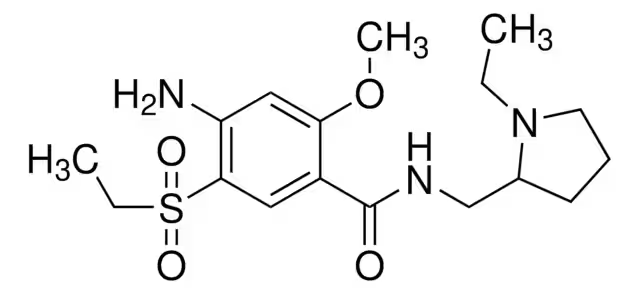
CAS Number71675-85-9
SynonymsAmisulpiride; Socian; 4-Amino-N-[(1-ethyl-2-pyrrolidinyl)methyl]-5-(ethylsulfonyl)-2-methoxybenzamide; Amisulpride; 4-amino-N-[(1-ethylpyrrolidin-2-yl)methyl]-5-ethylsulfonyl-2-methoxybenzamide; Amisulpridum [INN-Latin]; amisulpridum; 4-amino-N-[(1-ethyl-2-pyrrolidin-yl)methyl]-5-(ethyl-sulfonyl)-2--methoxybenzamide; MFCD00866691; Deniban; EINECS 275-831-7; Solian; UNII:8110R61I4U; 4-Amino-N-[(1-ethyl-2-pyrrolidinyl)methyl]-5-(ethylsulfonyl)-o-anisamide; amisulprida; 4-amino-N-[(1-ethylpyrrolidin-2-yl)methyl]-5-(ethylsulfonyl)-2-methoxybenzamide
Molecular FormulaC17H27N3O4S
Molecular Weight369.48
Purity98%
Density1.2±0.1 g/cm3
Boiling Point558.9±50.0 °C at 760 mmHg
Melting Point124-128ºC
AppearanceWhite or almost white crystalline powder
Symbol
Signal WordWarning
| Chemical & Physical Properties | |
|---|---|
| CAS Number | 71675-85-9 |
| Catalog No. | 2A-9009163 |
| Chinese Name | 阿米舒必利 |
| Synonyms | Amisulpiride; Socian; 4-Amino-N-[(1-ethyl-2-pyrrolidinyl)methyl]-5-(ethylsulfonyl)-2-methoxybenzamide; Amisulpride; 4-amino-N-[(1-ethylpyrrolidin-2-yl)methyl]-5-ethylsulfonyl-2-methoxybenzamide; Amisulpridum [INN-Latin]; amisulpridum; 4-amino-N-[(1-ethyl-2-pyrrolidin-yl)methyl]-5-(ethyl-sulfonyl)-2--methoxybenzamide; MFCD00866691; Deniban; EINECS 275-831-7; Solian; UNII:8110R61I4U; 4-Amino-N-[(1-ethyl-2-pyrrolidinyl)methyl]-5-(ethylsulfonyl)-o-anisamide; amisulprida; 4-amino-N-[(1-ethylpyrrolidin-2-yl)methyl]-5-(ethylsulfonyl)-2-methoxybenzamide |
| Molecular Formula | C17H27N3O4S |
| Molecular Weight | 369.48 |
| Purity | 98 |
| Density | 1.2±0.1 g/cm3 |
| Boiling Point | 558.9±50.0 °C at 760 mmHg |
| Melting Point | 124-128ºC |
| Appearance | White or almost white crystalline powder |
| Water Solubility | DMSO: ≥5 mg/mL |
| Storage Condition | 2-8°C |
| Application | Amisulpride is a dopamine D2/D3 receptor antagonist with Ki values of 2.8 and 3.2 nM for human dopamine D2 and D3, respectively. |
| HTC | 2933990090 |
| MDL Number | MFCD00866691 |
| SMILES | [S](=O)(=O)(CC)c1c(cc(c(c1)C(=O)NCC2N(CCC2)CC)OC)N |
| InChI | 1S/C17H27N3O4S/c1-4-20-8-6-7-12(20)11-19-17(21)13-9-16(25(22,23)5-2)14(18)10-15(13)24-3/h9-10,12H,4-8,11,18H2,1-3H3,(H,19,21) |
| InChI Key | NTJOBXMMWNYJFB-UHFFFAOYSA-N |
| NACRES Code | NA.24 |
| UNSPSC | 41116107 |
| Hazard Symbols | Transport |
| MSDS | msds/9163_1_71675_85_9.pdf |
| Bioactivity | Amisulpride is a dopamine D2/D3 receptor antagonist with Kis of 2.8 and 3.2 nM for human dopamine D2 and D3, respectively. Related Catalog Signaling Pathways >> GPCR/G Protein >> Dopamine Receptor Signaling Pathways >> Neuronal Signaling >> Dopamine Receptor Research Areas >> Neurological Disease Research Areas >> Cancer Target Ki: 2.8 nM (D2 receptor), 3.2 nM (D3 receptor)[1] In Vitro Amisulpride is an atypical dopamine D2/D3 receptor antagonist with Kis of 2.8 and 3.2 nM for human dopamine D2 and D3, respectively. Amisulpride (100 nM) inhibits quinpirole-elicited [3H]thymidine incorporation with an IC50 value of 22±3 nM (n=3). Amisulpride slightly but significantly increases [3H]dopamine release from slices of the rat striatum (S2/S1=0.88±0.04 under control conditions, n=6; 1.04±0.08 in the presence of 100 nM Amisulpride,n=4; P<0.05) and opposes the inhibitory effects of 7-OH-DPAT in both brain areas[1]. In Vivo Only the highest dose of Amisulpride (100 mg/kg) significantly reduces dopamine levels in the striatum or limbic system. Amisulpride significantly increases the synthesis of dopamine in the rat striatum and limbic system at doses of 20 and 100 mg/kg. Amisulpride (0.5 to 75 mg/kg) fails to provoke an additional increase in dopa accumulation in the striatum but slightly accelerates, at 75 mg/kg, dopamine synthesis in the limbic system. In comparison with vehicle-treated controls, Amisulpride (10 mg/kg) increases extracellular dopamine levels. The administration of Amisulpride (0.5 to 15 mg/kg s.c.) provokes a time- and dose-dependent increase in the stimulation-evoked dopamine release. Amisulpride decreases striatal ACh levels significantly at 30 and 100 mg/kg (87.5% and 56.3% of control levels, respectively)[1]. In both acute study, Amisulpride (70 mg/kg, p.o.) significantly increases the duration of swimming behavior [F(3,28)=45.90, p<0.01][2]. Cell Assay The functional effects of Amisulpride at the dopamine D3 receptor subtype are assessed. Briefly, the mitogenic response elicited in NG108-15 neuroblastoma-glioma cells stably transfected with human dopamine D3 receptor cDNA by the addition of 10 nM quinpirole in the presence of 1 μM forskolin is quantified by the incorporation of [3H]thymidine. Antagonism of quinpirole-induced mitogenesis is measured in the presence of increasing (0.1 to 100 nM) concentrations of Amisulpride[1]. Animal Admin A total of 64 male Swiss albino mice weighing between 20 to 30 g are used. The animals are fed with standard pellet diet and water ad libitum. The mice are divided in different groups (n=8 in each group) and drug administration is done as follows: Group 1 (control): distilled water (1 mL/kg) 23.5, 5 and 1 h before the test. Group 3 (Amisulpride): Amisulpride (70 mg/kg) 23.5, 5 and 1 h before the test[2]. References [1]. Schoemaker H, et al. Neurochemical characteristics of amisulpride, an atypical dopamine D2/D3 receptor antagonist with both presynaptic and limbic selectivity. J Pharmacol Exp Ther. 1997 Jan;280(1):83-97. [2]. Pawar GR, et al. Evaluation of antidepressant like property of amisulpride per se and its comparison with fluoxetine and olanzapine using forced swimming test in albino mice. Acta Pol Pharm. 2009 May-Jun;66(3):327-31. Chemical & Physical Properties Density 1.2±0.1 g/cm3 Boiling Point 558.9±50.0 °C at 760 mmHg Melting Point 124-128ºC Molecular Formula C17H27N3O4S Molecular Weight 369.479 Flash Point 291.8±30.1 °C Exact Mass 369.172241 PSA 110.11000 LogP 1.60 Vapour Pressure 0.0±1.5 mmHg at 25°C Index of Refraction 1.546 InChIKey NTJOBXMMWNYJFB-UHFFFAOYSA-N SMILES CCN1CCCC1CNC(=O)c1cc(S(=O)(=O)CC)c(N)cc1OC Storage condition 2-8°C Water Solubility DMSO: ≥5 mg/mL |
| Use of | Properties Name amisulpride Synonym More Synonyms Amisulpride Biological Activity Related Catalog Signaling Pathways >> GPCR/G Protein >> Dopamine Receptor Signaling Pathways >> Neuronal Signaling >> Dopamine Receptor Research Areas >> Neurological Disease Research Areas >> Cancer Ki: 2.8 nM (D2 receptor), 3.2 nM (D3 receptor)[1] Cell Assay The functional effects of Amisulpride at the dopamine D3 receptor subtype are assessed. Briefly, the mitogenic response elicited in NG108-15 neuroblastoma-glioma cells stably transfected with human dopamine D3 receptor cDNA by the addition of 10 nM quinpirole in the presence of 1 μM forskolin is quantified by the incorporation of [3H]thymidine. Antagonism of quinpirole-induced mitogenesis is measured in the presence of increasing (0.1 to 100 nM) concentrations of Amisulpride[1]. References [2]. Pawar GR, et al. Evaluation of antidepressant like property of amisulpride per se and its comparison with fluoxetine and olanzapine using forced swimming test in albino mice. Acta Pol Pharm. 2009 May-Jun;66(3):327-31. Chemical & Physical Properties Molecular Formula C17H27N3O4S Exact Mass 369.172241 PSA 110.11000 Index of Refraction 1.546 InChIKey NTJOBXMMWNYJFB-UHFFFAOYSA-N |
| Tax Rebate | 13.0% |
| Supervision | None. MFN tariff: 6.5%. Ordinary tariff: 20.0% |
| Transport Info | Product name: Purity: 98.0% |
| MSDS Transport Info | Module 14. Shipping information 14.1 UN dangerous goods number European Land Transport Dangerous Regulations: -International Maritime Dangerous Regulations: -International Air Transport Dangerous Regulations: - 14.2 Names specified by the United Nations (UN) European Land Transport Dangerous Regulations: Non-dangerous goods IMDG Code: Non-dangerous goods International air transport dangerous goods regulations: non-dangerous goods 14.3 Transport hazard categories European Land Transport Dangerous Regulations: -International Maritime Dangerous Regulations: -International Air Transport Dangerous Regulations: - 14.4 Package group European Land Transport Dangerous Regulations: -International Maritime Dangerous Regulations: -International Air Transport Dangerous Regulations: - 14.5 Environmental hazards European Land Transport Dangerous Regulations: No International Maritime Transport Dangerous Regulations Maritime Pollutants: No International Air Transport Risk Regulations: No 14.6 Special reminder to users No data available |
| Related Products in API & Advanced Intermediates | ||
|---|---|---|
| Allopurinol riboside | 16220-07-8 | 2A-9009114 |
| Amikacin disulfate salt | 39831-55-5 | 2A-9009154 |
| Aminophylline | 317-34-0 | 2A-9009158 |
| Amiodarone | 1951-25-3 | 2A-9009160 |
| Amiodarone hydrochloride | 19774-82-4 | 2A-9009161 |
| Amlodipine | 88150-42-9 | 2A-9009165 |
| Amlodipine besylate | 111470-99-6 | 2A-9009166 |
| Amlodipine maleate | 88150-47-4 | 2A-9009167 |
| Amoxicillin | 26787-78-0 | 2A-9009176 |
| Amoxicillin sodium | 34642-77-8 | 2A-9009177 |
| Browse all API & Advanced Intermediates products » | ||
Phone:
630-322-8886
630-322-8887
Email:
Office Locations:
Chicago, IL, USA
San Francisco, CA, USA


 EN
EN


 SDS
SDS