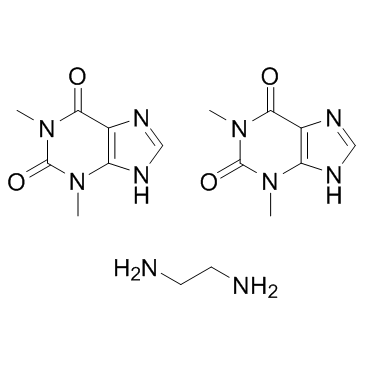
CAS Number317-34-0
Synonyms1,3-Dimethyl-3,7-dihydro-1H-purin-2,6-dion-ethan-1,2-diamin(2:1); 1,3-diméthyl-3,7-dihydro-1H-purine-2,6-dione - éthane-1,2-diamine (2:1); Cidophylline; Theophylline ethylenediamine; Aminophylline; Etilen-Xantisan; lasodex; aminodur; euufilin; Novophyllin; Variaphylline LA; cariomin; EINECS 206-264-5; tefamin; 1,3-Dimethyl-3,7-dihydro-1H-purine-2,6-dione - 1,2-ethanediamine (2:1); th/100; CaRine; 1,3-Dimethyl-3,7-dihydro-1H-purine-2,6-dione - ethane-1,2-diamine (2:1); MFCD00013221; Pecram; Novphyllin; dobo; carena; theomin; eufilina; 1,3-Dimethyl-3,9-dihydro-1H-purine-2,6-dione - ethane-1,2-diamine (2:1); Aminophylline ethylenediamine
Molecular FormulaC16H24N10O4
Molecular Weight420.426
Purity98.00%
Boiling Point454.1ºC at 760mmHg
Melting Point269-270 °C
AppearanceWhite to slightly yellow powder or granular form
Symbol
Signal WordWarning
| Chemical & Physical Properties | |
|---|---|
| CAS Number | 317-34-0 |
| Catalog No. | 2A-9009158 |
| Chinese Name | 氨茶碱 |
| Synonyms | 1,3-Dimethyl-3,7-dihydro-1H-purin-2,6-dion-ethan-1,2-diamin(2:1); 1,3-diméthyl-3,7-dihydro-1H-purine-2,6-dione - éthane-1,2-diamine (2:1); Cidophylline; Theophylline ethylenediamine; Aminophylline; Etilen-Xantisan; lasodex; aminodur; euufilin; Novophyllin; Variaphylline LA; cariomin; EINECS 206-264-5; tefamin; 1,3-Dimethyl-3,7-dihydro-1H-purine-2,6-dione - 1,2-ethanediamine (2:1); th/100; CaRine; 1,3-Dimethyl-3,7-dihydro-1H-purine-2,6-dione - ethane-1,2-diamine (2:1); MFCD00013221; Pecram; Novphyllin; dobo; carena; theomin; eufilina; 1,3-Dimethyl-3,9-dihydro-1H-purine-2,6-dione - ethane-1,2-diamine (2:1); Aminophylline ethylenediamine |
| Molecular Formula | C16H24N10O4 |
| Molecular Weight | 420.426 |
| Purity | 98.00 |
| Boiling Point | 454.1ºC at 760mmHg |
| Melting Point | 269-270 °C |
| Appearance | White to slightly yellow powder or granular form |
| Water Solubility | soluble |
| Storage Condition | Store at -20℃. |
| Packaging | III |
| Application | Aminophylline is a competitive non-selective phosphodiesterase inhibitor. |
| HTC | 2939590000 |
| SMILES | Cn1c(=O)c2[nH]cnc2n(C)c1=O.NCCN |
| InChI | InChI=1S/2C7H8N4O2.C2H8N2/c2*1-10-5-4(8-3-9-5)6(12)11(2)7(10)13;3-1-2-4/h2*3H,1-2H3,(H,8,9);1-4H2 |
| InChI Key | LHRHXWBJUQKYEL-UHFFFAOYSA-N |
| Hazard Symbols | 6.1(b) |
| Bioactivity | Aminophylline is a competitive nonselective phosphodiesterase inhibitor that is used to treat airway obstruction from asthma or COPD.Target: PhosphodiesteraseAminophylline is a compound of the bronchodilator theophylline with ethylenediamine in 2:1 ratio. The ethylenediamine improves solubility, and the aminophylline is usually found as a dihydrate. Aminophylline is less potent and shorter-acting than theophylline. Its most common use is in the treatment of airway obstruction from asthma or COPD. It is used off-label as a reversal agent during nuclear stress testing. Aminophylline is a nonselective adenosine receptor antagonist and phosphodiesterase inhibitor.Adenosine is an endogenous extracellular messenger that can regulate myocardial oxygen needs. It acts through cellular surface receptors which effect intracellular signalling pathways to increase coronary artery blood flow, slow heart rate, block atrioventricular node conduction, suppress cardiac automaticity, and decrease β-adrenergic effects on contractility. Adenosine also antagonizes chronotropic and ionotropic effects of circulating catecholamines. Overall, adenosine decreases the heart's rate and force of contraction, which increases blood supply to the cardiac muscle. Given specific circumstances this mechanism (which is intended to protect the heart) may cause atropine-resistant refractory bradyasystole. Adenosine's effects are concentration-dependent. Adenosine's receptors are competitively antagonized by methylxanthines such as aminophylline. Aminophylline competitively antagonizes the cardiac actions of adenosine at the cell surface receptors. Thus, it increases heart rate and contractility. Related Catalog Signaling Pathways >> Metabolic Enzyme/Protease >> Phosphodiesterase (PDE) Research Areas >> Inflammation/Immunology References [1]. Essayan DM. Cyclic nucleotide phosphodiesterases. J Allergy Clin Immunol. 2001 Nov;108(5):671-80. [2]. Daly JW, et al. Adenosine receptors: development of selective agonists and antagonists. Prog Clin Biol Res. 1987;230:41-63. Chemical & Physical Properties Boiling Point 454.1ºC at 760mmHg Melting Point 269-270 °C Molecular Formula C16H24N10O4 Molecular Weight 420.426 Exact Mass 420.198212 PSA 197.40000 InChIKey LHRHXWBJUQKYEL-UHFFFAOYSA-N SMILES Cn1c(=O)c2[nH]cnc2n(C)c1=O.NCCN Storage condition −20°C Water Solubility soluble |
| Use of | Aminophylline is a competitive nonselective phosphodiesterase inhibitor that is used to treat airway obstruction from asthma or COPD.Target: PhosphodiesteraseAminophylline is a compound of the bronchodilator theophylline with ethylenediamine in 2:1 ratio. The ethylenediamine improves solubility, and the aminophylline is usually found as a dihydrate. Aminophylline is less potent and shorter-acting than theophylline. Its most common use is in the treatment of airway obstruction from asthma or COPD. It is used off-label as a reversal agent during nuclear stress testing. Aminophylline is a nonselective adenosine receptor antagonist and phosphodiesterase inhibitor.Adenosine is an endogenous extracellular messenger that can regulate myocardial oxygen needs. It acts through cellular surface receptors which effect intracellular signalling pathways to increase coronary artery blood flow, slow heart rate, block atrioventricular node conduction, suppress cardiac automaticity, and decrease β-adrenergic effects on contractility. Adenosine also antagonizes chronotropic and ionotropic effects of circulating catecholamines. Overall, adenosine decreases the heart's rate and force of contraction, which increases blood supply to the cardiac muscle. Given specific circumstances this mechanism (which is intended to protect the heart) may cause atropine-resistant refractory bradyasystole. Adenosine's effects are concentration-dependent. Adenosine's receptors are competitively antagonized by methylxanthines such as aminophylline. Aminophylline competitively antagonizes the cardiac actions of adenosine at the cell surface receptors. Thus, it increases heart rate and contractility. Properties Articles55 Name Aminophylline Synonym More Synonyms Aminophylline Biological Activity Description Aminophylline is a competitive nonselective phosphodiesterase inhibitor that is used to treat airway obstruction from asthma or COPD.Target: PhosphodiesteraseAminophylline is a compound of the bronchodilator theophylline with ethylenediamine in 2:1 ratio. The ethylenediamine improves solubility, and the aminophylline is usually found as a dihydrate. Aminophylline is less potent and shorter-acting than theophylline. Its most common use is in the treatment of airway obstruction from asthma or COPD. It is used off-label as a reversal agent during nuclear stress testing. Aminophylline is a nonselective adenosine receptor antagonist and phosphodiesterase inhibitor.Adenosine is an endogenous extracellular messenger that can regulate myocardial oxygen needs. It acts through cellular surface receptors which effect intracellular signalling pathways to increase coronary artery blood flow, slow heart rate, block atrioventricular node conduction, suppress cardiac automaticity, and decrease β-adrenergic effects on contractility. Adenosine also antagonizes chronotropic and ionotropic effects of circulating catecholamines. Overall, adenosine decreases the heart's rate and force of contraction, which increases blood supply to the cardiac muscle. Given specific circumstances this mechanism (which is intended to protect the heart) may cause atropine-resistant refractory bradyasystole. Adenosine's effects are concentration-dependent. Adenosine's receptors are competitively antagonized by methylxanthines such as aminophylline. Aminophylline competitively antagonizes the cardiac actions of adenosine at the cell surface receptors. Thus, it increases heart rate and contractility. Related Catalog Signaling Pathways >> Metabolic Enzyme/Protease >> Phosphodiesterase (PDE) Research Areas >> Inflammation/Immunology References [1]. Essayan DM. Cyclic nucleotide phosphodiesterases. J Allergy Clin Immunol. 2001 Nov;108(5):671-80. [2]. Daly JW, et al. Adenosine receptors: development of selective agonists and antagonists. Prog Clin Biol Res. 1987;230:41-63. Chemical & Physical Properties Molecular Formula C16H24N10O4 Exact Mass 420.198212 PSA 197.40000 InChIKey LHRHXWBJUQKYEL-UHFFFAOYSA-N Water Solubility soluble |
| Tax Rebate | 13.0% |
| Supervision | None. MFN tariff: 6.5%. Ordinary tariff: 20.0% |
| Transport Info | Product name: Purity: 98.0% |
| MSDS Transport Info | Module 14. Shipping information United Nations classification: Item 1 Poisons. UN number: 2811 Proper Shipping Name: Toxic Solid, Organic, Not Otherwise Specified Packing grade: III |
| Related Products in API & Advanced Intermediates | ||
|---|---|---|
| Alfuzosin | 81403-80-7 | 2A-9009101 |
| Alfuzosin hydrochloride | 81403-68-1 | 2A-9009102 |
| Allopurinol | 315-30-0 | 2A-9009113 |
| Allopurinol riboside | 16220-07-8 | 2A-9009114 |
| Amikacin disulfate salt | 39831-55-5 | 2A-9009154 |
| Amiodarone | 1951-25-3 | 2A-9009160 |
| Amiodarone hydrochloride | 19774-82-4 | 2A-9009161 |
| Amisulpride | 71675-85-9 | 2A-9009163 |
| Amlodipine | 88150-42-9 | 2A-9009165 |
| Amlodipine besylate | 111470-99-6 | 2A-9009166 |
| Browse all API & Advanced Intermediates products » | ||
Phone:
630-322-8886
630-322-8887
Email:
Office Locations:
Chicago, IL, USA
San Francisco, CA, USA


 EN
EN


 SDS
SDS