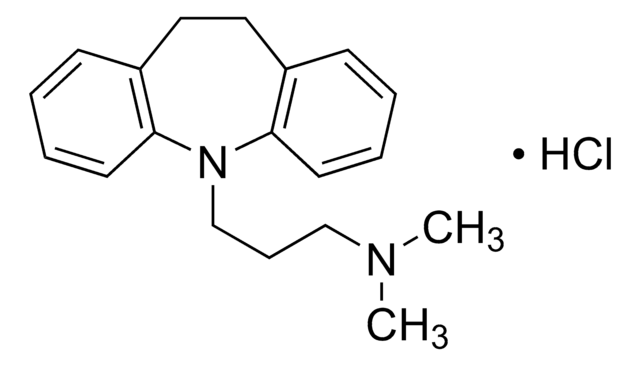
CAS Number113-52-0
SynonymsJanimine (hydrochloride); 3-(10,11-Dihydro-5H-dibenzo[b,f]azepin-5-yl)-N,N-dimethyl-1-propanamine hydrochloride (1:1); 5H-dibenz[b,f]azepine-5-propanamine, 10,11-dihydro-N,N-dimethyl-, monohydrochloride; 3-(10,11-dihydro-5H-dibenzo[b,f]azepin-5-yl)-N,N-dimethylpropan-1-amine hydrochloride; Imipramine hydrochloride; MFCD00012669; EINECS 204-030-7; 5H-Dibenz[b,f]azepine, 5-[3- (dimethylamino)propyl]-10,11-dihydro-, monohydrochloride; 3-(10,11-Dihydro-5H-dibenzo[b,f]azepin-5-yl)-N,N-dimethylpropan-1-aminhydrochlorid; Melipramine hydrochloride; Melipramine HCl; 3-(10,11-Dihydro-5H-dibenzo[b,f]azepin-5-yl)-N,N-dimethylpropan-1-amine hydrochloride (1:1); N-(γ-Dimethylaminopropyl)iminodibenzyl hydrochloride; 3-(10,11-dihydro-5H-dibenzo[b,f]azépin-5-yl)-N,N-diméthylpropan-1-amine chlorhydrate; Tof
Molecular FormulaC19H25ClN2
Molecular Weight316.87
Purity98%
Density1.041g/cm3
Boiling Point403.1ºC at 760mmHg
Melting Point168-1700C
Appearanceliquid
EINECS200-659-6
Symbol
Signal WordWarning
| Chemical & Physical Properties | |
|---|---|
| CAS Number | 113-52-0 |
| Catalog No. | 2A-9008026 |
| Chinese Name | 丙咪嗪盐酸盐 |
| Synonyms | Janimine (hydrochloride); 3-(10,11-Dihydro-5H-dibenzo[b,f]azepin-5-yl)-N,N-dimethyl-1-propanamine hydrochloride (1:1); 5H-dibenz[b,f]azepine-5-propanamine, 10,11-dihydro-N,N-dimethyl-, monohydrochloride; 3-(10,11-dihydro-5H-dibenzo[b,f]azepin-5-yl)-N,N-dimethylpropan-1-amine hydrochloride; Imipramine hydrochloride; MFCD00012669; EINECS 204-030-7; 5H-Dibenz[b,f]azepine, 5-[3- (dimethylamino)propyl]-10,11-dihydro-, monohydrochloride; 3-(10,11-Dihydro-5H-dibenzo[b,f]azepin-5-yl)-N,N-dimethylpropan-1-aminhydrochlorid; Melipramine hydrochloride; Melipramine HCl; 3-(10,11-Dihydro-5H-dibenzo[b,f]azepin-5-yl)-N,N-dimethylpropan-1-amine hydrochloride (1:1); N-(γ-Dimethylaminopropyl)iminodibenzyl hydrochloride; 3-(10,11-dihydro-5H-dibenzo[b,f]azépin-5-yl)-N,N-diméthylpropan-1-amine chlorhydrate; Tof |
| Molecular Formula | C19H25ClN2 |
| Molecular Weight | 316.87 |
| Purity | 98 |
| Density | 1.041g/cm3 |
| Boiling Point | 403.1ºC at 760mmHg |
| Melting Point | 168-1700C |
| Appearance | liquid |
| Water Solubility | H2O: 50 mg/mL |
| Storage Condition | 2-8°C |
| Application | Imipramine hydrochloride inhibits serotonin, with an IC50 value of 32 nM in in vivo testing. |
| EINECS | 200-659-6 |
| SMILES | Cl.CN(C)CCCN1c2ccccc2CCc3ccccc13 |
| InChI | 1S/C19H24N2.ClH/c1-20(2)14-7-15-21-18-10-5-3-8-16(18)12-13-17-9-4-6-11-19(17)21;/h3-6,8-11H,7,12-15H2,1-2H3;1H |
| InChI Key | XZZXIYZZBJDEEP-UHFFFAOYSA-N |
| NACRES Code | NA.24 |
| UNSPSC | 41116107 |
| Hazard Symbols | Transport |
| MSDS | msds/8026_1_113_52_0.pdf |
| Bioactivity | Imipramine hydrochloride inhibits serotonin transporter with an IC50 value of 32 nM in vitro. Related Catalog Signaling Pathways >> Neuronal Signaling >> Serotonin Transporter Research Areas >> Neurological Disease Target IC50: 32 nM (serotonin)[1] In Vitro Depression-like behavior is often complicated by chronic pain. Antidepressants including imipramine are widely used to treat chronic pain, but the mechanisms are not fully understood[2]. Imipramine (IC50=32 nM) and desipramine (IC50=160 nM) are found to be potent inhibitors of the human placental serotonin transporter[1]. In Vivo Administration of imipramine reverses social avoidance behavior, significantly increasing the interaction time. 24 days of imipramine treatment in RSD mice significantly decreases stress-induced mRNA levels for IL-6 in brain microglia[3]. Chronic mild stress induces a long-term altered gene expression profile in the prefrontal cortex that is partially reverted by imipramine treatment (10mg/kg, i.p.)[4]. Chronic imipramine administration alteres the amino acid dynamics in the brain. In the striatum, the concentrations of asparagine, glutamine and methionine are significantly increased by chronic imipramine administration. In the thalamus and hypothalamus, chronic imipramine administration significantly decreased the valine concentration[5]. Imipramine reduces pain-related negative emotion without influencing pain and that this effect is diminished by denervation of 5-HT neurons and by anti-BDNF treatment. Imipramine also normalizes derangement of ERK/CREB coupling, which leads to induction of BDNF. This suggests a possible interaction between 5-HT and BDNF[2]. Imipramine treatment counteracts the corticosterone administration-induced increase in the reactivity of rat CA3 hippocampal circuitry to the activation of the 5-HT receptor[6]. Animal Admin Rats: The Wistar (WIS) and Wistar Kyoto (WKY) rats are divided into four groups: (1) a control WIS rat group, (2) an imipramine-treated WIS rat group, (3) a control WKY rat group and (4) an imipramine-treated WKY rat group. Distilled water (10 mL/kg) or imipramine solution (10 mg/10 mL/kg) is orally administered for 28 days except on the day of the open field test, when nothing is administered in order to avoid the acute effect of single administration on the open field test[5]. Mice: C57BL/6 mice subjected to repeated social defeat (RSD), home cage control (HCC) are randomLy selected into four groups: RSD/imipramine, RSD/vehicle, HCC/imipramine, and HCC/vehicle. Mice in the RSD/imipramine received daily intraperitoneal (i.p.) injections of imipramine (20 mg/kg) for 24 days after the 6 cycles of RSD. HCC/imipramine received daily i.p. imipramine at the same dose while RSD/vehicle and HCC/vehicle groups received i.p. injections of vehicle (sodium chloride, 0.9%) for 24 days at the same time point[3]. References [1]. Balkovetz DF, et al. Evidence for an imipramine-sensitive serotonin transporter in human placental brush-border membranes. J Biol Chem. 1989 Feb 5;264(4):2195-8. [2]. Yasuda S, et al. Imipramine ameliorates pain-related negative emotion via induction of brain-derived neurotrophic factor. Cell Mol Neurobiol. 2014 Nov;34(8):1199-208. [3]. Ramirez K, et al. Imipramine attenuates neuroinflammatory signaling and reverses stress-induced social avoidance. Brain Behav Immun. 2015 May;46:212-20. [4]. Erburu M, et al. Chronic mild stress and imipramine treatment elicit opposite changes in behavior and in gene expression in the mouse prefrontal cortex. Pharmacol BiochemBehav. 2015 Aug;135:227-36. [5]. Nagasawa M, et al. Chronic imipramine treatment differentially alters the brain and plasma amino acid metabolism in Wistar and Wistar Kyoto rats. Eur J Pharmacol. 2015 Sep 5;762:127-35. [6]. Tokarski K, et al. Imipramine counteracts corticosterone-induced alterations in the effects of the activation of 5-HT(7) receptors in rat hippocampus. J Physiol Pharmacol. 2009 Jun;60(2):83-8. Chemical & Physical Properties Density 1.041g/cm3 Boiling Point 403.1ºC at 760mmHg Melting Point 168-1700C Molecular Formula C19H25ClN2 Molecular Weight 316.868 Flash Point 179.7ºC Exact Mass 316.170624 PSA 6.48000 LogP 4.74200 Appearance of Characters crystalline | white Vapour Pressure 6.6E-06mmHg at 25°C InChIKey XZZXIYZZBJDEEP-UHFFFAOYSA-N SMILES CN(C)CCCN1c2ccccc2CCc2ccccc21.Cl Storage condition 2-8°C Water Solubility H2O: 50 mg/mL |
| Use of | Imipramine hydrochloride inhibits serotonin transporter with an IC50 value of 32 nM in vitro. Properties Articles58 Name imipramine hydrochloride Synonym More Synonyms Imipramine hydrochloride Biological Activity Description Imipramine hydrochloride inhibits serotonin transporter with an IC50 value of 32 nM in vitro. Related Catalog Signaling Pathways >> Neuronal Signaling >> Serotonin Transporter Research Areas >> Neurological Disease IC50: 32 nM (serotonin)[1] In Vitro Depression-like behavior is often complicated by chronic pain. Antidepressants including imipramine are widely used to treat chronic pain, but the mechanisms are not fully understood[2]. Imipramine (IC50=32 nM) and desipramine (IC50=160 nM) are found to be potent inhibitors of the human placental serotonin transporter[1]. References [1]. Balkovetz DF, et al. Evidence for an imipramine-sensitive serotonin transporter in human placental brush-border membranes. J Biol Chem. 1989 Feb 5;264(4):2195-8. [2]. Yasuda S, et al. Imipramine ameliorates pain-related negative emotion via induction of brain-derived neurotrophic factor. Cell Mol Neurobiol. 2014 Nov;34(8):1199-208. [3]. Ramirez K, et al. Imipramine attenuates neuroinflammatory signaling and reverses stress-induced social avoidance. Brain Behav Immun. 2015 May;46:212-20. [4]. Erburu M, et al. Chronic mild stress and imipramine treatment elicit opposite changes in behavior and in gene expression in the mouse prefrontal cortex. Pharmacol BiochemBehav. 2015 Aug;135:227-36. [5]. Nagasawa M, et al. Chronic imipramine treatment differentially alters the brain and plasma amino acid metabolism in Wistar and Wistar Kyoto rats. Eur J Pharmacol. 2015 Sep 5;762:127-35. [6]. Tokarski K, et al. Imipramine counteracts corticosterone-induced alterations in the effects of the activation of 5-HT(7) receptors in rat hippocampus. J Physiol Pharmacol. 2009 Jun;60(2):83-8. Chemical & Physical Properties Exact Mass 316.170624 PSA 6.48000 LogP 4.74200 Appearance of Characters crystalline | white InChIKey XZZXIYZZBJDEEP-UHFFFAOYSA-N |
| Transport Info | Shipping Name: UN |
| MSDS Transport Info | Module 14. Shipping information 14.1 UN dangerous goods number European Land Transport Dangerous Regulations: -International Maritime Dangerous Regulations: -International Air Transport Dangerous Regulations: - 14.2 United Nations shipping name European Land Transport Dangerous Regulations: Non-dangerous goods IMDG Code: Non-dangerous goods International air transport dangerous goods regulations: non-dangerous goods 14.3 Transport hazard categories European Land Transport Dangerous Regulations: -International Maritime Dangerous Regulations: -International Air Transport Dangerous Regulations: - 14.4 Package group European Land Transport Dangerous Regulations: -International Maritime Dangerous Regulations: -International Air Transport Dangerous Regulations: - 14.5 Environmental hazards European Land Transport Danger Regulations: No International Maritime Danger Regulations International Air Transport Danger Regulations: No Marine pollutants (yes/no): No 14.6 Special reminder to users No data available The above information is believed to be correct, but is not all-inclusive and should be used as a guide only. The information in this document is based on our current knowledge and is Correct safety instructions apply to this product. This information does not represent a warranty as to the properties of this product. See reverse side of invoice or packing slip. |
| Related Products in API & Advanced Intermediates | ||
|---|---|---|
| Famotidine | 76824-35-6 | 2A-9007799 |
| Fluticasone propiponate | 80474-14-2 | 2A-9007816 |
| Hydrocortisone butyrate | 13609-67-1 | 2A-9008009 |
| Hydrocortisone sodium phosphate | 6000-74-4 | 2A-9008010 |
| Hydrocortisone succinate | 2203-97-6 | 2A-9008011 |
| Ketoprofen lysinate | 57469-78-0 | 2A-9008083 |
| Medroxyprogesterone acetate | 71-58-9 | 2A-9008181 |
| Methylparoxetine | 110429-36-2 | 2A-9008308 |
| Methylprednisolone acetate | 53-36-1 | 2A-9008309 |
| Nandrolone decanoate | 360-70-3 | 2A-9008470 |
| Browse all API & Advanced Intermediates products » | ||
Phone:
630-322-8886
630-322-8887
Email:
Office Locations:
Chicago, IL, USA
San Francisco, CA, USA


 EN
EN


 SDS
SDS