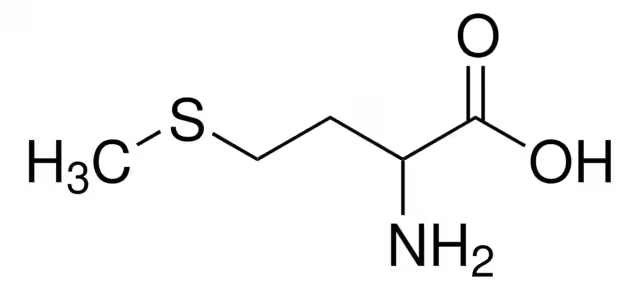
CAS Number59-51-8
SynonymsMeonine; MFCD00063097; Metion; DL-2-Amino-4-(methylthio)butanoic acid; Neston; Urimeth; Metione; Dyprin; MET; Amurex; Cynaron; L-MET; EINECS 200-432-1
Molecular FormulaCH3SCH2CH2CH(NH2)COOH
Molecular Weight149.21
Purity≥99%
Density1.2±0.1 g/cm3
Boiling Point306.9±37.0 °C at 760 mmHg
Melting Point280 °C (dec.) (lit.)
Appearancepowder
EINECS200-432-1
Symbol
Signal WordWarning
| Chemical & Physical Properties | |
|---|---|
| CAS Number | 59-51-8 |
| Catalog No. | 2A-9016818 |
| Chinese Name | DL-蛋氨酸 |
| Synonyms | Meonine; MFCD00063097; Metion; DL-2-Amino-4-(methylthio)butanoic acid; Neston; Urimeth; Metione; Dyprin; MET; Amurex; Cynaron; L-MET; EINECS 200-432-1 |
| Molecular Formula | CH3SCH2CH2CH(NH2)COOH |
| Molecular Weight | 149.21 |
| Purity | ≥99 |
| Density | 1.2±0.1 g/cm3 |
| Boiling Point | 306.9±37.0 °C at 760 mmHg |
| Melting Point | 280 °C (dec.) (lit.) |
| Appearance | powder |
| Water Solubility | 1 M HCl: 0.5 M at 20 °C, clear, colorless | 2.9 g/ |
| Storage Condition | Store sealed and away from light. |
| Application | DL-Methionine is an essential amino acid containing sulfur and has oxidative stress defense effects. DL-Methionine can be used as a natural feed for animals and also kills potato wireworm (H. rostochi |
| EINECS | 200-432-1 |
| HTC | 2930400000 |
| PubChem ID | 24897336 |
| MDL Number | MFCD00063096 |
| SMILES | CSCCC(N)C(O)=O |
| InChI | 1S/C5H11NO2S/c1-9-3-2-4(6)5(7)8/h4H,2-3,6H2,1H3,(H,7,8) |
| InChI Key | FFEARJCKVFRZRR-UHFFFAOYSA-N |
| Beilstein/REAXYS | 636185 |
| NACRES Code | NA.26 |
| UNSPSC | 12352209 |
| Hazard Symbols | Transport |
| Safety Description | S24/25 |
| MSDS | msds/16818_1_59_51_8.pdf |
| Bioactivity | DL-Methionine is an essential amino acid containing sulfur with oxidative stress defense effects. DL-Methionine can be used for animal natural feed. DL-Methionine also kills H. rostochiensis on potato plants[1][2][3]. Related Catalog Research Areas >> Infection Research Areas >> Inflammation/Immunology Target H. rostochiensis[1] In Vitro The impact of DL-Methionine supplementation on animal performance interacts strongly with the crude protein (CP) content of the diet. Supplementation of DLM to a 20% crude protein diet for broilers reduces their abdominal fat weight, whereas this is not the case when the diet contained 23% CP. Breast meat yield is increased and abdominal fat content is decreased with increasing DL-Methionine supplementation, and this response is more pronounced in chickens reared on a diet with a lower protein level (20.5% CP) compared with a higher protein level (26%)[2]. In Vivo DL-methionine significantly decreases the numbers of males, females, cysts and eggs of H. rostochiensis on potato plants. DL-methionine kills almost all the nematodes when applied 3 days after inoculation, and DL-methionine does not affect plant growth adversely[1]. References [1]. K. evans, et al. Effects of amino acids on the reproduction of Heterodera rostochiensis. Nematologica, 1971, 17(4), 495-500. [2]. Swennen Q, et al. Effects of dietary protein content and 2-hydroxy-4-methylthiobutanoic acid or DL-methionine supplementation on performance and oxidative status of broiler chickens. Br J Nutr. 2011 Dec;106(12):1845-54. [3]. Garlich JD. Response of broilers to DL-methionine hydroxy analog free acid, DL-methionine, and L-methionine. Poult Sci. 1985 Aug;64(8):1541-8. Chemical & Physical Properties Density 1.2±0.1 g/cm3 Boiling Point 306.9±37.0 °C at 760 mmHg Melting Point 270-273ºC Molecular Formula C5H11NO2S Molecular Weight 149.211 Flash Point 139.4±26.5 °C Exact Mass 149.051056 PSA 88.62000 LogP 0.37 Vapour Pressure 0.0±1.4 mmHg at 25°C Index of Refraction 1.531 InChIKey FFEARJCKVFRZRR-UHFFFAOYSA-N SMILES CSCCC(N)C(=O)O Storage condition 0-6°C Stability Stable. Incompatible with strong oxidising agents. Water Solubility 1 M HCl: 0.5 M at 20 °C, clear, colorless | 2.9 g/100 mL (20 ºC) |
| Use of | DL-Methionine is an essential amino acid containing sulfur with oxidative stress defense effects. DL-Methionine can be used for animal natural feed. DL-Methionine also kills H. rostochiensis on potato plants[1][2][3]. Properties Articles307 Name methionine Synonym More Synonyms DL-Methionine Biological Activity Description DL-Methionine is an essential amino acid containing sulfur with oxidative stress defense effects. DL-Methionine can be used for animal natural feed. DL-Methionine also kills H. rostochiensis on potato plants[1][2][3]. Related Catalog Research Areas >> Infection Research Areas >> Inflammation/Immunology H. rostochiensis[1] In Vitro The impact of DL-Methionine supplementation on animal performance interacts strongly with the crude protein (CP) content of the diet. Supplementation of DLM to a 20% crude protein diet for broilers reduces their abdominal fat weight, whereas this is not the case when the diet contained 23% CP. Breast meat yield is increased and abdominal fat content is decreased with increasing DL-Methionine supplementation, and this response is more pronounced in chickens reared on a diet with a lower protein level (20.5% CP) compared with a higher protein level (26%)[2]. In Vivo DL-methionine significantly decreases the numbers of males, females, cysts and eggs of H. rostochiensis on potato plants. DL-methionine kills almost all the nematodes when applied 3 days after inoculation, and DL-methionine does not affect plant growth adversely[1]. References [1]. K. evans, et al. Effects of amino acids on the reproduction of Heterodera rostochiensis. Nematologica, 1971, 17(4), 495-500. [2]. Swennen Q, et al. Effects of dietary protein content and 2-hydroxy-4-methylthiobutanoic acid or DL-methionine supplementation on performance and oxidative status of broiler chickens. Br J Nutr. 2011 Dec;106(12):1845-54. [3]. Garlich JD. Response of broilers to DL-methionine hydroxy analog free acid, DL-methionine, and L-methionine. Poult Sci. 1985 Aug;64(8):1541-8. Chemical & Physical Properties Molecular Formula C5H11NO2S Exact Mass 149.051056 PSA 88.62000 Index of Refraction 1.531 InChIKey FFEARJCKVFRZRR-UHFFFAOYSA-N SMILES CSCCC(N)C(=O)O Stability Stable. Incompatible with strong oxidising agents. |
| Transport Info | Shipping Name: UN |
| MSDS Transport Info | Module 14. Shipping information 14.1 UN dangerous goods number European Land Transport Dangerous Regulations: -International Maritime Dangerous Regulations: -International Air Transport Dangerous Regulations: - 14.2 United Nations shipping name European Land Transport Dangerous Regulations: Non-dangerous goods IMDG Code: Non-dangerous goods International air transport dangerous goods regulations: non-dangerous goods 14.3 Transport hazard categories European Land Transport Dangerous Regulations: -International Maritime Dangerous Regulations: -International Air Transport Dangerous Regulations: - 14.4 Package group European Land Transport Dangerous Regulations: -International Maritime Dangerous Regulations: -International Air Transport Dangerous Regulations: - 14.5 Environmental hazards European Land Transport Danger Regulations: No International Maritime Danger Regulations International Air Transport Danger Regulations: No Marine pollutants (yes/no): No 14.6 Special reminder to users No data available |
| Related Products in Specialty Chemicals | ||
|---|---|---|
| 2-Quinolinol | 59-31-4 | 2A-9016807 |
| Chloropyramine | 59-32-5 | 2A-9016808 |
| Mepyramine maleate | 59-33-6 | 2A-9016809 |
| Procaine | 59-46-1 | 2A-9016814 |
| Chlorocresol | 59-50-7 | 2A-9016817 |
| Prosultiamine | 59-58-5 | 2A-9016820 |
| Furacilin; Nitrofurazone | 59-87-0 | 2A-9016823 |
| Tolazoline hydrochloride | 59-97-2 | 2A-9016826 |
| Dithizone | 60-10-6 | 2A-9016830 |
| 2-Aminoethanethiol | 60-23-1 | 2A-9016835 |
| Browse all Specialty Chemicals products » | ||
Phone:
630-322-8886
630-322-8887
Email:
Office Locations:
Chicago, IL, USA
San Francisco, CA, USA


 EN
EN


 SDS
SDS