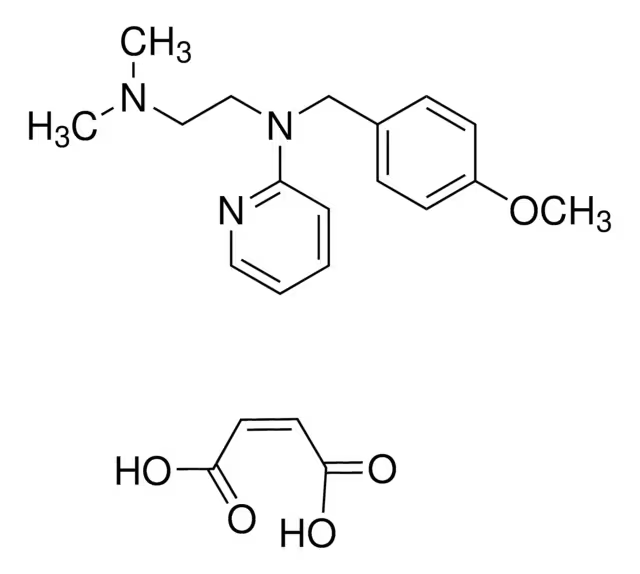
| Chemical & Physical Properties | |
|---|---|
| CAS Number | 59-33-6 |
| Catalog No. | 2A-9016809 |
| Chinese Name | 马来酸吡拉明 |
| Synonyms | EINECS 200-422-7; pyrilamine maleate; MFCD00069333; Mepyramine maleate |
| Molecular Formula | C21H27N3O5 |
| Molecular Weight | 401.46 |
| Purity | 98.00 |
| Boiling Point | 423.8ºC at 760 mmHg |
| Melting Point | 100-101ºC |
| Appearance | powder |
| Water Solubility | Water solubility: soluble |
| Storage Condition | This product should be sealed and stored in a cool |
| Application | Mepyramine maleate is a first-generation antihistamine and a histamine H1 receptor antagonist. The Kd values for H1, H2 and H3 receptors are 0.8 nM, 5200 nM and >3000 nM respectively. The pKd value |
| EINECS | 200-422-7 |
| HTC | 2933399090 |
| PubChem ID | 24277797 |
| MDL Number | MFCD00069333 |
| SMILES | OC(=O)\C=C/C(O)=O.COc1ccc(CN(CCN(C)C)c2ccccn2)cc1 |
| InChI | 1S/C17H23N3O.C4H4O4/c1-19(2)12-13-20(17-6-4-5-11-18-17)14-15-7-9-16(21-3)10-8-15;5-3(6)1-2-4(7)8/h4-11H,12-14H2,1-3H3;1-2H,(H,5,6)(H,7,8)/b;2-1- |
| InChI Key | JXYWFNAQESKDNC-BTJKTKAUSA-N |
| NACRES Code | NA.77 |
| UNSPSC | 12352116 |
| Hazard Symbols | Transport |
| Risk Codes | R22;R36/37/38 |
| Safety Description | S26;S36/37 |
| MSDS | msds/16809_1_59_33_6.pdf |
| Bioactivity | Mepyramine maleate, a first generation antihistamine, is an antagonist of histamine H1 receptor, with Kds of 0.8 nM, 5200 nM and >3000 nM for H1, H2, and H3 receptor, respectively, and a pKd of 9.4 for H1 receptor. Related Catalog Signaling Pathways >> GPCR/G Protein >> Histamine Receptor Signaling Pathways >> Immunology/Inflammation >> Histamine Receptor Research Areas >> Neurological Disease Target Kd: 0.8 nM (Histamine H1 receptor), 5200 nM (Histamine H2 receptor), >3000 nM (Histamine H3 receptor)[1] pKd: 9.4 (Histamine H1 receptor)[2] In Vitro Mepyramine maleate is an antagonist of histamine H1 receptor, with Kds of 0.8 nM, 5200 nM and >3000 nM for H1, H2, and H3 receptor, respectively[1], and a pKd of 9.4 for H1 receptor[2]. Mepyramine binds to the H1 receptor with different Kds in Guinea pig brain (0.8 nM), rat brain (9.1 nM) and DDT1-MF-2 and BC3H1 cell (276 nM)[1]. Mepyramine decreases the InsP levels in CHO-gpH1 cells, with log EC50 of -7.94 ± 0.11, and reduces the the maximal response to ATP in CHO-gpH1 cells[3]. In Vivo Mepyramine obviously decreases the second phase of nociceptive response via i.p at 10 and 20 mg/kg, but shows no significant effect at 5 mg/kg in rats[4]. Cell Assay Briefly, cells are seeded in 24-well cluster dishes and cultured for 24 h (70-80% confluence) in DMEM. Cells are then washed, and the medium is replaced for DMEM without calf serum plus the addition of myo-[3H]inositol (2 μCi/mL) and cultured for 24 h. Thereafter, the medium is aspirated and replaced with DMEM without calf serum containing 10 mM LiCl and incubated for 20 min. Cells are then stimulated for 20 min with histamine in concentrations ranging from 1 nM to 100 μM in a final volume of 300 μL in the presence or absence of [3H]inositol the concentrations indicated in each particular experiment. The incubation is stopped by the addition of 900 μL of cold chloroform, methanol, 0.12 M HCl (1:2:1 v/v, freshly prepared), and phases are split by the addition of 300 μL of water and 300 μL of chloroform. The mixture is then centrifuged at 1500 × g for 10 min, and the total water-soluble inositol phosphate fraction is purified by anion exchange chromatography. Radioactivity of the eluted fractions is measured using a liquid scintillation counter. Results are expressed as the ratio obtained when total [3H]inositol phosphate radioactivity is normalized to total [3H]inositol radioactivity recovered from the initial water wash of the columns[3]. Animal Admin Rats[4] Healthy adult male albino Wistar rats weighing 200-220 g are maintained in polypropylene cages with 6 rats in each cage with food and water available ad libitum. Mepyramine is dissolved in normal saine. Mepyramine at doses of 5, 10, and 20 mg/kg and intraperitoneally injected 30 min before induction of nociception. Physostigmine at doses of 0.05, 0.1, and 0.2 mg/kg, and atropine at a dose of 2 mg/kg, are subcutaneously administered 20 and 40 min before induction of formalin-induced pain, respectively. Atropine (2 mg/kg, s.c.) is injected 20 min before subcutaneous injection of physostigmine (0.1 mg/kg). In combined treatment, intraperitoneal injections of mepyramine (10 mg/kg) and famotidine (20 mg/kg) are performed 10 min before physostigmine (0.1 mg/kg, s.c.) and 10 min after atropine (0.2 mg/kg, s.c.) administrations. Drug solutions are intraperitoneally injected in a volum of 1 mL/kg, using a 25-gauge injection needle. Subcutaneous injections of drug solutions are perfoemed in a constant volume 0.2 mL per rat at the neck region using a 27-gauge injection needle[4]. References [1]. Hill SJ. Distribution, properties, and functional characteristics of three classes of histamine receptor. Pharmacol Rev. 1990 Mar;42(1):45-83. [2]. van der Goot H1, et al. Selective ligands as tools to study histamine receptors. Eur J Med Chem. 2000 Jan;35(1):5-20. [3]. Fitzsimons CP, et al. Mepyramine, a histamine H1 receptor inverse agonist, binds preferentially to a G protein-coupled form of the receptor and sequesters G protein. J Biol Chem. 2004 Aug 13;279(33):34431-9. [4]. Mojtahedin A, et al. Effects of mepyramine and famotidine on the physostigmine-induced antinociception in the formalin test in rats. Pak J Biol Sci. 2008 Nov 15;11(22):2573-8. Chemical & Physical Properties Boiling Point 423.8ºC at 760 mmHg Melting Point 100-101ºC Molecular Formula C21H27N3O5 Molecular Weight 401.45600 Flash Point 210.1ºC Exact Mass 401.19500 PSA 103.20000 LogP 2.37020 InChIKey JXYWFNAQESKDNC-BTJKTKAUSA-N SMILES COc1ccc(CN(CCN(C)C)c2ccccn2)cc1.O=C(O)C=CC(=O)O Storage condition 2-8°C Stability Stability Combustible. Incompatible with strong oxidizing agents. |
| Use of | Mepyramine maleate, a first generation antihistamine, is an antagonist of histamine H1 receptor, with Kds of 0.8 nM, 5200 nM and >3000 nM for H1, H2, and H3 receptor, respectively, and a pKd of 9.4 for H1 receptor. Properties Articles14 Name Pyrilamine Maleate Salt Synonym More Synonyms Pyrilamine Maleate Salt Biological Activity Description Mepyramine maleate, a first generation antihistamine, is an antagonist of histamine H1 receptor, with Kds of 0.8 nM, 5200 nM and >3000 nM for H1, H2, and H3 receptor, respectively, and a pKd of 9.4 for H1 receptor. Related Catalog Signaling Pathways >> GPCR/G Protein >> Histamine Receptor Signaling Pathways >> Immunology/Inflammation >> Histamine Receptor Research Areas >> Neurological Disease Kd: 0.8 nM (Histamine H1 receptor), 5200 nM (Histamine H2 receptor), >3000 nM (Histamine H3 receptor)[1] pKd: 9.4 (Histamine H1 receptor)[2] References [1]. Hill SJ. Distribution, properties, and functional characteristics of three classes of histamine receptor. Pharmacol Rev. 1990 Mar;42(1):45-83. [2]. van der Goot H1, et al. Selective ligands as tools to study histamine receptors. Eur J Med Chem. 2000 Jan;35(1):5-20. [3]. Fitzsimons CP, et al. Mepyramine, a histamine H1 receptor inverse agonist, binds preferentially to a G protein-coupled form of the receptor and sequesters G protein. J Biol Chem. 2004 Aug 13;279(33):34431-9. [4]. Mojtahedin A, et al. Effects of mepyramine and famotidine on the physostigmine-induced antinociception in the formalin test in rats. Pak J Biol Sci. 2008 Nov 15;11(22):2573-8. Chemical & Physical Properties Molecular Formula C21H27N3O5 Exact Mass 401.19500 PSA 103.20000 LogP 2.37020 InChIKey JXYWFNAQESKDNC-BTJKTKAUSA-N Stability Stability Combustible. Incompatible with strong oxidizing agents. |
| Tax Rebate | 13.0% |
| Supervision | None. MFN tariff: 6.5%. Ordinary tariff: 20.0% |
| Transport Info | Shipping Name: UN |
| MSDS Transport Info | Module 14. Shipping information 14.1 UN dangerous goods number European Land Transport Dangerous Regulations: -International Maritime Dangerous Regulations: -International Air Transport Dangerous Regulations: - 14.2 United Nations shipping name European Land Transport Dangerous Regulations: Non-dangerous goods IMDG Code: Non-dangerous goods International air transport dangerous goods regulations: non-dangerous goods 14.3 Transport hazard categories European Land Transport Dangerous Regulations: -International Maritime Dangerous Regulations: -International Air Transport Dangerous Regulations: - 14.4 Package group European Land Transport Dangerous Regulations: -International Maritime Dangerous Regulations: -International Air Transport Dangerous Regulations: - 14.5 Environmental hazards European Land Transport Danger Regulations: No International Maritime Danger Regulations International Air Transport Danger Regulations: No Marine pollutants (yes/no): No 14.6 Special reminder to users No data available |
| Related Products in Specialty Chemicals | ||
|---|---|---|
| Lindane | 58-89-9 | 2A-9016794 |
| D-alpha-Tocopheryl acetate | 58-95-7 | 2A-9016797 |
| D-Galactose | 59-23-4 | 2A-9016805 |
| 2-Quinolinol | 59-31-4 | 2A-9016807 |
| Chloropyramine | 59-32-5 | 2A-9016808 |
| Procaine | 59-46-1 | 2A-9016814 |
| Chlorocresol | 59-50-7 | 2A-9016817 |
| DL-Methionine | 59-51-8 | 2A-9016818 |
| Prosultiamine | 59-58-5 | 2A-9016820 |
| Furacilin; Nitrofurazone | 59-87-0 | 2A-9016823 |
| Browse all Specialty Chemicals products » | ||
Phone:
630-322-8886
630-322-8887
Email:
Office Locations:
Chicago, IL, USA
San Francisco, CA, USA


 EN
EN


 SDS
SDS