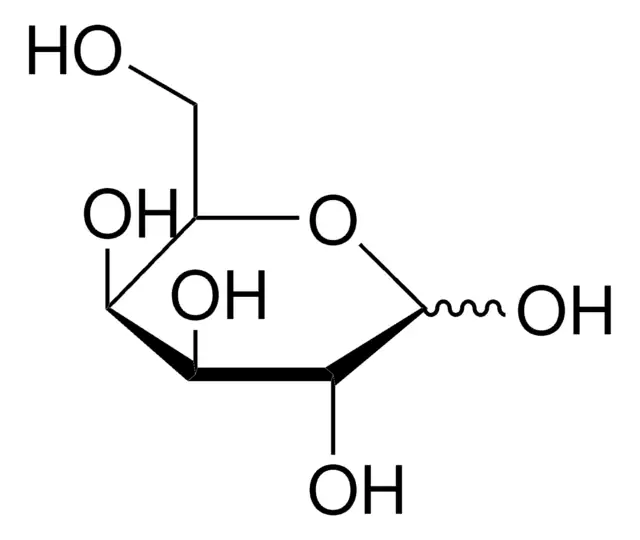
CAS Number59-23-4
SynonymsBRAIN SUGAR; galactos; EINECS 200-416-4; D-(+)-Galactose; Dextrogalactose; (+)-Galactose; MFCD00871336; Gal; d-galactos; D(+)-Galactose; (+)-aldehydo-D-galactose; D(+)-Glactose; aldehydo-D-galactose; Lactoglucose; cerebrose; MaltaseHydrate; Galactose; D-Galactose
Molecular FormulaC6H12O6
Molecular Weight180.16
Purity≥99 (HPLC)%
Density1.6±0.1 g/cm3
Boiling Point527.1±50.0 °C at 760 mmHg
Melting Point168-170 °C (lit.)
Appearancepowder
EINECS200-416-4
Symbol
Signal WordWarning
| Chemical & Physical Properties | |
|---|---|
| CAS Number | 59-23-4 |
| Catalog No. | 2A-9016805 |
| Chinese Name | 半乳糖 |
| Synonyms | BRAIN SUGAR; galactos; EINECS 200-416-4; D-(+)-Galactose; Dextrogalactose; (+)-Galactose; MFCD00871336; Gal; d-galactos; D(+)-Galactose; (+)-aldehydo-D-galactose; D(+)-Glactose; aldehydo-D-galactose; Lactoglucose; cerebrose; MaltaseHydrate; Galactose; D-Galactose |
| Molecular Formula | C6H12O6 |
| Molecular Weight | 180.16 |
| Purity | ≥99 (HPLC) |
| Density | 1.6±0.1 g/cm3 |
| Boiling Point | 527.1±50.0 °C at 760 mmHg |
| Melting Point | 168-170 °C (lit.) |
| Appearance | powder |
| Water Solubility | H2O: 100 mg/mL |
| Storage Condition | This product should be kept sealed and dry. |
| Application | D-Galactose is a natural hexose sugar, the C-4 epimer of glucose. |
| EINECS | 200-416-4 |
| HTC | 29400090 |
| PubChem ID | 24895207 |
| MDL Number | MFCD00151230 |
| SMILES | OC[C@@H](O)[C@H](O)[C@H](O)[C@@H](O)C=O |
| InChI | 1S/C6H12O6/c7-1-3(9)5(11)6(12)4(10)2-8/h1,3-6,8-12H,2H2/t3-,4+,5+,6-/m0/s1 |
| InChI Key | GZCGUPFRVQAUEE-KCDKBNATSA-N |
| Beilstein/REAXYS | 1724619 |
| NACRES Code | NA.21 |
| UNSPSC | 12352201 |
| Hazard Symbols | Transport |
| Safety Description | S22;S24/25 |
| MSDS | msds/16805_1_59_23_4.pdf |
| Bioactivity | D-Galactose is a natural aldohexose and C-4 epimer of glucose. Related Catalog Research Areas >> Neurological Disease Natural Products >> Saccharides and Glycosides Target Human Endogenous Metabolite In Vitro Galactose is important for the survival and virulence of bacteria. In Escherichia coli galactose is utilized by the Leloir pathway. Two anomers of d-galactose are used for different purposes, α-d-galactose as a carbon source and β-d-galactose for induction of UDP-galactose synthesis for biosynthetic glycosylation[1]. In Vivo Chronic D-galactose exposure induces neurodegeneration by enhancing caspase-mediated apoptosis and inhibiting neurogenesis and neuron migration in mice, as well as increasing oxidative damage. In addition, D-galactose-induced toxicity in mice is a useful model for studying the mechanisms of neurodegeneration and neuroprotective drugs and agents[2]. D-galactose given by oral route causes cognitive impairments in rats which are accompanied by oxidative damage. Cognitive impairments is observed in the open-field test in the 4th and 6th weeks after d-gal administration, as well as an impairment in spatial memory in the radial maze test after the 6th week of d-gal administration[3]. Animal Admin Rats: D-galactose is dissolved in water for administration at the dose of 100 mg/kg of body weight, and given by oral gavage, once a day, over a period of 1, 2, 4, 6 or 8 weeks. Animals are randomized into two groups: control animals (receiving water by oral gavage) or d-gal animals (receiving D-galactose by oral gavage). The behavioral tests and biochemical analysis are undertaken on the1st, 2nd, 4th, 6th and 8th weeks after the last administration of d-gal[3]. Mice: Male adult C57BL/6 mice are randomly divided into three groups (control, D-galactose, and D-galactose plus α-LA). D-galactose (100 mg/kg) is injected subcutaneously (s.c.) daily into mice for 7 weeks. α-LA (100 mg/kg body weight) is injected peritoneally (i.p.) daily concomitantly for 7 weeks. All control animals are given saline[2]. References [1]. Csiszovszki Z, et al. Structure and function of the D-galactose network in enterobacteria. MBio. 2011 Jun 28;2(4):e00053-11. [2]. Cui X, et al. Chronic systemic D-galactose exposure induces memory loss, neurodegeneration, and oxidativedamage in mice: protective effects of R-alpha-lipoic acid. J Neurosci Res. 2006 Aug 15;84(3):647-54. [3]. Budni J, et al. Oral administration of d-galactose induces cognitive impairments and oxidative damage in rats. Behav Brain Res. 2016 Apr 1;302:35-43. Chemical & Physical Properties Density 1.6±0.1 g/cm3 Boiling Point 527.1±50.0 °C at 760 mmHg Melting Point 168-170 °C(lit.) Molecular Formula C6H12O6 Molecular Weight 180.156 Flash Point 286.7±26.6 °C Exact Mass 180.063385 PSA 110.38000 LogP -3.17 Vapour Pressure 0.0±3.1 mmHg at 25°C Index of Refraction 1.573 Storage condition Store at RT. Water Solubility H2O: 100 mg/mL |
| Use of | D-Galactose is a natural aldohexose and C-4 epimer of glucose. Properties Articles218 Name D-Galactose Synonym More Synonyms D-Galactose Biological Activity Description D-Galactose is a natural aldohexose and C-4 epimer of glucose. Related Catalog Research Areas >> Neurological Disease Natural Products >> Saccharides and Glycosides Human Endogenous Metabolite In Vitro Galactose is important for the survival and virulence of bacteria. In Escherichia coli galactose is utilized by the Leloir pathway. Two anomers of d-galactose are used for different purposes, α-d-galactose as a carbon source and β-d-galactose for induction of UDP-galactose synthesis for biosynthetic glycosylation[1]. In Vivo Chronic D-galactose exposure induces neurodegeneration by enhancing caspase-mediated apoptosis and inhibiting neurogenesis and neuron migration in mice, as well as increasing oxidative damage. In addition, D-galactose-induced toxicity in mice is a useful model for studying the mechanisms of neurodegeneration and neuroprotective drugs and agents[2]. D-galactose given by oral route causes cognitive impairments in rats which are accompanied by oxidative damage. Cognitive impairments is observed in the open-field test in the 4th and 6th weeks after d-gal administration, as well as an impairment in spatial memory in the radial maze test after the 6th week of d-gal administration[3]. References [1]. Csiszovszki Z, et al. Structure and function of the D-galactose network in enterobacteria. MBio. 2011 Jun 28;2(4):e00053-11. [2]. Cui X, et al. Chronic systemic D-galactose exposure induces memory loss, neurodegeneration, and oxidativedamage in mice: protective effects of R-alpha-lipoic acid. J Neurosci Res. 2006 Aug 15;84(3):647-54. [3]. Budni J, et al. Oral administration of d-galactose induces cognitive impairments and oxidative damage in rats. Behav Brain Res. 2016 Apr 1;302:35-43. Chemical & Physical Properties Molecular Formula C6H12O6 Exact Mass 180.063385 PSA 110.38000 LogP -3.17 Index of Refraction 1.573 Storage condition Store at RT. |
| Transport Info | Shipping Name: UN |
| MSDS Transport Info | Module 14. Shipping information 14.1 UN dangerous goods number European Land Transport Dangerous Regulations: -International Maritime Dangerous Regulations: -International Air Transport Dangerous Regulations: - 14.2 United Nations shipping name European Land Transport Dangerous Regulations: Non-dangerous goods IMDG Code: Non-dangerous goods International air transport dangerous goods regulations: non-dangerous goods 14.3 Transport hazard categories European Land Transport Dangerous Regulations: -International Maritime Dangerous Regulations: -International Air Transport Dangerous Regulations: - 14.4 Package group European Land Transport Dangerous Regulations: -International Maritime Dangerous Regulations: -International Air Transport Dangerous Regulations: - 14.5 Environmental hazards European Land Transport Danger Regulations: No International Maritime Danger Regulations International Air Transport Danger Regulations: No Marine pollutants (yes/no): No 14.6 Special reminder to users No data available |
| Related Products in Specialty Chemicals | ||
|---|---|---|
| Angiotensin acetate | 58-49-1 | 2A-9016781 |
| Diphenhydramine | 58-73-1 | 2A-9016790 |
| D(+)-Xylose | 58-86-6 | 2A-9016793 |
| Lindane | 58-89-9 | 2A-9016794 |
| D-alpha-Tocopheryl acetate | 58-95-7 | 2A-9016797 |
| 2-Quinolinol | 59-31-4 | 2A-9016807 |
| Chloropyramine | 59-32-5 | 2A-9016808 |
| Mepyramine maleate | 59-33-6 | 2A-9016809 |
| Procaine | 59-46-1 | 2A-9016814 |
| Chlorocresol | 59-50-7 | 2A-9016817 |
| Browse all Specialty Chemicals products » | ||
Phone:
630-322-8886
630-322-8887
Email:
Office Locations:
Chicago, IL, USA
San Francisco, CA, USA


 EN
EN


 SDS
SDS