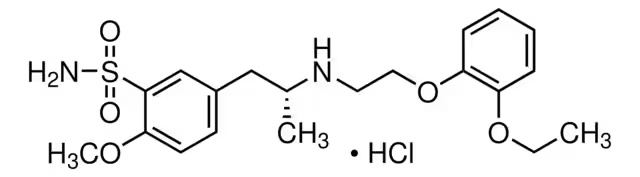
CAS Number106463-17-6
SynonymsTAMSULOSINHCL; TAMSOLUSIN HYDROCHLORIDE; YM 12617-1; (R)-Tamsulosin; (R)-5-(2-((2-(2-Ethoxyphenoxy)ethyl)amino)propyl)-2-methoxybenzenesulfonamide hydrochloride; 5-[(2R)-2-{[2-(2-Ethoxyphenoxy)ethyl]amino}propyl]-2-methoxybenzolsulfonamidhydrochlorid; Tamsulosin HCl; Tamsulosin hydrochloride; Yutanal; YM-617; 5-[(R)-2-[2-(2-Ethoxyphenoxy)ethylamino]propyl]]-2-methoxybenzenesulfonamide Hydrochloride; (R)-TAMSULOSIN HCL; 5-[(2R)-2-[[2-(2-Ethoxyphenoxy)ethyl]amino]propyl]-2-methoxybenzenesulfonamide hydrochloride; Yutana; TAMSULOSINE HYDROCHLORIDE; FLOMAX; benzenesulfonamide, 5-[(2R)-2-[[2-(2-ethoxyphenoxy)ethyl]amino]propyl]-2-methoxy-, monohydrochloride; TAMSULOSIN HYDROCHLORIDE , CERTIFIED REFERENCE MATERIAL; Tamsulosin (hydrochloride); MFCD00922997; PRADIF; (R)-TAMSULOSIN HYDROCHLORIDE,WH
Molecular FormulaC20H29ClN2O5S
Molecular Weight444.97
Purity99.5%
Boiling Point595.5ºC at 760 mmHg
Melting Point228-230ºC
AppearanceWhite to off-white solid
| Chemical & Physical Properties | |
|---|---|
| CAS Number | 106463-17-6 |
| Catalog No. | 2A-9012577 |
| Chinese Name | 盐酸坦索罗辛 |
| Synonyms | TAMSULOSINHCL; TAMSOLUSIN HYDROCHLORIDE; YM 12617-1; (R)-Tamsulosin; (R)-5-(2-((2-(2-Ethoxyphenoxy)ethyl)amino)propyl)-2-methoxybenzenesulfonamide hydrochloride; 5-[(2R)-2-{[2-(2-Ethoxyphenoxy)ethyl]amino}propyl]-2-methoxybenzolsulfonamidhydrochlorid; Tamsulosin HCl; Tamsulosin hydrochloride; Yutanal; YM-617; 5-[(R)-2-[2-(2-Ethoxyphenoxy)ethylamino]propyl]]-2-methoxybenzenesulfonamide Hydrochloride; (R)-TAMSULOSIN HCL; 5-[(2R)-2-[[2-(2-Ethoxyphenoxy)ethyl]amino]propyl]-2-methoxybenzenesulfonamide hydrochloride; Yutana; TAMSULOSINE HYDROCHLORIDE; FLOMAX; benzenesulfonamide, 5-[(2R)-2-[[2-(2-ethoxyphenoxy)ethyl]amino]propyl]-2-methoxy-, monohydrochloride; TAMSULOSIN HYDROCHLORIDE , CERTIFIED REFERENCE MATERIAL; Tamsulosin (hydrochloride); MFCD00922997; PRADIF; (R)-TAMSULOSIN HYDROCHLORIDE,WH |
| Molecular Formula | C20H29ClN2O5S |
| Molecular Weight | 444.97 |
| Purity | 99.5 |
| Boiling Point | 595.5ºC at 760 mmHg |
| Melting Point | 228-230ºC |
| Appearance | White to off-white solid |
| Storage Condition | Desiccate at RT |
| Packaging | Foil bag |
| Application | Tamsulosin hydrochloride (R-(-)-YM12617; LY253351) is a selective antagonist of α1 receptors. |
| PubChem ID | 329823437 |
| MDL Number | MFCD00922997 |
| SMILES | Cl.CCOc1ccccc1OCCN[C@H](C)Cc2ccc(OC)c(c2)S(N)(=O)=O |
| InChI | 1S/C20H28N2O5S.ClH/c1-4-26-17-7-5-6-8-18(17)27-12-11-22-15(2)13-16-9-10-19(25-3)20(14-16)28(21,23)24;/h5-10,14-15,22H,4,11-13H2,1-3H3,(H2,21,23,24);1H/t15-;/m1./s1 |
| InChI Key | ZZIZZTHXZRDOFM-XFULWGLBSA-N |
| NACRES Code | NA.24 |
| UNSPSC | 41116107 |
| MSDS | msds/12577_1_106463_17_6.pdf |
| Bioactivity | Tamsulosin hydrochloride((R)-(-)-YM12617;LY253351) is a selective α1 receptor antagonist.Target: α1 receptorTamsulosin is a selective α1 receptor antagonist that has preferential selectivity for the α1A receptor in the prostate versus the α1B receptor in the blood vessels. Tamsulosin-treated patients had a 0.30-fold lower risk of developing acute urinary retention compared with control patients. None of the International Continence Society male questionnaire domain scores showed significant changes between the groups [1]. tamsulosin can be recommended for treating men after catheterization for AUR, and can reduce the likelihood of the need for re-catheterization [2]. Related Catalog Research Areas >> Endocrinology Signaling Pathways >> GPCR/G Protein >> Adrenergic Receptor Research Areas >> Neurological Disease References [1]. Jeong, I.G., et al., Impact of tamsulosin on urinary retention following early catheter removal after robot-assisted laparoscopic radical prostatectomy: a prospective randomized controlled trial. Int J Urol, 2014. 21(2): p. 164-8. [2]. Lucas, M.G., T.P. Stephenson, and V. Nargund, Tamsulosin in the management of patients in acute urinary retention from benign prostatic hyperplasia. BJU Int, 2005. 95(3): p. 354-7. Chemical & Physical Properties Boiling Point 595.5ºC at 760 mmHg Melting Point 228-230ºC Molecular Formula C20H29ClN2O5S Molecular Weight 444.973 Flash Point 313.9ºC Exact Mass 444.148560 PSA 108.26000 LogP 4.51290 Vapour Pressure 3.79E-14mmHg at 25°C InChIKey ZZIZZTHXZRDOFM-XFULWGLBSA-N SMILES CCOc1ccccc1OCCNC(C)Cc1ccc(OC)c(S(N)(=O)=O)c1.Cl Storage condition Desiccate at RT |
| Use of | Tamsulosin hydrochloride((R)-(-)-YM12617;LY253351) is a selective α1 receptor antagonist.Target: α1 receptorTamsulosin is a selective α1 receptor antagonist that has preferential selectivity for the α1A receptor in the prostate versus the α1B receptor in the blood vessels. Tamsulosin-treated patients had a 0.30-fold lower risk of developing acute urinary retention compared with control patients. None of the International Continence Society male questionnaire domain scores showed significant changes between the groups [1]. tamsulosin can be recommended for treating men after catheterization for AUR, and can reduce the likelihood of the need for re-catheterization [2]. Properties Name tamsulosin hydrochloride Synonym More Synonyms Tamsulosin hydrochloride Biological Activity Description Tamsulosin hydrochloride((R)-(-)-YM12617;LY253351) is a selective α1 receptor antagonist.Target: α1 receptorTamsulosin is a selective α1 receptor antagonist that has preferential selectivity for the α1A receptor in the prostate versus the α1B receptor in the blood vessels. Tamsulosin-treated patients had a 0.30-fold lower risk of developing acute urinary retention compared with control patients. None of the International Continence Society male questionnaire domain scores showed significant changes between the groups [1]. tamsulosin can be recommended for treating men after catheterization for AUR, and can reduce the likelihood of the need for re-catheterization [2]. Related Catalog Research Areas >> Endocrinology Signaling Pathways >> GPCR/G Protein >> Adrenergic Receptor Research Areas >> Neurological Disease References [1]. Jeong, I.G., et al., Impact of tamsulosin on urinary retention following early catheter removal after robot-assisted laparoscopic radical prostatectomy: a prospective randomized controlled trial. Int J Urol, 2014. 21(2): p. 164-8. [2]. Lucas, M.G., T.P. Stephenson, and V. Nargund, Tamsulosin in the management of patients in acute urinary retention from benign prostatic hyperplasia. BJU Int, 2005. 95(3): p. 354-7. Chemical & Physical Properties Exact Mass 444.148560 PSA 108.26000 LogP 4.51290 InChIKey ZZIZZTHXZRDOFM-XFULWGLBSA-N Storage condition Desiccate at RT |
| Transport Info | Product name: Purity: 98.0% |
| MSDS Transport Info | Module 14. Shipping information United Nations classification: inconsistent with United Nations classification standards UN number: not specified |
| Related Products in API & Advanced Intermediates | ||
|---|---|---|
| Sulfasalazine | 599-79-1 | 2A-9012526 |
| Sulindac sulfide | 32004-67-4 | 2A-9012534 |
| Tacrolimus | 104987-11-3 | 2A-9012563 |
| Tamoxifen | 10540-29-1 | 2A-9012574 |
| Tamsulosin | 106133-20-4 | 2A-9012576 |
| Tecloftalam metabolite | 26491-30-5 | 2A-9012603 |
| Telmisartan | 144701-48-4 | 2A-9012611 |
| Tenofovir | 147127-20-6 | 2A-9012625 |
| Tenofovir disoproxil | 202138-50-9 | 2A-9012626 |
| Gatifloxacin | 112811-59-3 | 2A-9012631 |
| Browse all API & Advanced Intermediates products » | ||
Phone:
630-322-8886
630-322-8887
Email:
Office Locations:
Chicago, IL, USA
San Francisco, CA, USA


 EN
EN


 SDS
SDS