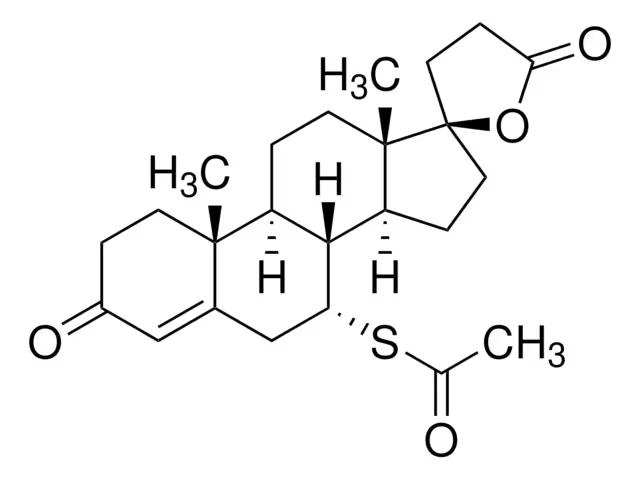
CAS Number52-01-7
SynonymsSpirolakton; Aldopur; Osiren; Sagisal; Laractone; Suracton; Diatensec; MFCD00082250; spironolactone; Deverol; Supra-puren; Aquareduct; Lacalmin; Nefurofan; Aldace; Duraspiron; (7a,17a)-7-(Acetylthio)-17-hydroxy-3-oxopregn-4-ene-21-carboxylic acid g-lactone; EINECS 200-133-6; Osyrol; Lacdene; SPIRONOLACTONE A; Aldactone; Spiroderm; Spiretic; 17-Hydroxy-7a-mercapto-3-oxo-17a-pregn-4-ene-21-carboxylic Acid g-Lactone Acetate; 3-(3-Oxo-7a-acetylthio-17b-hydroxy-4-androsten-17a-yl)propionic Acid g-Lactone; Altex; Spirolone; Almatol; Sincomen
Molecular FormulaC24H32O4S
Molecular Weight416.57
Purity99%
Density1.2±0.1 g/cm3
Boiling Point597.0±50.0 °C at 760 mmHg
Melting Point207-208 °C (lit.)
Appearancewhite powder
Symbol
Signal WordWarning
| Chemical & Physical Properties | |
|---|---|
| CAS Number | 52-01-7 |
| Catalog No. | 2A-0202180 |
| Chinese Name | 螺内酯 |
| Synonyms | Spirolakton; Aldopur; Osiren; Sagisal; Laractone; Suracton; Diatensec; MFCD00082250; spironolactone; Deverol; Supra-puren; Aquareduct; Lacalmin; Nefurofan; Aldace; Duraspiron; (7a,17a)-7-(Acetylthio)-17-hydroxy-3-oxopregn-4-ene-21-carboxylic acid g-lactone; EINECS 200-133-6; Osyrol; Lacdene; SPIRONOLACTONE A; Aldactone; Spiroderm; Spiretic; 17-Hydroxy-7a-mercapto-3-oxo-17a-pregn-4-ene-21-carboxylic Acid g-Lactone Acetate; 3-(3-Oxo-7a-acetylthio-17b-hydroxy-4-androsten-17a-yl)propionic Acid g-Lactone; Altex; Spirolone; Almatol; Sincomen |
| Molecular Formula | C24H32O4S |
| Molecular Weight | 416.57 |
| Purity | 99 |
| Density | 1.2±0.1 g/cm3 |
| Boiling Point | 597.0±50.0 °C at 760 mmHg |
| Melting Point | 207-208 °C (lit.) |
| Appearance | white powder |
| Water Solubility | practically insoluble |
| Storage Condition | The warehouse is ventilated and dried at low tempe |
| Application | Spironolactone is an androgen receptor antagonist. |
| HTC | 2937290090 |
| PubChem ID | 329751140 |
| MDL Number | MFCD00082250 |
| SMILES | CC(=O)S[C@@H]1CC2=CC(=O)CC[C@]2(C)[C@H]3CC[C@@]4(C)[C@@H](CC[C@@]45CCC(=O)O5)[C@H]13 |
| InChI | 1S/C24H32O4S/c1-14(25)29-19-13-15-12-16(26)4-8-22(15,2)17-5-9-23(3)18(21(17)19)6-10-24(23)11-7-20(27)28-24/h12,17-19,21H,4-11,13H2,1-3H3/t17-,18-,19+,21+,22-,23-,24+/m0/s1 |
| InChI Key | LXMSZDCAJNLERA-ZHYRCANASA-N |
| NACRES Code | NA.24 |
| UNSPSC | 41116107 |
| Hazard Symbols | Transport |
| MSDS | msds/12503_1_52_01_7.pdf |
| Bioactivity | Spironolactone is a potent antagonist of the androgen receptor. Target: Androgen ReceptorSpironolactone is a potassium sparing diuretic that acts by antagonism of aldosterone in the distal renal tubules. It is used mainly in the treatment of refractory edema in patients with congestive heart failure, nephrotic syndrome, or hepatic cirrhosis. Its effects on the endocrine system are utilized in the treatments of hirsutism and acne but they can lead to adverse effects. 5% topical spironolactone cream acts as an antiandrogen in human sebaceous glands, competing with DHT receptors and producing a decrease of labelled DHT. At the concentrations used the effect has been only local. No side-effects were recorded during both studies [1]. Patients who received spironolactone had a significant improvement in the symptoms of heart failure, as assessed on the basis of the New York Heart Association functional class (P<0.001). Gynecomastia or breast pain was reported in 10 percent of men who were treated with spironolactone, as compared with 1 percent of men in the placebo group (P<0.001). The incidence of serious hyperkalemia was minimal in both groups of patients [2]. Related Catalog Signaling Pathways >> Others >> Androgen Receptor Signaling Pathways >> Autophagy >> Autophagy Research Areas >> Metabolic Disease References [1]. Berardesca, E., et al., Topical spironolactone inhibits dihydrotestosterone receptors in human sebaceous glands: an autoradiographic study in subjects with acne vulgaris. Int J Tissue React, 1988. 10(2): p. 115-9. [2]. Pitt, B., et al., The effect of spironolactone on morbidity and mortality in patients with severe heart failure. Randomized Aldactone Evaluation Study Investigators. N Engl J Med, 1999. 341(10): p. 709-17. Chemical & Physical Properties Density 1.2±0.1 g/cm3 Boiling Point 597.0±50.0 °C at 760 mmHg Melting Point 207-208 °C(lit.) Molecular Formula C24H32O4S Molecular Weight 416.573 Flash Point 302.3±18.1 °C Exact Mass 416.202118 PSA 85.74000 LogP 3.12 Vapour Pressure 0.0±1.7 mmHg at 25°C Index of Refraction 1.586 InChIKey LXMSZDCAJNLERA-ZHYRCANASA-N SMILES CC(=O)SC1CC2=CC(=O)CCC2(C)C2CCC3(C)C(CCC34CCC(=O)O4)C12 Water Solubility practically insoluble |
| Use of | Spironolactone is a potent antagonist of the androgen receptor. Target: Androgen ReceptorSpironolactone is a potassium sparing diuretic that acts by antagonism of aldosterone in the distal renal tubules. It is used mainly in the treatment of refractory edema in patients with congestive heart failure, nephrotic syndrome, or hepatic cirrhosis. Its effects on the endocrine system are utilized in the treatments of hirsutism and acne but they can lead to adverse effects. 5% topical spironolactone cream acts as an antiandrogen in human sebaceous glands, competing with DHT receptors and producing a decrease of labelled DHT. At the concentrations used the effect has been only local. No side-effects were recorded during both studies [1]. Patients who received spironolactone had a significant improvement in the symptoms of heart failure, as assessed on the basis of the New York Heart Association functional class (P<0.001). Gynecomastia or breast pain was reported in 10 percent of men who were treated with spironolactone, as compared with 1 percent of men in the placebo group (P<0.001). The incidence of serious hyperkalemia was minimal in both groups of patients [2]. Properties Articles102 Name Spironolactone Synonym More Synonyms Spironolactone Biological Activity Description Spironolactone is a potent antagonist of the androgen receptor. Target: Androgen ReceptorSpironolactone is a potassium sparing diuretic that acts by antagonism of aldosterone in the distal renal tubules. It is used mainly in the treatment of refractory edema in patients with congestive heart failure, nephrotic syndrome, or hepatic cirrhosis. Its effects on the endocrine system are utilized in the treatments of hirsutism and acne but they can lead to adverse effects. 5% topical spironolactone cream acts as an antiandrogen in human sebaceous glands, competing with DHT receptors and producing a decrease of labelled DHT. At the concentrations used the effect has been only local. No side-effects were recorded during both studies [1]. Patients who received spironolactone had a significant improvement in the symptoms of heart failure, as assessed on the basis of the New York Heart Association functional class (P<0.001). Gynecomastia or breast pain was reported in 10 percent of men who were treated with spironolactone, as compared with 1 percent of men in the placebo group (P<0.001). The incidence of serious hyperkalemia was minimal in both groups of patients [2]. Related Catalog Signaling Pathways >> Others >> Androgen Receptor Signaling Pathways >> Autophagy >> Autophagy Research Areas >> Metabolic Disease References [1]. Berardesca, E., et al., Topical spironolactone inhibits dihydrotestosterone receptors in human sebaceous glands: an autoradiographic study in subjects with acne vulgaris. Int J Tissue React, 1988. 10(2): p. 115-9. [2]. Pitt, B., et al., The effect of spironolactone on morbidity and mortality in patients with severe heart failure. Randomized Aldactone Evaluation Study Investigators. N Engl J Med, 1999. 341(10): p. 709-17. Chemical & Physical Properties Molecular Formula C24H32O4S Exact Mass 416.202118 PSA 85.74000 Index of Refraction 1.586 InChIKey LXMSZDCAJNLERA-ZHYRCANASA-N Water Solubility practically insoluble |
| Transport Info | Product name: Purity: 98.0% |
| MSDS Transport Info | Module 14. Shipping information 14.1 UN dangerous goods number European Land Transport Dangerous Regulations: -International Maritime Dangerous Regulations: -International Air Transport Dangerous Regulations: - 14.2 Names specified by the United Nations (UN) European Land Transport Dangerous Regulations: Non-dangerous goods IMDG Code: Non-dangerous goods International air transport dangerous goods regulations: non-dangerous goods 14.3 Transport hazard categories European Land Transport Dangerous Regulations: -International Maritime Dangerous Regulations: -International Air Transport Dangerous Regulations: - 14.4 Package group European Land Transport Dangerous Regulations: -International Maritime Dangerous Regulations: -International Air Transport Dangerous Regulations: - 14.5 Environmental hazards European Land Transport Dangerous Regulations: No International Maritime Transport Dangerous Regulations Maritime Pollutants: No International Air Transport Risk Regulations: No 14.6 Special reminder to users No data available See reverse side of invoice or packing slip. |
| Related Products in API & Advanced Intermediates | ||
|---|---|---|
| Sildenafil | 139755-83-2 | 2A-9012439 |
| Sildenafil citrate | 171599-83-0 | 2A-0200391 |
| Silver sulfadiazine | 22199-08-2 | 2A-9012444 |
| Simvastatin | 79902-63-9 | 2A-9012452 |
| Sotalol hydrochloride | 959-24-0 | 2A-9012492 |
| Stavudine | 3056-17-5 | 2A-9012507 |
| Sulfasalazine | 599-79-1 | 2A-9012526 |
| Sulindac sulfide | 32004-67-4 | 2A-9012534 |
| Tacrolimus | 104987-11-3 | 2A-9012563 |
| Tamoxifen | 10540-29-1 | 2A-9012574 |
| Browse all API & Advanced Intermediates products » | ||
Phone:
630-322-8886
630-322-8887
Email:
Office Locations:
Chicago, IL, USA
San Francisco, CA, USA


 EN
EN


 SDS
SDS