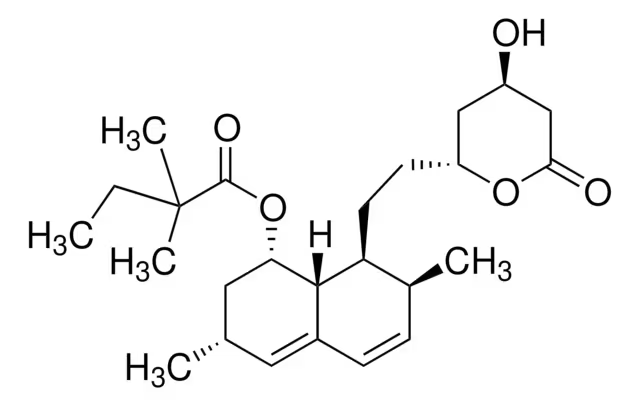
CAS Number79902-63-9
SynonymsLipex; Velostatin; ZOCOR; Simvotin; Corolin; MFCD00072007; Cholestat; Colemin; Coledis; Simvastatin; EINECS 404-520-2; Kolestevan; Lipovas; Nor-Vastina; Zocord; Liponorm; Lipinorm; Modutrol; Eucor; simcor; Denan; simvasterol; Rechol; Valemia; Sivastin
Molecular FormulaC25H38O5
Molecular Weight418.57
Purity≥97 (HPLC)%
Density1.1±0.1 g/cm3
Boiling Point564.9±50.0 °C at 760 mmHg
Melting Point127-132 °C (lit.)
Appearancesolid
Symbol
Signal WordWarning
| Chemical & Physical Properties | |
|---|---|
| CAS Number | 79902-63-9 |
| Catalog No. | 2A-9012452 |
| Chinese Name | 辛伐他汀,斯伐他汀 |
| Synonyms | Lipex; Velostatin; ZOCOR; Simvotin; Corolin; MFCD00072007; Cholestat; Colemin; Coledis; Simvastatin; EINECS 404-520-2; Kolestevan; Lipovas; Nor-Vastina; Zocord; Liponorm; Lipinorm; Modutrol; Eucor; simcor; Denan; simvasterol; Rechol; Valemia; Sivastin |
| Molecular Formula | C25H38O5 |
| Molecular Weight | 418.57 |
| Purity | ≥97 (HPLC) |
| Density | 1.1±0.1 g/cm3 |
| Boiling Point | 564.9±50.0 °C at 760 mmHg |
| Melting Point | 127-132 °C (lit.) |
| Appearance | solid |
| Storage Condition | Store in an airtight container in a cool, dry plac |
| Packaging | III |
| Application | Simvastatin is a competitive HMG-CoA reductase inhibitor with a Ki value of 0.2 nM. |
| PubChem ID | 24724617 |
| MDL Number | MFCD00072007 |
| SMILES | [H][C@]12[C@H](C[C@@H](C)C=C1C=C[C@H](C)[C@@H]2CC[C@@H]3C[C@@H](O)CC(=O)O3)OC(=O)C(C)(C)CC |
| InChI | 1S/C25H38O5/c1-6-25(4,5)24(28)30-21-12-15(2)11-17-8-7-16(3)20(23(17)21)10-9-19-13-18(26)14-22(27)29-19/h7-8,11,15-16,18-21,23,26H,6,9-10,12-14H2,1-5H3/t15-,16-,18+,19+,20-,21-,23-/m0/s1 |
| InChI Key | RYMZZMVNJRMUDD-HGQWONQESA-N |
| NACRES Code | NA.77 |
| UNSPSC | 12352200 |
| Hazard Symbols | 9 |
| MSDS | msds/12452_1_79902_63_9.pdf |
| Bioactivity | Simvastatin (MK 733) is a competitive inhibitor of HMG-CoA reductase with a Ki of 0.2 nM. Related Catalog Signaling Pathways >> Autophagy >> Autophagy Signaling Pathways >> Metabolic Enzyme/Protease >> HMG-CoA Reductase (HMGCR) Signaling Pathways >> Autophagy >> Mitophagy Research Areas >> Cardiovascular Disease Target Ki: 0.2 nM (HMG-CoA reductase)[1] In Vitro Simvastatin needs to be activated by NaOH in EtOH treatment before use for cell assay. Simvastatin suppresses cholesterol synthesis in mouse L-M cell, rat H4II E cell, and human Hep G2 cell with IC50s of 19.3 nM, 13.3 nM and 15.6 nM, respectively[1]. Simvastatin causes a dose-dependent increase in serine 473 phosphorylation of Akt within 30 minutes, with maximal phosphorylation occurring at 1.0 µM. Simvastatin (1.0 μM) enhances phosphorylation of the endogenous Akt substrate endothelial nitric oxide synthase (eNOS), inhibits serum-free media undergo apoptosis and accelerates vascular structure formation[2]. Simvastatin shows anti-inflammatory effects, reduces anti-CD3/anti-CD28 antibody-stimulated proliferation of PB-derived mononuclear cells and synovial fluid cells from rheumatoid arthritis blood, as well as IFN-γ release at 10 μM. Simvastatin (10 μM) also blocks cell-mediated macrophage TNF-γ release induced via cognate interactions by appr 30%[3]. Simvastatin (5 μM) significantly reduces the expression of ABCA1 in astrocytes and neuroblastoma cells, the expression of apolipoprotein E in astrocytes, and increases cyclin-dependent kinase 5 and glycogen synthase kinase 3β expression in SK-N-SH cells[7]. In Vivo Simvastatin suppresses the conversion of radiolabeled acetate to cholesterol with an IC50 of 0.2 mg/kg via p.o. administration[1]. Simvastatin (4 mg/day, p.o. for 13 weeks) returns the cholesterol-induced increases in total cholesterol, LDL-cholesterol and HDL-cholesterol to normal level in rabbits fed an atherogenci cholesterol-rich diet[4]. Simvastatin (6 mg/kg) increases LDL receptor-dependent binding and the number of hepatic LDL receptors in rabbits fed a diet containing 0.25% cholesterol[5]. Simvastatin affects inflammation independent of its effect on plasma cholesterol level. Simvastatin (20 mg/kg/day) causes a 1.3-fold less macrophage content in lesions, and 2-fold less vascular cell adhesion molecule-1, interleukin-1beta, and tissue factor expression, companied by a 2.1-fold increases in lesional smooth muscle cell and collagen content in cynomolgus monkeys fed an atherogenic diet[6]. Kinase Assay For assessment of Akt protein kinase activity in vitro, substrate (2 μg histone H2B or 25 μg eNOS peptide) is incubated with Akt immunoprecipitated from cell lysate using goat polyclonal anti-Akt1 antibody. Kinase reactions are initiated following the addition of Simvastatin to a final concentration of ATP (50 μM) containing 10 μCi of 32P-γATP, dithiotreitol (1 mM), HEPES buffer (20 mM, pH 7.4), MnCl2 (10 mM), MgCl2 (10 mM). After incubation for 30 min at 30°C, phosphorylated histone H2B is visualized after SDS-PAGE (15%) and autoradiography. To estimate the extent of 32P incorporation into eNOS peptides, each reaction mixture is measured by spotting onto phosphocellulose disc filter and the amount of phosphate incorporated is measured by Cerenkov counting. The wild-type peptide sequence is 1174-RIRTQSFSLQERHLRGAVPWA-1194, and the mutant eNOS peptide is identical except that serine 1179 is substituted by alanine[3]. Cell Assay Primary human astrocytes from four different donors are prepared from tissue obtained from legally aborted fetuses. Primary human astrocytes and SK-N-SH neuroblastoma cell line (ATCC) are plated on 6-well plates and grown in DMEM supplemented with 5% or 8% fetal calf serum, respectively, at 37°C, 5% CO2 until 80% confluent. For measurement of gene expression levels at baseline, cells are just washed and RNA is prepared and assayed as outlined below. Baseline gene expression levels in astrocytes are measured in primary human astrocytes obtained from two donors. For experimental purposes, cells are incubated under serum-free conditions. Primary human astrocytes are obtained from four donors. Based on preliminary time-dependent studies, 48-h incubation is used for all of experiments. Based on the dose-response studies, a majority of our experiments are conducted using the following concentrations of active compounds: Simvastatin at 5 μM, pravastatin at 10 μM, mevalonate at 50 μM, and GGPP and FPP at 10 μM. Following incubation, cells are extensively washed to remove dead cells and cell debris and prepared for further analyses[7]. Animal Admin Monkeys[1] Thirty-nine adult male cynomolgus monkeys are initially fed a moderately atherogenic diet containing 0.28 mg cholesterol per calorie of diet, with 16.7% from protein, 45.1% from lipids, and 38.1% from carbohydrates. After consuming the atherogenic diet for 3 months, the monkeys are divided into 3 groups (n=13 each) that are equivalent in their total plasma cholesterol (TPC), LDL-C, and HDL cholesterol (HDL-C) concentrations; these groups consume the atherogenic diet and receive statin (or control) treatment for an additional 15 months. Control monkeys are fed the atherogenic diet with no added statins. Prava-treated monkeys have 40 mg Prava/kg body wt per day added to the atherogenic diet. Simvastatin-treated monkeys consumed 20 mg Simvastatin/kg body wt per day[1]. References [1]. Slater, E.E., et al. Mechanism of action and biological profile of HMG CoA reductase inhibitors. A new therapeutic alternative. Drugs, 1988. 36 Suppl 3: p. 72-82. [2]. Kureishi, Y., et al. The HMG-CoA reductase inhibitor simvastatin activates the protein kinase Akt and promotes angiogenesis in normocholesterolemic animals. Nat Med, 2000. 6(9): p. 1004-10. [3]. Leung BP, et al. A novel anti-inflammatory role for simvastatin in inflammatory arthritis. J Immunol. 2003 Feb 1;170(3):1524-30. [4]. Kobayashi M, et al. Preventive effect of MK-733 (simvastatin), an inhibitor of HMG-CoA reductase, on hypercholesterolemia and atherosclerosis induced by cholesterol feeding in rabbits. Jpn J Pharmacol. 1989 Jan;49(1):125-33. [5]. Ishida F, et al. Comparative effects of simvastatin (MK-733) and pravastatin (CS-514) on hypercholesterolemia induced by cholesterol feeding in rabbits. Biochim Biophys Acta. 1990 Feb 23;1042(3):365-73. [6]. Sukhova GK, et al. Statins reduce inflammation in atheroma of nonhuman primates independent of effects on serum cholesterol. Arterioscler Thromb Vasc Biol. 2002 Sep 1;22(9):1452-8. [7]. Weijiang Dong, et al. Differential effects of simvastatin and pravastatin on expression of Alzheimer's disease-related genes in human astrocytes and neuronal cells. J Lipid Res. 2009 Oct; 50(10): 2095-2102. [8]. Liu Z, et al. Pretreatment Donors after Circulatory Death with Simvastatin Alleviates Liver Ischemia Reperfusion Injury through a KLF2-Dependent Mechanism in Rat. Oxid Med Cell Longev. 2017;2017:3861914. Chemical & Physical Properties Density 1.1±0.1 g/cm3 Boiling Point 564.9±50.0 °C at 760 mmHg Melting Point 139 °C Molecular Formula C25H38O5 Molecular Weight 418.566 Flash Point 184.8±23.6 °C Exact Mass 418.271912 PSA 72.83000 LogP 4.41 Vapour Pressure 0.0±3.5 mmHg at 25°C Index of Refraction 1.530 InChIKey RYMZZMVNJRMUDD-HGQWONQESA-N SMILES CCC(C)(C)C(=O)OC1CC(C)C=C2C=CC(C)C(CCC3CC(O)CC(=O)O3)C21 |
| Use of | Simvastatin (MK 733) is a competitive inhibitor of HMG-CoA reductase with a Ki of 0.2 nM. Properties Articles267 Name simvastatin Synonym More Synonyms Simvastatin Biological Activity Description Simvastatin (MK 733) is a competitive inhibitor of HMG-CoA reductase with a Ki of 0.2 nM. Related Catalog Signaling Pathways >> Autophagy >> Autophagy Signaling Pathways >> Metabolic Enzyme/Protease >> HMG-CoA Reductase (HMGCR) Signaling Pathways >> Autophagy >> Mitophagy Research Areas >> Cardiovascular Disease Ki: 0.2 nM (HMG-CoA reductase)[1] References [1]. Slater, E.E., et al. Mechanism of action and biological profile of HMG CoA reductase inhibitors. A new therapeutic alternative. Drugs, 1988. 36 Suppl 3: p. 72-82. [2]. Kureishi, Y., et al. The HMG-CoA reductase inhibitor simvastatin activates the protein kinase Akt and promotes angiogenesis in normocholesterolemic animals. Nat Med, 2000. 6(9): p. 1004-10. [3]. Leung BP, et al. A novel anti-inflammatory role for simvastatin in inflammatory arthritis. J Immunol. 2003 Feb 1;170(3):1524-30. [4]. Kobayashi M, et al. Preventive effect of MK-733 (simvastatin), an inhibitor of HMG-CoA reductase, on hypercholesterolemia and atherosclerosis induced by cholesterol feeding in rabbits. Jpn J Pharmacol. 1989 Jan;49(1):125-33. [5]. Ishida F, et al. Comparative effects of simvastatin (MK-733) and pravastatin (CS-514) on hypercholesterolemia induced by cholesterol feeding in rabbits. Biochim Biophys Acta. 1990 Feb 23;1042(3):365-73. [6]. Sukhova GK, et al. Statins reduce inflammation in atheroma of nonhuman primates independent of effects on serum cholesterol. Arterioscler Thromb Vasc Biol. 2002 Sep 1;22(9):1452-8. [7]. Weijiang Dong, et al. Differential effects of simvastatin and pravastatin on expression of Alzheimer's disease-related genes in human astrocytes and neuronal cells. J Lipid Res. 2009 Oct; 50(10): 2095-2102. [8]. Liu Z, et al. Pretreatment Donors after Circulatory Death with Simvastatin Alleviates Liver Ischemia Reperfusion Injury through a KLF2-Dependent Mechanism in Rat. Oxid Med Cell Longev. 2017;2017:3861914. Chemical & Physical Properties Molecular Formula C25H38O5 Exact Mass 418.271912 PSA 72.83000 Index of Refraction 1.530 InChIKey RYMZZMVNJRMUDD-HGQWONQESA-N |
| Transport Info | Shipping Name: UN |
| MSDS Transport Info | Module 14. Shipping information 14.1 UN dangerous goods number European Land Transport Dangerous Regulations: -International Maritime Dangerous Regulations: -International Air Transport Dangerous Regulations: - 14.2 United Nations shipping name European Land Transport Dangerous Regulations: Non-dangerous goods IMDG Code: Non-dangerous goods International air transport dangerous goods regulations: non-dangerous goods 14.3 Transport hazard categories European Land Transport Dangerous Regulations: -International Maritime Dangerous Regulations: -International Air Transport Dangerous Regulations: - 14.4 Package group European Land Transport Dangerous Regulations: -International Maritime Dangerous Regulations: -International Air Transport Dangerous Regulations: - 14.5 Environmental hazards European Land Transport Danger Regulations: No International Maritime Danger Regulations International Air Transport Danger Regulations: No Marine pollutants (yes/no): No 14.6 Special reminder to users No data available The above information is believed to be correct, but is not all-inclusive and should be used as a guide only. The information in this document is based on our current knowledge and is Correct safety instructions apply to this product. This information does not represent a warranty as to the properties of this product. See reverse side of invoice or packing slip. |
| Related Products in API & Advanced Intermediates | ||
|---|---|---|
| Saquinavir mesylate | 149845-06-7 | 2A-9012392 |
| Sertraline | 79617-96-2 | 2A-9012427 |
| Sildenafil | 139755-83-2 | 2A-9012439 |
| Sildenafil citrate | 171599-83-0 | 2A-0200391 |
| Silver sulfadiazine | 22199-08-2 | 2A-9012444 |
| Sotalol hydrochloride | 959-24-0 | 2A-9012492 |
| Spironolactone | 52-01-7 | 2A-0202180 |
| Stavudine | 3056-17-5 | 2A-9012507 |
| Sulfasalazine | 599-79-1 | 2A-9012526 |
| Sulindac sulfide | 32004-67-4 | 2A-9012534 |
| Browse all API & Advanced Intermediates products » | ||
Phone:
630-322-8886
630-322-8887
Email:
Office Locations:
Chicago, IL, USA
San Francisco, CA, USA


 EN
EN


 SDS
SDS