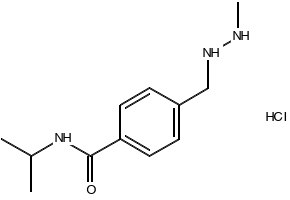
CAS Number366-70-1
SynonymsN-Isopropyl-4-[(2-methylhydrazino)methyl]benzamide hydrochloride (1:1); 4-[(2-methylhydrazinyl)methyl]-N-propan-2-ylbenzamide,hydrochloride; N-(1-Methylethyl)-4-[(2-methylhydrazinyl)methyl]benzamide hydrochloride; MFCD00072082; Procarbazine hydrochloride; 4-[(2-methylhydrazinyl)methyl]-N-(propan-2-yl)benzamide hydrochloride (1:1); benzamide, N-(1-methylethyl)-4-[(2-methylhydrazino)methyl]-, monohydrochloride; Benzamide, N-(1-methylethyl)-4-[(2-methylhydrazinyl)methyl]-, hydrochloride (1:1); Procarbazine HCl; EINECS 206-678-6; p-Toluamide, N-isopropyl-α- (2-methylhydrazino)-, monohydrochloride; Procarbazine (Hydrochloride)
Molecular FormulaC12H20O1N3Cl1
Molecular Weight257.76
Purity99%
Boiling Point384.6ºC at 760 mmHg
Melting Point223ºC
AppearanceWhite to light yellow crystalline powder
| Chemical & Physical Properties | |
|---|---|
| CAS Number | 366-70-1 |
| Catalog No. | 2A-9012133 |
| Chinese Name | 盐酸甲基苄肼 |
| Synonyms | N-Isopropyl-4-[(2-methylhydrazino)methyl]benzamide hydrochloride (1:1); 4-[(2-methylhydrazinyl)methyl]-N-propan-2-ylbenzamide,hydrochloride; N-(1-Methylethyl)-4-[(2-methylhydrazinyl)methyl]benzamide hydrochloride; MFCD00072082; Procarbazine hydrochloride; 4-[(2-methylhydrazinyl)methyl]-N-(propan-2-yl)benzamide hydrochloride (1:1); benzamide, N-(1-methylethyl)-4-[(2-methylhydrazino)methyl]-, monohydrochloride; Benzamide, N-(1-methylethyl)-4-[(2-methylhydrazinyl)methyl]-, hydrochloride (1:1); Procarbazine HCl; EINECS 206-678-6; p-Toluamide, N-isopropyl-α- (2-methylhydrazino)-, monohydrochloride; Procarbazine (Hydrochloride) |
| Molecular Formula | C12H20O1N3Cl1 |
| Molecular Weight | 257.76 |
| Purity | 99 |
| Boiling Point | 384.6ºC at 760 mmHg |
| Melting Point | 223ºC |
| Appearance | White to light yellow crystalline powder |
| Water Solubility | ≥10 g/100 mL at 21.5 ºC |
| Storage Condition | -20°C Freezer |
| Application | Procarbazine Hydrochloride is an alkylating agent with anti-tumor effects. |
| HTC | 2928000090 |
| MDL Number | MFCD00072082 |
| SMILES | CNNCc1ccc(C(=O)NC(C)C)cc1.Cl |
| InChI | InChI=1S/C12H19N3O.ClH/c1-9(2)15-12(16)11-6-4-10(5-7-11)8-14-13-3;/h4-7,9,13-14H,8H2,1-3H3,(H,15,16);1H |
| InChI Key | DERJYEZSLHIUKF-UHFFFAOYSA-N |
| MSDS | msds/12133_1_366_70_1.pdf |
| Bioactivity | Procarbazine Hydrochloride is an alkylating agent, with anticancer activity. Related Catalog Signaling Pathways >> Cell Cycle/DNA Damage >> DNA Alkylator/Crosslinker Research Areas >> Cancer In Vitro Procarbazine Hydrochloride is an anticancer agent. Procarbazine is not cytotoxic to the LI 210 cells which lack cytochrome P-450 or monoamine oxidase activity[1]. In Vivo Procarbazine Hydrochloride (50 mg/kg, i.p.) causes micronuclei in hematopoietic cells, but does not increase the lacZ mutant frequency (MF) in bone marrow of mice, similar to that in liver, testis, spleen, kidney, and lung. Procarbazine Hydrochloride (50 mg/kg, i.p.) has positive effect on lung, bone marrow, and spleen for carcinogenesis[2]. Procarbazine (450 mg/kg) significantly decreases testicular and epididymal weight and drastically reduces haploid cells and spermatogenic arrest in hamster[3]. Cell Assay Following Procarbazine or metabolite treatment, cells are diluted to 50.000/mL in 25-cm2 culture flasks (10 mL). Every 24 h, a 0.5-mL aliquot is removed, diluted 20-fold in Hematall isotonic diluent, and the cell number determined with a Coulter Model F electronic cell counter. Counts greater than 10,000/0.5 mL are corrected for coincidence. Cells are diluted in fresh culture media when cell density exceeded 1 × 10⁶/mL. Cultures are maintained until the aggregate cell number approached 100 × 106/mL and doubling time has returned to 12 h. Cell survival is determined using Equation A, where TD(doubling time for cells of interest) is 12 h[1]. Animal Admin Mice[2] Male MutaTM Mouse animals (7-8 weeks old) are used after 2 weeks of acclimation. In the first experiment, 18 mice are injected intraperitoneally (i.p.) with 50 mg/kg Procarbazine hydrochloride in 10 mL saline/kg and eight mice are injected with 10 mL saline/kg as the vehicle control. Six treated mice are killed 7, 14, and 28 days after treatment, and four control mice are killed 7 and 28 days after the treatment. Killing is by cervical dislocation[2]. References [1]. Erikson JM, et al. Cytotoxicity and DNA damage caused by the azoxy metabolites of procarbazine in L1210 tumor cells. Cancer Res. 1989 Jan 1;49(1):127-33. [2]. Suzuki T, et al. Procarbazine genotoxicity in the MutaMouse; strong clastogenicity and organ-specific induction of lacZ mutations. Mutat Res. 1999 Aug 18;444(2):269-81. [3]. Weissenberg R, et al. Procarbazine effects on spermatogenesis in golden hamster: a flow cytometric evaluation. Arch Androl. 2002 Mar-Apr;48(2):91-100. Chemical & Physical Properties Boiling Point 384.6ºC at 760 mmHg Melting Point 223ºC Molecular Formula C12H20ClN3O Molecular Weight 257.760 Flash Point 148.9ºC Exact Mass 257.129486 PSA 53.16000 LogP 3.02350 InChIKey DERJYEZSLHIUKF-UHFFFAOYSA-N SMILES CNNCc1ccc(C(=O)NC(C)C)cc1.Cl Storage condition -20°C Freezer Water Solubility ≥10 g/100 mL at 21.5 ºC |
| Use of | Procarbazine Hydrochloride is an alkylating agent, with anticancer activity. Properties Articles30 Name procarbazine hydrochloride Synonym More Synonyms Procarbazine hydrochloride Biological Activity Description Procarbazine Hydrochloride is an alkylating agent, with anticancer activity. Related Catalog Signaling Pathways >> Cell Cycle/DNA Damage >> DNA Alkylator/Crosslinker Research Areas >> Cancer References [1]. Erikson JM, et al. Cytotoxicity and DNA damage caused by the azoxy metabolites of procarbazine in L1210 tumor cells. Cancer Res. 1989 Jan 1;49(1):127-33. [2]. Suzuki T, et al. Procarbazine genotoxicity in the MutaMouse; strong clastogenicity and organ-specific induction of lacZ mutations. Mutat Res. 1999 Aug 18;444(2):269-81. [3]. Weissenberg R, et al. Procarbazine effects on spermatogenesis in golden hamster: a flow cytometric evaluation. Arch Androl. 2002 Mar-Apr;48(2):91-100. Chemical & Physical Properties Exact Mass 257.129486 PSA 53.16000 LogP 3.02350 InChIKey DERJYEZSLHIUKF-UHFFFAOYSA-N |
| Tax Rebate | 9.0% |
| Supervision | none |
| Transport Info | Product name: Summary 2928000090 other organic derivatives of hydrazine or of hydroxylamine VAT:17.0% Tax rebate rate:9.0% Supervision conditions:none MFN tariff:6.5% General tariff:20.0% |
| Related Products in Specialty Chemicals | ||
|---|---|---|
| Proadifen hydrochloride | 62-68-0 | 2A-9012126 |
| Probucol | 23288-49-5 | 2A-9012128 |
| Procainamide | 51-06-9 | 2A-9012129 |
| Procainamide hydrochloride | 614-39-1 | 2A-9012130 |
| Procarbazine | 671-16-9 | 2A-9012132 |
| Procaterol | 72332-33-3 | 2A-9012134 |
| Procaterol Hydrochlorid | 62929-91-3 | 2A-9012135 |
| Procaterol hydrochloride | 81262-93-3 | 2A-9012136 |
| Prochloraz | 67747-09-5 | 2A-9012137 |
| Prochlorperazine | 58-38-8 | 2A-9012138 |
| Browse all Specialty Chemicals products » | ||
Phone:
630-322-8886
630-322-8887
Email:
Office Locations:
Chicago, IL, USA
San Francisco, CA, USA


 EN
EN


 SDS
SDS