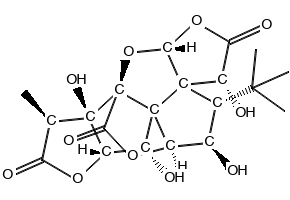
CAS Number15291-76-6
SynonymsGinkgolid C; MFCD02094178; 1,7-DIHYDROXY-GINKGOLIDE A; Gingkolide C; 1,3,7,10-Tetrahydroxyginkgolid; GinkgolideC
Molecular FormulaC20H24O11
Molecular Weight440.398
Purity98%
Density1.7±0.1 g/cm3
Boiling Point813.8±65.0 °C at 760 mmHg
Melting Point>3000ºC
Appearancewhite powder
Symbol
Signal WordWarning
| Chemical & Physical Properties | |
|---|---|
| CAS Number | 15291-76-6 |
| Catalog No. | 2A-9010728 |
| Chinese Name | 银杏内酯 C |
| Synonyms | Ginkgolid C; MFCD02094178; 1,7-DIHYDROXY-GINKGOLIDE A; Gingkolide C; 1,3,7,10-Tetrahydroxyginkgolid; GinkgolideC |
| Molecular Formula | C20H24O11 |
| Molecular Weight | 440.398 |
| Purity | 98 |
| Density | 1.7±0.1 g/cm3 |
| Boiling Point | 813.8±65.0 °C at 760 mmHg |
| Melting Point | >3000ºC |
| Appearance | white powder |
| Storage Condition | -20°C |
| Application | Ginkgolide C is a flavonoid isolated from Ginkgo leaves. It has a variety of biological functions and can reduce platelet aggregation and improve Alzheimer's disease. |
| SMILES | CC1C(=O)OC2C(O)C34C5OC(=O)C3(OC3OC(=O)C(O)C34C(C(C)(C)C)C5O)C12O |
| InChI | InChI=1S/C20H24O11/c1-5-12(24)28-11-8(22)18-10-6(21)7(16(2,3)4)17(18)9(23)13(25)30-15(17)31-20(18,14(26)29-10)19(5,11)27/h5-11,15,21-23,27H,1-4H3/t5-,6-,7?,8?,9?,10-,11+,15+,17?,18?,19-,20-/m1/s1 |
| InChI Key | AMOGMTLMADGEOQ-UHFFFAOYSA-N |
| Hazard Symbols | Transport |
| MSDS | msds/10728_1_15291_76_6.pdf |
| Bioactivity | Ginkgolide C is a flavone isolated from Ginkgo biloba leaves, possessing multiple biological functions, such as decreasing platelet aggregation and ameliorating Alzheimer disease. Related Catalog Research Areas >> Metabolic Disease Research Areas >> Neurological Disease Natural Products >> Terpenoids and Glycosides Target AMPK MMP-9 Sirtuin In Vitro Ginkgolide C (3-100 μM) has no significant effect on 3T3-L1 cell viability, but suppresses adipogenesis in 3T3-L1 cells followling 24 h treatment. Ginkgolide C (10-100 μM) significantly suppresses lipid accumulation compared with the control group and also significantly promotes glycerol release in 3T3-L1 adipocytes. Ginkgolide C suppresses PPAR-α and PPAR-γ expression and decreases C/EBPα, C/EBPβ, and SREBP-1c expression in differentiated 3T3-L1 adipocytes. In addition, Ginkgolide C (3-100 μM) suppress adipogenesis-related protein (FAS, LPL, and aP2) and mRNA expression in a dose-dependent manner in differentiated 3T3-L1 adipocytes. Ginkgolide C (3-100 μM) also significantly promotes Sirt1 production and increases phosphorylation of AMPKα and ACC-1 in a concentration-dependent manner[1]. Ginkgolide C (1, 10, 50, 100, 500 mM) significantly reduces the collagen (10 mg/mL)-stimulated rat platelet aggregation in a dose-dependent manner. Ginkgolide C (50, 100 mM) causes pro-MMP-9 (92-kDa) to form an activated MMP-9 (86-kDa) in collagen-stimulated platelets[2]. Cell Assay 3T3-L1 cells are treated with various concentrations of ginkgolide C in 96-well plates for 24 h. Cell viability is analyzed by the MTT assay. The culture medium is removed, and the cells are incubated with 100 μL MTT solution (5 mg/mL) for 4 h at 37°C. After plates are washed, isopropanol is added to dissolve formazone crystals, followed by absorbance detection with a spectrophotometer at 570 nm[1]. References [1]. Liou CJ, et al. Ginkgolide C Suppresses Adipogenesis in 3T3-L1 Adipocytes via the AMPK Signaling Pathway. Evid Based Complement Alternat Med. 2015;2015:298635. [2]. Ginkgolide C, et al. Ginkgolide C inhibits platelet aggregation in cAMP- and cGMP-dependent manner by activating MMP-9. Biol Pharm Bull. 2007 Dec;30(12):2340-4. Chemical & Physical Properties Density 1.7±0.1 g/cm3 Boiling Point 813.8±65.0 °C at 760 mmHg Melting Point >3000ºC Molecular Formula C20H24O11 Molecular Weight 440.398 Flash Point 291.4±27.8 °C Exact Mass 440.131866 PSA 169.05000 LogP 0.16 Vapour Pressure 0.0±6.6 mmHg at 25°C Index of Refraction 1.671 InChIKey AMOGMTLMADGEOQ-UHFFFAOYSA-N SMILES CC1C(=O)OC2C(O)C34C5OC(=O)C3(OC3OC(=O)C(O)C34C(C(C)(C)C)C5O)C12O Storage condition -20°C |
| Use of | Ginkgolide C is a flavone isolated from Ginkgo biloba leaves, possessing multiple biological functions, such as decreasing platelet aggregation and ameliorating Alzheimer disease. Properties Name Ginkgolide C Synonym More Synonyms Ginkgolide C Biological Activity Description Ginkgolide C is a flavone isolated from Ginkgo biloba leaves, possessing multiple biological functions, such as decreasing platelet aggregation and ameliorating Alzheimer disease. Related Catalog Research Areas >> Metabolic Disease Research Areas >> Neurological Disease Natural Products >> Terpenoids and Glycosides References [1]. Liou CJ, et al. Ginkgolide C Suppresses Adipogenesis in 3T3-L1 Adipocytes via the AMPK Signaling Pathway. Evid Based Complement Alternat Med. 2015;2015:298635. [2]. Ginkgolide C, et al. Ginkgolide C inhibits platelet aggregation in cAMP- and cGMP-dependent manner by activating MMP-9. Biol Pharm Bull. 2007 Dec;30(12):2340-4. Chemical & Physical Properties Molecular Formula C20H24O11 Exact Mass 440.131866 PSA 169.05000 Index of Refraction 1.671 InChIKey AMOGMTLMADGEOQ-UHFFFAOYSA-N |
| Transport Info | Shipping Name: UN |
| MSDS Transport Info | Module 14. Shipping information 14.1 UN dangerous goods number European Land Transport Dangerous Regulations: -International Maritime Dangerous Regulations: -International Air Transport Dangerous Regulations: - 14.2 United Nations shipping name European Land Transport Dangerous Regulations: Non-dangerous goods IMDG Code: Non-dangerous goods International air transport dangerous goods regulations: non-dangerous goods 14.3 Transport hazard categories European Land Transport Dangerous Regulations: -International Maritime Dangerous Regulations: -International Air Transport Dangerous Regulations: - 14.4 Package group European Land Transport Dangerous Regulations: -International Maritime Dangerous Regulations: -International Air Transport Dangerous Regulations: - 14.5 Environmental hazards European Land Transport Danger Regulations: No International Maritime Danger Regulations International Air Transport Danger Regulations: No Marine pollutants (yes/no): No 14.6 Special reminder to users No data available |
| Related Products in Botanical Reference Standards | ||
|---|---|---|
| Fraxin | 524-30-1 | 2A-9010631 |
| Fucosterol | 17605-67-3 | 2A-9010644 |
| Genistein | 446-72-0 | 2A-9010713 |
| Gentiopicrin | 20831-76-9 | 2A-9010716 |
| Ginkgolide A | 15291-75-5 | 2A-9010726 |
| Ginsenoside F1 | 53963-43-2 | 2A-9010731 |
| Ginsenoside F3 | 62025-50-7 | 2A-9010732 |
| Ginsenoside Rb1 | 41753-43-9 | 2A-9010733 |
| Ginsenoside Rb3 | 68406-26-8 | 2A-9010734 |
| Ginsenoside Rc | 11021-14-0 | 2A-9010735 |
| Browse all Botanical Reference Standards products » | ||
Phone:
630-322-8886
630-322-8887
Email:
Office Locations:
Chicago, IL, USA
San Francisco, CA, USA


 EN
EN


 SDS
SDS