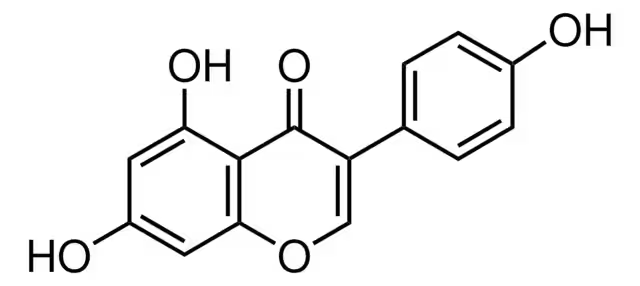
CAS Number446-72-0
Synonyms5-18-04-00594 (Beilstein Handbook Reference); 5,7,4'-trihydroxyisoflavone; 4',5,7-trihydroxyisoflavone; Genistein; GeniVida; prunetol; EINECS 207-174-9; genisteol; Bonistein; MFCD00016952; 5,7-Dihydroxy-3-(4-hydroxyphenyl)-4H-chromen-4-one; 5,7-Dihydroxy-3-(4-hydroxyphenyl)-4H-1-benzopyran-4-one; Genestein; sophoricol; GLYCITEN
Molecular FormulaC15H10O5
Molecular Weight270.24
Purity≥98 (HPLC)%
Density1.5±0.1 g/cm3
Boiling Point555.5±50.0 °C at 760 mmHg
Melting Point297.0-298.0 °C
Appearancepowder
EINECS207-174-9
Symbol
Signal WordWarning
| Chemical & Physical Properties | |
|---|---|
| CAS Number | 446-72-0 |
| Catalog No. | 2A-9010713 |
| Chinese Name | 染料木素 |
| Synonyms | 5-18-04-00594 (Beilstein Handbook Reference); 5,7,4'-trihydroxyisoflavone; 4',5,7-trihydroxyisoflavone; Genistein; GeniVida; prunetol; EINECS 207-174-9; genisteol; Bonistein; MFCD00016952; 5,7-Dihydroxy-3-(4-hydroxyphenyl)-4H-chromen-4-one; 5,7-Dihydroxy-3-(4-hydroxyphenyl)-4H-1-benzopyran-4-one; Genestein; sophoricol; GLYCITEN |
| Molecular Formula | C15H10O5 |
| Molecular Weight | 270.24 |
| Purity | ≥98 (HPLC) |
| Density | 1.5±0.1 g/cm3 |
| Boiling Point | 555.5±50.0 °C at 760 mmHg |
| Melting Point | 297.0-298.0 °C |
| Appearance | powder |
| Water Solubility | insoluble |
| Storage Condition | Store in a sealed container in a ventilated and dr |
| Application | Genistein is a soy isoflavone, a multiple tyrosine kinase inhibitor, and a chemotherapeutic agent for various cancers, mainly by changing apoptosis, cell cycle and angiogenesis and inhibiting metastas |
| EINECS | 207-174-9 |
| HTC | 2932999099 |
| PubChem ID | 24278036 |
| MDL Number | MFCD00016952 |
| SMILES | Oc1ccc(cc1)C2=COc3cc(O)cc(O)c3C2=O |
| InChI | 1S/C15H10O5/c16-9-3-1-8(2-4-9)11-7-20-13-6-10(17)5-12(18)14(13)15(11)19/h1-7,16-18H |
| InChI Key | TZBJGXHYKVUXJN-UHFFFAOYSA-N |
| Beilstein/REAXYS | 263823 |
| NACRES Code | NA.77 |
| UNSPSC | 12352200 |
| Hazard Symbols | Transport |
| MSDS | msds/10713_1_446_72_0.pdf |
| Bioactivity | Genistein, a soy isoflavone, is a multiple tyrosine kinases inhibitor which acts as a chemotherapeutic agent against different types of cancer, mainly by altering apoptosis, the cell cycle, and angiogenesis and inhibiting metastasis. Related Catalog Signaling Pathways >> Autophagy >> Autophagy Signaling Pathways >> JAK/STAT Signaling >> EGFR Signaling Pathways >> Protein Tyrosine Kinase/RTK >> EGFR Natural Products >> Flavonoids Research Areas >> Cancer Target EGFR:0.6 μM (IC50, Cell Assay) In Vitro Genistein inhibits serum-stimulated growth of MCF-7 and T47D ER+ cells with IC50 values of 7.6 and 8.7 μg/mL by dye exclusion, respectively, and 8.7 and 10.6 μg/mL by [3H]thymidmne incorporation, respectively. These values are similar to the IC50 values of 9.4 and 7 μg/mL for MCF-7 and T47D ER+ cells, respectively, obtained with the MTT assay. Additionally, Genistein at concentrations up to 20 μg/mL does not alter MTT mitochondrial reduction when compared to control cells in an 8 h incubation period. Furthermore, neither biochanin A or daidzein are found to interfere with the MTT assay at IC50 concentrations. Therefore, the MTT assay is valid for determining growth inhibition by Genistein at concentrations under 20 μg/mL in the systems studied[1]. In Vivo In the present study, the effective dose of morphine caused a significant decrease in testis weight of mice compared to Saline group (p=0.00). Moreover, testis weight are significantly increase in treated animals with Genistein and Genistein plus morphine in all doses in comparison with morphine group (p=0.028). Morphine caused a significant decrease in the testosterone, LH and FSH hormones compared to saline group (p=0.00). In addition, the testosterone, LH and FSH hormones increased significantly in Genistein (p<0.05) and Genistein plus morphine in all groups administration compared to morphine group (p=0.024)[2]. Bisphenol A (BPA) treatment alone and combined with Genistein had no significant effect on the protein expression of LC3II and PPARα in liver of STD- or HFD-fed rats (P>0.05; P>0.05). Significant decreasing of the protein expression of PPARγ in liver is observed when Genistein is added to rats, compared to either HFD group or HFD-BPA group[3]. Cell Assay The IC50 values for Genistein are determined by the MTT assay. Briefly, the MTT assay is a colorimetric assay that is based on the ability of living but not dead cells to reduce a tetrazolium-based compound to a blue formazan product. The formazan crystals are solubilized in DMSO, and the absorbance is measured at 540 nm. The absorbance at 540 nm is proportional to the number of viable cells. The lC50 values obtained with the MTT assay are compared with the lC50 values obtained by counting viable cells using trypan blue dye exclusion and by tritiated thymidine incorporation into DNA[1]. Animal Admin Mice[2] Balb/c male mice are used. Genistein is administered as follows: On days 1-30, Genistein once daily, interaperitoneally injecting. Morphine plus Genistein is administered as follows: On days 1-30, Genistein once daily plus morphine, interaperitoneally injecting (17, 18). The same volume of saline is administered. Mice are randomly divided into 8 groups (n=6). 1) Normal saline group (1 mL DW/daily); 2) Morphine treated group; 3) Genistein 1 mg/kg treated group; 4) Genistein 2 mg/kg treated group 5) Genistein 4 mg/kg treated group; 6) Morphine plus Genistein 1 mg/kg treated group; 7) Morphine plus Genistein 2 mg/kg treated group; 8) Morphine plus Genistein 4 mg/kg treated group. Rats[3] Male 8-week-old Wistar rats (150-180g) are used. After one week acclimation, all rats are randomly divided into 8 groups with 10 rats per group and treated for 35 weeks as follows: (1) STD group is fed with rodent standard chow diet (STD); (2) STD-BPA group is fed with STD and administered with BPA (50 μg/kg/day); (3) STD-(BPA+G) group is fed with STD and administered with BPA (50 μg/kg/day) plus Genistein (10 mg/kg/day); (4) STD-G group is fed with STD and administered with Genistein (10 mg/kg/day); (5) HFD group received high-fat diet (HFD); (6) HFD-BPA group is fed with HFD and administered with BPA (50 μg/kg/day); (7) STD-(BPA+G) group is fed with HFD and administered with BPA (50 μg/kg/day) plus Genistein (10 mg/kg/day); (8) HFD-G group is fed with HFD and administrated with Genistein (10 mg/kg/day). All the male genitors are treated for 35 weeks consecutively. The details of BPA (50 μg/kg/day) and Genistein (10 mg/kg/day) treatment methods have been described previously: BPA is dissolved in corn oil and diluted with three stock solutions (20, 40, 80, and 120 μg/mL). References [1]. Peterson G, et al. Genistein inhibits both estrogen and growth factor-stimulated proliferation of human breast cancer cells. Cell Growth Differ. 1996 Oct;7(10):1345-51. [2]. Jalili C, et al. Effect of Genistein on reproductive parameter and serum nitric oxide levels in morphine-treated mice. Int J Reprod Biomed (Yazd). 2016 Feb;14(2):95-102. [3]. Ding S, et al. Environmentally Relevant Dose of Bisphenol A Does Not Affect Lipid Metabolism and Has No Synergetic or Antagonistic Effects on Genistein's Beneficial Roles on Lipid Metabolism. PLoS One. 2016 May 12;11(5):e0155352. Chemical & Physical Properties Density 1.5±0.1 g/cm3 Boiling Point 555.5±50.0 °C at 760 mmHg Melting Point 297-298 °C Molecular Formula C15H10O5 Molecular Weight 270.237 Flash Point 217.1±23.6 °C Exact Mass 270.052826 PSA 90.90000 LogP 2.96 Vapour Pressure 0.0±1.6 mmHg at 25°C Index of Refraction 1.732 InChIKey TZBJGXHYKVUXJN-UHFFFAOYSA-N SMILES O=c1c(-c2ccc(O)cc2)coc2cc(O)cc(O)c12 Storage condition −20°C Stability Light Sensitive Water Solubility insoluble |
| Use of | Genistein, a soy isoflavone, is a multiple tyrosine kinases inhibitor which acts as a chemotherapeutic agent against different types of cancer, mainly by altering apoptosis, the cell cycle, and angiogenesis and inhibiting metastasis. Properties Articles343 Name genistein Synonym More Synonyms Genistein Biological Activity Description Genistein, a soy isoflavone, is a multiple tyrosine kinases inhibitor which acts as a chemotherapeutic agent against different types of cancer, mainly by altering apoptosis, the cell cycle, and angiogenesis and inhibiting metastasis. Related Catalog Signaling Pathways >> Autophagy >> Autophagy Signaling Pathways >> JAK/STAT Signaling >> EGFR Signaling Pathways >> Protein Tyrosine Kinase/RTK >> EGFR Natural Products >> Flavonoids Research Areas >> Cancer EGFR:0.6 μM (IC50, Cell Assay) In Vivo In the present study, the effective dose of morphine caused a significant decrease in testis weight of mice compared to Saline group (p=0.00). Moreover, testis weight are significantly increase in treated animals with Genistein and Genistein plus morphine in all doses in comparison with morphine group (p=0.028). Morphine caused a significant decrease in the testosterone, LH and FSH hormones compared to saline group (p=0.00). In addition, the testosterone, LH and FSH hormones increased significantly in Genistein (p<0.05) and Genistein plus morphine in all groups administration compared to morphine group (p=0.024)[2]. Bisphenol A (BPA) treatment alone and combined with Genistein had no significant effect on the protein expression of LC3II and PPARα in liver of STD- or HFD-fed rats (P>0.05; P>0.05). Significant decreasing of the protein expression of PPARγ in liver is observed when Genistein is added to rats, compared to either HFD group or HFD-BPA group[3]. Cell Assay The IC50 values for Genistein are determined by the MTT assay. Briefly, the MTT assay is a colorimetric assay that is based on the ability of living but not dead cells to reduce a tetrazolium-based compound to a blue formazan product. The formazan crystals are solubilized in DMSO, and the absorbance is measured at 540 nm. The absorbance at 540 nm is proportional to the number of viable cells. The lC50 values obtained with the MTT assay are compared with the lC50 values obtained by counting viable cells using trypan blue dye exclusion and by tritiated thymidine incorporation into DNA[1]. References [1]. Peterson G, et al. Genistein inhibits both estrogen and growth factor-stimulated proliferation of human breast cancer cells. Cell Growth Differ. 1996 Oct;7(10):1345-51. [2]. Jalili C, et al. Effect of Genistein on reproductive parameter and serum nitric oxide levels in morphine-treated mice. Int J Reprod Biomed (Yazd). 2016 Feb;14(2):95-102. [3]. Ding S, et al. Environmentally Relevant Dose of Bisphenol A Does Not Affect Lipid Metabolism and Has No Synergetic or Antagonistic Effects on Genistein's Beneficial Roles on Lipid Metabolism. PLoS One. 2016 May 12;11(5):e0155352. Chemical & Physical Properties Molecular Formula C15H10O5 Exact Mass 270.052826 PSA 90.90000 Index of Refraction 1.732 InChIKey TZBJGXHYKVUXJN-UHFFFAOYSA-N Stability Light Sensitive Water Solubility insoluble |
| Tax Rebate | 13.0% |
| Supervision | None. MFN tariff: 6.5%. Ordinary tariff: 20.0% |
| Transport Info | Shipping Name: UN |
| MSDS Transport Info | Module 14. Shipping information 14.1 UN dangerous goods number European Land Transport Dangerous Regulations: -International Maritime Dangerous Regulations: -International Air Transport Dangerous Regulations: - 14.2 United Nations shipping name European Land Transport Dangerous Regulations: Non-dangerous goods IMDG Code: Non-dangerous goods International air transport dangerous goods regulations: non-dangerous goods 14.3 Transport hazard categories European Land Transport Dangerous Regulations: -International Maritime Dangerous Regulations: -International Air Transport Dangerous Regulations: - 14.4 Package group European Land Transport Dangerous Regulations: -International Maritime Dangerous Regulations: -International Air Transport Dangerous Regulations: - 14.5 Environmental hazards European Land Transport Danger Regulations: No International Maritime Danger Regulations International Air Transport Danger Regulations: No Marine pollutants (yes/no): No 14.6 Special reminder to users No data available |
| Related Products in Botanical Reference Standards | ||
|---|---|---|
| Eucommia ulmoides Oliver | 2A-301514 | 2A-9010431 |
| Frangulin A | 521-62-0 | 2A-9010628 |
| Frangulin B | 14101-04-3 | 2A-9010629 |
| Fraxin | 524-30-1 | 2A-9010631 |
| Fucosterol | 17605-67-3 | 2A-9010644 |
| Gentiopicrin | 20831-76-9 | 2A-9010716 |
| Ginkgolide A | 15291-75-5 | 2A-9010726 |
| Ginkgolide C | 15291-76-6 | 2A-9010728 |
| Ginsenoside F1 | 53963-43-2 | 2A-9010731 |
| Ginsenoside F3 | 62025-50-7 | 2A-9010732 |
| Browse all Botanical Reference Standards products » | ||
Phone:
630-322-8886
630-322-8887
Email:
Office Locations:
Chicago, IL, USA
San Francisco, CA, USA


 EN
EN


 SDS
SDS