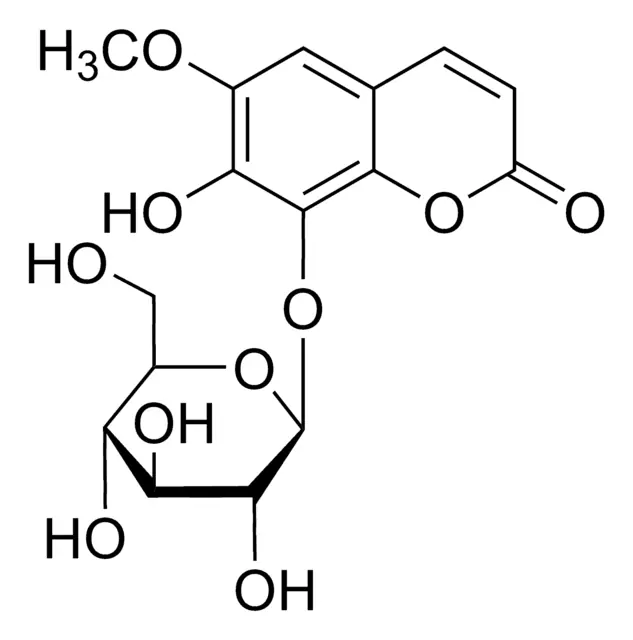
CAS Number524-30-1
Synonyms7,8-Dihydroxy-6-methoxycoumarin-8-b-D-glucoside; 7-Hydroxy-6-methoxy-2-oxo-2H-chromen-8-yl β-D-glucopyranoside; 8-(Glucosyloxy)-6-methoxyumbelliferone; 8-(β-D-Glucopyranosyloxy)-7-hydroxy-6-methoxy-2H-1-benzopyran-2-one; Fraxin; 8-(b-D-Glucopyranosyloxy)-7-hydroxy-6-methoxy-2H-1-benzopyran-2-one; Fraxoside; Fraxetin-8-O-glucoside; Fraxetin-8-glucoside; Paviin; 7-Hydroxy-6-methoxy-2-oxo-2H-chromen-8-yl-β-D-glucopyranoside; Fraxetol 8-glucoside
Molecular FormulaC16H18O10
Molecular Weight370.31
Purity≥95.0 (HPLC)%
Density1.6±0.1 g/cm3
Boiling Point722.2±60.0 °C at 760 mmHg
Melting Point205-208ºC
Appearanceyellow powder
Symbol
Signal WordWarning
| Chemical & Physical Properties | |
|---|---|
| CAS Number | 524-30-1 |
| Catalog No. | 2A-9010631 |
| Chinese Name | 秦皮苷; 白蜡树苷 |
| Synonyms | 7,8-Dihydroxy-6-methoxycoumarin-8-b-D-glucoside; 7-Hydroxy-6-methoxy-2-oxo-2H-chromen-8-yl β-D-glucopyranoside; 8-(Glucosyloxy)-6-methoxyumbelliferone; 8-(β-D-Glucopyranosyloxy)-7-hydroxy-6-methoxy-2H-1-benzopyran-2-one; Fraxin; 8-(b-D-Glucopyranosyloxy)-7-hydroxy-6-methoxy-2H-1-benzopyran-2-one; Fraxoside; Fraxetin-8-O-glucoside; Fraxetin-8-glucoside; Paviin; 7-Hydroxy-6-methoxy-2-oxo-2H-chromen-8-yl-β-D-glucopyranoside; Fraxetol 8-glucoside |
| Molecular Formula | C16H18O10 |
| Molecular Weight | 370.31 |
| Purity | ≥95.0 (HPLC) |
| Density | 1.6±0.1 g/cm3 |
| Boiling Point | 722.2±60.0 °C at 760 mmHg |
| Melting Point | 205-208ºC |
| Appearance | yellow powder |
| Storage Condition | 2-8°C |
| Application | Fraxin can be isolated from Acer tegmentosum, F. ornus and A. hippocastanum. It is a glycoside of ash lactone [1] and has antioxidant, anti-inflammatory and anti-metastatic activities. Fraxin exhibits |
| MDL Number | MFCD00010093 |
| SMILES | COc1cc2C=CC(=O)Oc2c(OC3OC(CO)C(O)C(O)C3O)c1O |
| InChI | 1S/C16H18O10/c1-23-7-4-6-2-3-9(18)25-14(6)15(11(7)20)26-16-13(22)12(21)10(19)8(5-17)24-16/h2-4,8,10,12-13,16-17,19-22H,5H2,1H3/t8-,10-,12+,13-,16+/m1/s1 |
| InChI Key | CRSFLLTWRCYNNX-QBNNUVSCSA-N |
| NACRES Code | NA.24 |
| UNSPSC | 41116107 |
| Hazard Symbols | Transport |
| MSDS | msds/10631_1_524_30_1.pdf |
| Bioactivity | Fraxin isolated from Acer tegmentosum, F. ornus or A. hippocastanum, is a glucoside of fraxetin and reported to exert potent anti-oxidative stress action[1], anti-inflammatory and antimetastatic properties. Fraxin shows its antioxidative effect through inhibition of cyclo AMP phosphodiesterase enzyme[2]. Related Catalog Signaling Pathways >> Metabolic Enzyme/Protease >> Phosphodiesterase (PDE) Research Areas >> Inflammation/Immunology Natural Products >> Saccharides and Glycosides Target Cyclo AMP phosphodiesterase enzyme[2]. In Vitro Fraxin (100 μM) is non-cytotoxic on Hep G2 cells. Fraxin at non-cytotoxic concentrations significantly decreases the t-BHP-induced ROS generation in a dose-dependent manner[1]. Fraxin (0.5 mM) shows free radical scavenging effect at high concentration and cell protective effect against H2O2-mediated oxidative stress[2]. In Vivo Fraxin (50 mg/kg, p.o.) significantly blocks the CCl4-induced elevation of ALT and AST. Fraxin (10 and 50 mg/kg, p.o.) significantly reduces the GSSG levels (1.7±0.3 and 1.5±0.2 nM/g liver, respectively) compared with the GSSG levels of the CCl4-treated group[1]. References [1]. Fraxin (50 mg/kg, p.o.) significantly blocks the CCl4-induced elevation of ALT and AST. Fraxin (10 and 50 mg/kg, p.o.) significantly reduces the GSSG levels (1.7±0.3 and 1.5±0.2 nM/g liver, respectively) compared with the GSSG levels of the CCl4-treated group[1]. [2]. Whang WK, et al. Natural compounds,fraxin and chemicals structurally related to fraxin protect cells from oxidative stress. Exp Mol Med. 2005 Oct 31;37(5):436-46. Chemical & Physical Properties Density 1.6±0.1 g/cm3 Boiling Point 722.2±60.0 °C at 760 mmHg Melting Point 205-208ºC Molecular Formula C16H18O10 Molecular Weight 370.308 Flash Point 267.1±26.4 °C Exact Mass 370.089996 PSA 159.05000 LogP -1.93 Vapour Pressure 0.0±2.5 mmHg at 25°C Index of Refraction 1.664 InChIKey CRSFLLTWRCYNNX-QBNNUVSCSA-N SMILES COc1cc2ccc(=O)oc2c(OC2OC(CO)C(O)C(O)C2O)c1O Storage condition 2-8°C |
| Use of | Fraxin isolated from Acer tegmentosum, F. ornus or A. hippocastanum, is a glucoside of fraxetin and reported to exert potent anti-oxidative stress action[1], anti-inflammatory and antimetastatic properties. Fraxin shows its antioxidative effect through inhibition of cyclo AMP phosphodiesterase enzyme[2]. Properties Articles12 Name fraxin Synonym More Synonyms Fraxin Biological Activity Description Fraxin isolated from Acer tegmentosum, F. ornus or A. hippocastanum, is a glucoside of fraxetin and reported to exert potent anti-oxidative stress action[1], anti-inflammatory and antimetastatic properties. Fraxin shows its antioxidative effect through inhibition of cyclo AMP phosphodiesterase enzyme[2]. Related Catalog Signaling Pathways >> Metabolic Enzyme/Protease >> Phosphodiesterase (PDE) Research Areas >> Inflammation/Immunology Natural Products >> Saccharides and Glycosides Cyclo AMP phosphodiesterase enzyme[2]. References [2]. Whang WK, et al. Natural compounds,fraxin and chemicals structurally related to fraxin protect cells from oxidative stress. Exp Mol Med. 2005 Oct 31;37(5):436-46. Chemical & Physical Properties Molecular Formula C16H18O10 Exact Mass 370.089996 PSA 159.05000 LogP -1.93 Index of Refraction 1.664 InChIKey CRSFLLTWRCYNNX-QBNNUVSCSA-N |
| Transport Info | Shipping Name: UN |
| MSDS Transport Info | Module 14. Shipping information 14.1 UN dangerous goods number European Land Transport Dangerous Regulations: -International Maritime Dangerous Regulations: -International Air Transport Dangerous Regulations: - 14.2 United Nations shipping name European Land Transport Dangerous Regulations: Non-dangerous goods IMDG Code: Non-dangerous goods International air transport dangerous goods regulations: non-dangerous goods 14.3 Transport hazard categories European Land Transport Dangerous Regulations: -International Maritime Dangerous Regulations: -International Air Transport Dangerous Regulations: - 14.4 Package group European Land Transport Dangerous Regulations: -International Maritime Dangerous Regulations: -International Air Transport Dangerous Regulations: - 14.5 Environmental hazards European Land Transport Danger Regulations: No International Maritime Danger Regulations International Air Transport Danger Regulations: No Marine pollutants (yes/no): No 14.6 Special reminder to users No data available |
| Related Products in Botanical Reference Standards | ||
|---|---|---|
| Escin | 11072-93-8 | 2A-9010376 |
| Esculin | 531-75-9 | 2A-9010379 |
| Eucommia ulmoides Oliver | 2A-301514 | 2A-9010431 |
| Frangulin A | 521-62-0 | 2A-9010628 |
| Frangulin B | 14101-04-3 | 2A-9010629 |
| Fucosterol | 17605-67-3 | 2A-9010644 |
| Genistein | 446-72-0 | 2A-9010713 |
| Gentiopicrin | 20831-76-9 | 2A-9010716 |
| Ginkgolide A | 15291-75-5 | 2A-9010726 |
| Ginkgolide C | 15291-76-6 | 2A-9010728 |
| Browse all Botanical Reference Standards products » | ||
Phone:
630-322-8886
630-322-8887
Email:
Office Locations:
Chicago, IL, USA
San Francisco, CA, USA


 EN
EN


 SDS
SDS