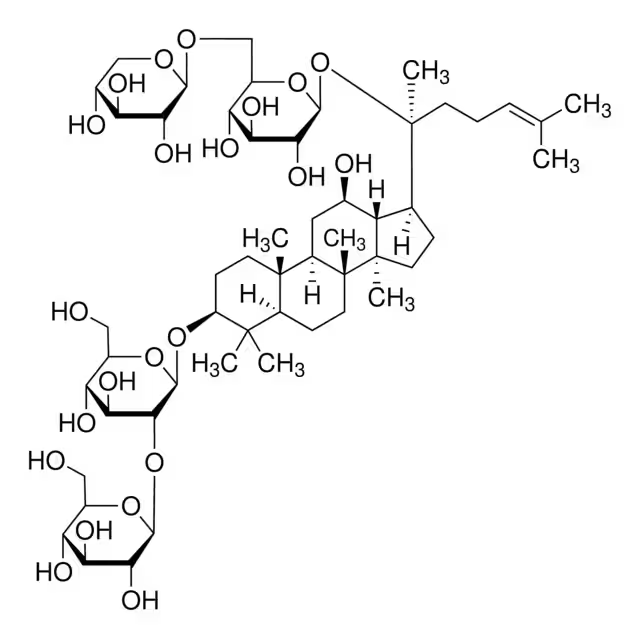
CAS Number68406-26-8
Synonyms20(S)-ginsenoside Rg3; Ginsenoside Rg3 (R-); ginsenoside-RB2; 20(R)Ginsenoside Rg3; GinsenosideRb3; 3-epicabraleahydroxylactone; 3|A-Acetoxy-22,23-dinorchol-5-en-24-al; Ginsenoside Rb3; (3|A,20S)-20-Formyl-3-hydroxy-5-pregnene 3-O-AcetateDiscontinued; Ginsenoside Rg3 Rh2; (20S)-3|A-Acetoxypregn-5-ene-20-carboxaldehyde; (3|A,20S)-3-(Acetyloxy)pregn-5-ene-20-carboxaldehyde; R-form-Ginsenoside Rg3; GINSENOSIDE RG3(R-FORM)(P); 3|A-Acetoxybisnor-5-cholen-22-al
Molecular FormulaC53H90O22
Molecular Weight1079.27
Purity≥90.0 (HPLC)%
Density1.4±0.1 g/cm3
Boiling Point1117.1±65.0 °C at 760 mmHg
Appearancesolid
Symbol
Signal WordWarning


Please Login or Create an Account to: See VlP prices and availability
US Stock: ship in 0-1 business day
Global Stock: ship in 5-7 days
| Chemical & Physical Properties | |
|---|---|
| CAS Number | 68406-26-8 |
| Catalog No. | 2A-9010734 |
| Chinese Name | 人参皂苷Rb3 |
| Synonyms | 20(S)-ginsenoside Rg3; Ginsenoside Rg3 (R-); ginsenoside-RB2; 20(R)Ginsenoside Rg3; GinsenosideRb3; 3-epicabraleahydroxylactone; 3|A-Acetoxy-22,23-dinorchol-5-en-24-al; Ginsenoside Rb3; (3|A,20S)-20-Formyl-3-hydroxy-5-pregnene 3-O-AcetateDiscontinued; Ginsenoside Rg3 Rh2; (20S)-3|A-Acetoxypregn-5-ene-20-carboxaldehyde; (3|A,20S)-3-(Acetyloxy)pregn-5-ene-20-carboxaldehyde; R-form-Ginsenoside Rg3; GINSENOSIDE RG3(R-FORM)(P); 3|A-Acetoxybisnor-5-cholen-22-al |
| Molecular Formula | C53H90O22 |
| Molecular Weight | 1079.27 |
| Purity | ≥90.0 (HPLC) |
| Density | 1.4±0.1 g/cm3 |
| Boiling Point | 1117.1±65.0 °C at 760 mmHg |
| Appearance | solid |
| Storage Condition | 2-8°C |
| Application | Ginsenoside Rb3 is extracted from Panax notoginseng. Ginsenoside Rb3 inhibits TNFα-induced NF-κB transcriptional activity in the 293T cell line with an IC50 of 8.2 μM. Ginsenoside Rb3 also inhibits th |
| HTC | 29389090 |
| MDL Number | MFCD10566396 |
| SMILES | C\C(C)=C/CC[C@](C)(O[C@@H]1O[C@H](CO[C@@H]2OC[C@@H](O)[C@H](O)[C@H]2O)[C@@H](O)[C@H](O)[C@H]1O)[C@H]3CC[C@]4(C)[C@@H]3[C@H](O)C[C@@H]5[C@@]6(C)CC[C@H](O[C@@H]7O[C@H](CO)[C@@H](O)[C@H](O)[C@H]7O[C@@H]8O[C@H](CO)[C@@H](O)[C@H](O)[C@H]8O)C(C)(C)[C@@H]6CC[C@@]45C |
| InChI | 1S/C53H90O22/c1-23(2)10-9-14-53(8,75-47-43(67)39(63)37(61)29(72-47)22-69-45-41(65)34(58)26(57)21-68-45)24-11-16-52(7)33(24)25(56)18-31-50(5)15-13-32(49(3,4)30(50)12-17-51(31,52)6)73-48-44(40(64)36(60)28(20-55)71-48)74-46-42(66)38(62)35(59)27(19-54)70-46/h10,24-48,54-67H,9,11-22H2,1-8H3/t24-,25+,26+,27+,28+,29+,30-,31+,32-,33-,34-,35+,36+,37+,38-,39-,40-,41+,42+,43+,44+,45-,46-,47-,48-,50-,51+,52+,53-/m0/s1 |
| InChI Key | NODILNFGTFIURN-USYOXQFSSA-N |
| NACRES Code | NA.24 |
| UNSPSC | 41116107 |
| Hazard Symbols | Transport |
| MSDS | msds/10734_1_68406_26_8.pdf |
| Bioactivity | Ginsenoside Rb3 is extracted from steamed Panax notoginseng. Ginsenoside Rb3 exhibits inhibitory effect on TNFα-induced NF-κB transcriptional activity with an IC50 of 8.2 μM in 293T cell lines. Ginsenoside Rb3 also inhibits the induction of COX-2 and iNOS mRNA. Related Catalog Signaling Pathways >> Immunology/Inflammation >> NO Synthase Research Areas >> Cancer Research Areas >> Inflammation/Immunology Natural Products >> Terpenoids and Glycosides Target NF-κB:8.2 μM (IC50, in 293T cell lines) COX-2 iNOS In Vitro Ginsenoside Rb3 (0.1-10 μM) is tested for inhibition of tumor necrosis factor-α (TNF)-induced nuclear factor kappa-light-chain-enhancer of activated B cells (NF-κB) luciferase reporter activity using a human kidney 293T cell-based assay. Ginsenoside Rb3 shows the significant activity with an IC50 of 8.2 μM. Ginsenoside Rb3 also inhibits the induction of cyclooxygenase-2 (COX-2) and inducible nitric oxide synthase (iNOS) messenger Ribonucleic acid (mRNA) in a dose-dependent manner after HepG2 cells have been treated with TNF-α (10 ng/mL)[1]. Ginsenoside Rb3 (0.1-10 μM) significantly increases cell viability and inhibits lactate dehydrogenase (LDH) release in a dose-dependent manner. PC12 cell viability as determined by MTT reduction is also markedly decreased after the cell is exposed to oxygen and glucose deprivation (OGD)/OGD-Rep. But, when the cells are pretreated with Ginsenoside Rb3 (0.1, 1, and 10 μM), OGD/OGD-Rep induced cell toxicity is significantly attenuated, which is concentration-dependently attenuated by Ginsenoside Rb3 treatment. The viabilities are raised to 52.8%±5.6%, 64.6%±5.7%, and 76.4%±8.8%, respectively, compared with the control group[2]. In Vivo Ginsenosides Rb3 is a major compound isolated from Gynostemma pentaphyllum that holistically improves gut microenvironment and induces anti-polyposis in ApcMin/+ mice. Six-weeks-old mice are subjected to Rb3 treatment, before the appearance of the intestinal polyps. All the mice are monitored for food intake, water consumption, and weight changes. Throughout the experiment, no Rb3/Rd-associated weight loss in mice is observed. In addition, none of the treated mice show variations in food and water consumption. Whereas, the number and size of the polyps are effectively reduced by Rb3 treatments[3]. Kinase Assay HepG2 cells are seeded at a concentration of 1×10⁵ cells/mL (1.5 mL) in a 12-well plate and grown for 24 h. All cells are then transfected with Pnf-κB-luc plasmid (0.5 μg/well). Transfection are performed by the lipofectamine LTX. After 23 h of transfection, medium is changed to assay medium. After 24 h of transfection, cells are treated with test compounds (e.g., Ginsenoside Rb3; 0.1, 1 and 10 uM) for another 24 hours. After 25 h of transfection, cells are treated with 10 ng/mL of TNF-α for another 23 hours. The luciferase activity of cell lysates is assayed with 100 μL of by luciferase assay kit using an LB 953 Autolumat. Transfections are performed in triplicate, and activation is normalized against α-galactosidase activity[1]. Cell Assay NGF-differentiated PC12 cells are plated at a density of 1.0×10⁵ cells/mL 2 days before each experiment. To initiate OGD, the cell culture medium is removed and replaced with the glucose-free DMEM, then the cells are incubated at 37°C in an oxygen-free chamber (95% N2 and 5% CO2) for 4 h (OGD), and the change in oxygen levels of the culture medium are monitored during incubation in oxygen-free chamber. Following OGD, glucose is added to normal levels (final concentration: 4.5 mg/mL) and cells are incubated under normal growth conditions (95% air and 5% CO2) for additional 24 h as OGD-reperfusion (OGD-Rep). Ginsenoside Rb3 (0.1, 1, 10 μM) is added to the culture 24 h before OGD treatment and throughout the OGD reperfusion. The control culture is always maintained in normal DMEM and put in the incubator under normal conditions[2]. Animal Admin Mice[3] Heterozygous male ApcMin/+ (C57BL/6J-ApcMin/+) mice are used. Total 32 male ApcMin/+ mice (aged 6 weeks) are divided into three groups; 10 mice in the control group and 22 mice equally divided for Rb3 and Rd treatments. The mice are daily gavage with a single dose of Ginsenoside Rb3 or Rd at 20 mg/kg, or solvent control. The treatments are carried out for 8 consecutive weeks. References [1]. He F, et al. Antitumor effects of dammarane-type saponins from steamed Notoginseng. Pharmacogn Mag. 2014 Jul;10(39):314-7. [2]. Zhu JR, et al. Protective effects of ginsenoside Rb(3) on oxygen and glucose deprivation-induced ischemic injury in PC12 cells. Acta Pharmacol Sin. 2010 Mar;31(3):273-80. [3]. Huang G, et al. Ginsenosides Rb3 and Rd reduce polyps formation while reinstate the dysbiotic gut microbiota and the intestinal microenvironment in ApcMin/+ mice. Sci Rep. 2017 Oct 2;7(1):12552. Chemical & Physical Properties Density 1.4±0.1 g/cm3 Boiling Point 1117.1±65.0 °C at 760 mmHg Molecular Formula C53H90O22 Molecular Weight 1079.269 Flash Point 629.4±34.3 °C Exact Mass 1078.592407 PSA 357.06000 LogP 4.73 Vapour Pressure 0.0±0.6 mmHg at 25°C Index of Refraction 1.622 InChIKey NODILNFGTFIURN-UHFFFAOYSA-N SMILES CC(C)=CCCC(C)(OC1OC(COC2OCC(O)C(O)C2O)C(O)C(O)C1O)C1CCC2(C)C1C(O)CC1C3(C)CCC(OC4OC(CO)C(O)C(O)C4OC4OC(CO)C(O)C(O)C4O)C(C)(C)C3CCC12C Storage condition 2-8°C |
| Use of | Ginsenoside Rb3 is extracted from steamed Panax notoginseng. Ginsenoside Rb3 exhibits inhibitory effect on TNFα-induced NF-κB transcriptional activity with an IC50 of 8.2 μM in 293T cell lines. Ginsenoside Rb3 also inhibits the induction of COX-2 and iNOS mRNA. Properties Articles21 Name ginsenoside Rb3 Synonym More Synonyms Ginsenoside Rb3 Biological Activity Description Ginsenoside Rb3 is extracted from steamed Panax notoginseng. Ginsenoside Rb3 exhibits inhibitory effect on TNFα-induced NF-κB transcriptional activity with an IC50 of 8.2 μM in 293T cell lines. Ginsenoside Rb3 also inhibits the induction of COX-2 and iNOS mRNA. Related Catalog Signaling Pathways >> Immunology/Inflammation >> NO Synthase Research Areas >> Cancer Research Areas >> Inflammation/Immunology Natural Products >> Terpenoids and Glycosides NF-κB:8.2 μM (IC50, in 293T cell lines) References [1]. He F, et al. Antitumor effects of dammarane-type saponins from steamed Notoginseng. Pharmacogn Mag. 2014 Jul;10(39):314-7. [3]. Huang G, et al. Ginsenosides Rb3 and Rd reduce polyps formation while reinstate the dysbiotic gut microbiota and the intestinal microenvironment in ApcMin/+ mice. Sci Rep. 2017 Oct 2;7(1):12552. Chemical & Physical Properties Molecular Formula C53H90O22 Exact Mass 1078.592407 PSA 357.06000 Index of Refraction 1.622 InChIKey NODILNFGTFIURN-UHFFFAOYSA-N |
| Transport Info | Product name: Purity: 98.0% |
| MSDS Transport Info | Module 14. Shipping information 14.1 UN dangerous goods number European Land Transport Dangerous Regulations: -International Maritime Dangerous Regulations: -International Air Transport Dangerous Regulations: - 14.2 Names specified by the United Nations (UN) European Land Transport Dangerous Regulations: Non-dangerous goods IMDG Code: Non-dangerous goods International air transport dangerous goods regulations: non-dangerous goods 14.3 Transport hazard categories European Land Transport Dangerous Regulations: -International Maritime Dangerous Regulations: -International Air Transport Dangerous Regulations: - 14.4 Package group European Land Transport Dangerous Regulations: -International Maritime Dangerous Regulations: -International Air Transport Dangerous Regulations: - 14.5 Environmental hazards European Land Transport Dangerous Regulations: No International Maritime Transport Dangerous Regulations Maritime Pollutants: No International Air Transport Risk Regulations: No 14.6 Special reminder to users No data available |
| Related Products in Botanical Reference Standards | ||
|---|---|---|
| Ginkgolide A | 15291-75-5 | 2A-9010726 |
| Ginkgolide C | 15291-76-6 | 2A-9010728 |
| Ginsenoside F1 | 53963-43-2 | 2A-9010731 |
| Ginsenoside F3 | 62025-50-7 | 2A-9010732 |
| Ginsenoside Rb1 | 41753-43-9 | 2A-9010733 |
| Ginsenoside Rc | 11021-14-0 | 2A-9010735 |
| Ginsenoside Re | 52286-59-6 | 2A-9010736 |
| Ginsenoside Rg1 | 22427-39-0 | 2A-9010737 |
| Ginsenoside Rg2 | 52286-74-5 | 2A-9010738 |
| Ginsenoside Rg3 | 14197-60-5 | 2A-9010739 |
| Browse all Botanical Reference Standards products » | ||
Phone:
630-322-8886
630-322-8887
Email:
Office Locations:
Chicago, IL, USA
San Francisco, CA, USA


 EN
EN

 SDS
SDS