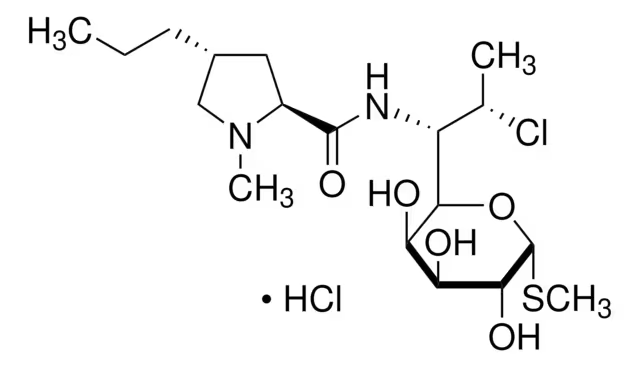
CAS Number21462-39-5
SynonymsEINECS 244-398-6; Cleocin HCL; MFCD07793327; 7(S)-Chloro-7-deoxylincomycin hydrochloride; (7S)-7-Chloro-7-deoxylincomycin hydrochloride Cleocin; (7S)-7-Chloro-7-deoxylincomycin hydrochloride; 7-Chloro-7-deoxylincomycin hydrochloride; Clindimycin hydrochloride; clindamycin hydrochloride
Molecular FormulaC18H34Cl2N2O5S
Molecular Weight461.44
Purity98.00%
Boiling Point628.1ºC at 760 mmHg
Melting Point141°C
Appearancepowder or crystals
Symbol
Signal WordWarning
| Chemical & Physical Properties | |
|---|---|
| CAS Number | 21462-39-5 |
| Catalog No. | 2A-9009836 |
| Chinese Name | 盐酸克林霉素 |
| Synonyms | EINECS 244-398-6; Cleocin HCL; MFCD07793327; 7(S)-Chloro-7-deoxylincomycin hydrochloride; (7S)-7-Chloro-7-deoxylincomycin hydrochloride Cleocin; (7S)-7-Chloro-7-deoxylincomycin hydrochloride; 7-Chloro-7-deoxylincomycin hydrochloride; Clindimycin hydrochloride; clindamycin hydrochloride |
| Molecular Formula | C18H34Cl2N2O5S |
| Molecular Weight | 461.44 |
| Purity | 98.00 |
| Boiling Point | 628.1ºC at 760 mmHg |
| Melting Point | 141°C |
| Appearance | powder or crystals |
| Water Solubility | H2O: 50 mg/mL, clear, colorless |
| Storage Condition | 2-8℃ |
| Application | Clindamycin hydrochloride is a semi-synthetic lincosamide antibiotic that inhibits protein synthesis by acting on 50S ribosomal. |
| HTC | 2941904000 |
| PubChem ID | 24892772 |
| MDL Number | MFCD07793327 |
| SMILES | Cl.CCC[C@@H]1C[C@H](N(C)C1)C(=O)N[C@H]([C@H](C)Cl)C2O[C@H](SC)[C@H](O)[C@@H](O)[C@H]2O |
| InChI | 1S/C18H33ClN2O5S.ClH/c1-5-6-10-7-11(21(3)8-10)17(25)20-12(9(2)19)16-14(23)13(22)15(24)18(26-16)27-4;/h9-16,18,22-24H,5-8H2,1-4H3,(H,20,25);1H/t9-,10+,11-,12+,13-,14+,15+,16+,18+;/m0./s1 |
| InChI Key | AUODDLQVRAJAJM-XJQDNNTCSA-N |
| Beilstein/REAXYS | 4070786 |
| NACRES Code | NA.85 |
| UNSPSC | 51102829 |
| Hazard Symbols | Transport |
| MSDS | msds/9836_1_21462_39_5.pdf |
| Bioactivity | Clindamycin (hydrochloride) is a semisynthetic lincosamide antibiotic, which inhibits protein synthesis by acting on the 50S ribosomal. Related Catalog Signaling Pathways >> Anti-infection >> Bacterial Research Areas >> Infection In Vitro Clindamycin is a classical inhibitor of bacterial protein synthesis, by binding to the 23S ribosomal RNA of the 50S ribosomal subunit[1]. In Vivo Clindamycin hydrochloride results in fast absorption after oral administration in dogs, with a mean absorption time (MAT) of 0.87 hour, and bioavailability is 72.55%. Clindamycin hydrochloride results in total clearance (CL) of Clindamycin after both IV and oral administration (0.503 vs. 0.458 L/h/kg) in dogs. Clindamycin hydrochloride results in volume of distribution at steady-state (IV) at 2.48 L/kg, indicating a wide distribution of clindamycin in body fluids and tissues. Clindamycin serum concentrations after IV and oral administration remain above 0.5 μg/mL approximately for 10 hours[1]. Clindamycin hydrochloride significantly reduces oral malodor from the dogs' baseline levels through 42 days. Clindamycin hydrochloride also results in significant reductions in dental plaque, dental calculus, and gingival bleeding in dogs[2]. Clindamycin hydrochloride (2.5 mg/Lb), after ultrasonic scaling, root planing, and polishing (USRP), has a significant effect on plaque and pocket depth measures of periodontal disease but not on gingivitis in canine[3]. Clindamycin hydrochloride results in complete remission ratio of 71.4% (15/21) in dogs with canine superficial bacterial pyoderma after treat within 14 to 28 days[4]. Animal Admin For the first experimental period, 11 mg/kg BW clindamycin hydrochloride are administered IV to all animals (Day 0), after catheterisation of the left cephalic vein. The catheters (18 G×51 mm Abbocath-T) are removed shortly after administration of the drug. Blood samples (3 mL) are collected into plastic tubes by aspiration from the catheterized lateral cephalic vein, prior to (t=0 h) and at 2, 5, 10, 15, 20, 30, 45 min, 1, 1.5, 2, 2.5, 3, 4, 5, 6, 8, 10, 12 and 24 h after administration. The intravenous catheters are flushed with 2 mL 1% heparinized normal saline after each sampling. On Day 28, all dogs receive one Antirobe capsule (150 mg clindamycin hydrochloride). Dose normalisation from mg/animal to mg/kg BW is carried out in each animal by dividing the total amount of clindamycin received, by its body weight. Blood sample collection is performed, following the technique described above, immediately before (t=0 h) and at 15, 30, 45 min, 1, 1.5, 2, 2.5, 3, 4, 5, 6, 8, 10, 12 and 24 h after drug administration. All blood samples are allowed to stand in a dark place for 20 min. After centrifugation at 1500 g for 10 min, at 4°C, the supernatant serum is transferred into 5-mL plastic tubes and is stored at −30°C, pending analysis. References [1]. Batzias GC, et al. Clindamycin bioavailability and pharmacokinetics following oral administration of clindamycin hydrochloride capsules in dogs. Vet J. 2005 Nov;170(3):339-45. [2]. Warrick JM, et al. Effect of clindamycin hydrochloride on oral malodor, plaque, calculus, and gingivitis in dogs with periodontitis. Vet Ther. 2000 Winter;1(1):5-16. [3]. Nielsen D, et al. Effects of treatment with clindamycin hydrochloride on progression of canine periodontal disease after ultrasonic scaling. Vet Ther. 2000 Summer;1(3):150-8. [4]. Bloom PB, et al. Efficacy of once-daily clindamycin hydrochloride in the treatment of superficial bacterial pyoderma in dogs. J Am Anim Hosp Assoc. 2001 Nov-Dec;37(6):537-42. Chemical & Physical Properties Boiling Point 628.1ºC at 760 mmHg Melting Point 141°C Molecular Formula C18H34Cl2N2O5S Molecular Weight 461.444 Flash Point 333.6ºC Exact Mass 460.156555 PSA 127.56000 LogP 1.52030 Vapour Pressure 1.79E-19mmHg at 25°C InChIKey AUODDLQVRAJAJM-XJQDNNTCSA-N SMILES CCCC1CC(C(=O)NC(C(C)Cl)C2OC(SC)C(O)C(O)C2O)N(C)C1.Cl Storage condition 2-8°C Water Solubility H2O: 50 mg/mL, clear, colorless |
| Use of | Clindamycin (hydrochloride) is a semisynthetic lincosamide antibiotic, which inhibits protein synthesis by acting on the 50S ribosomal. Properties Articles59 Name Clindamycin Hydrochloride Synonym More Synonyms Clindamycin Hydrochloride Biological Activity Description Clindamycin (hydrochloride) is a semisynthetic lincosamide antibiotic, which inhibits protein synthesis by acting on the 50S ribosomal. Related Catalog Signaling Pathways >> Anti-infection >> Bacterial Research Areas >> Infection In Vitro Clindamycin is a classical inhibitor of bacterial protein synthesis, by binding to the 23S ribosomal RNA of the 50S ribosomal subunit[1]. References [1]. Batzias GC, et al. Clindamycin bioavailability and pharmacokinetics following oral administration of clindamycin hydrochloride capsules in dogs. Vet J. 2005 Nov;170(3):339-45. [2]. Warrick JM, et al. Effect of clindamycin hydrochloride on oral malodor, plaque, calculus, and gingivitis in dogs with periodontitis. Vet Ther. 2000 Winter;1(1):5-16. [3]. Nielsen D, et al. Effects of treatment with clindamycin hydrochloride on progression of canine periodontal disease after ultrasonic scaling. Vet Ther. 2000 Summer;1(3):150-8. [4]. Bloom PB, et al. Efficacy of once-daily clindamycin hydrochloride in the treatment of superficial bacterial pyoderma in dogs. J Am Anim Hosp Assoc. 2001 Nov-Dec;37(6):537-42. Chemical & Physical Properties Exact Mass 460.156555 PSA 127.56000 LogP 1.52030 InChIKey AUODDLQVRAJAJM-XJQDNNTCSA-N |
| Transport Info | Shipping Name: UN |
| MSDS Transport Info | Module 14. Shipping information 14.1 UN dangerous goods number European Land Transport Dangerous Regulations: -International Maritime Dangerous Regulations: -International Air Transport Dangerous Regulations: - 14.2 United Nations shipping name European Land Transport Dangerous Regulations: Non-dangerous goods IMDG Code: Non-dangerous goods International air transport dangerous goods regulations: non-dangerous goods 14.3 Transport hazard categories European Land Transport Dangerous Regulations: -International Maritime Dangerous Regulations: -International Air Transport Dangerous Regulations: - 14.4 Package group European Land Transport Dangerous Regulations: -International Maritime Dangerous Regulations: -International Air Transport Dangerous Regulations: - 14.5 Environmental hazards European Land Transport Danger Regulations: No International Maritime Danger Regulations International Air Transport Danger Regulations: No Marine pollutants (yes/no): No 14.6 Special reminder to users No data available |
| Related Products in API & Advanced Intermediates | ||
|---|---|---|
| Ciprofloxacin | 85721-33-1 | 2A-9009818 |
| Ciprofloxacin hydrochloride | 86393-32-0 | 2A-9009819 |
| Ciprofloxacin lactate | 97867-33-9 | 2A-9009820 |
| Clarithromycin | 81103-11-9 | 2A-9009826 |
| Clindamycin | 18323-44-9 | 2A-0201883 |
| Clindamycin palmitate | 36688-78-5 | 2A-9009837 |
| Clindamycin Palmitate Hydrochloride | 25507-04-4 | 2A-9009838 |
| Clindamycin phosphate | 24729-96-2 | 2A-0201388 |
| Clonazepam | 1622-61-3 | 2A-9009862 |
| Clopidogrel | 113665-84-2 | 2A-9009870 |
| Browse all API & Advanced Intermediates products » | ||
Phone:
630-322-8886
630-322-8887
Email:
Office Locations:
Chicago, IL, USA
San Francisco, CA, USA


 EN
EN


 SDS
SDS