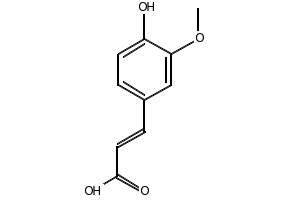
CAS Number1135-24-6
SynonymsFERULLIC ACID; FERULIC ACID pure; Fumalic acid; conifericacid; Forulic acid; 3-(4-Hydroxy-3-methoxyphenyl)acrylic acid; Ferulic acid; Ferulicacid; EINECS 208-679-7; 4-hydroxy-3-methoxy-cinnamic acid; 4-Hydroxy-3-methoxycinnamic acid; MFCD00004400; ferulaic acid
Molecular FormulaC10H10O4
Molecular Weight194.184
Purity99%
Density1.3±0.1 g/cm3
Boiling Point372.3±27.0 °C at 760 mmHg
Melting Point168-172 °C(lit.)
AppearanceLight yellow solid
Symbol
Signal WordWarning
| Chemical & Physical Properties | |
|---|---|
| CAS Number | 1135-24-6 |
| Catalog No. | 2A-9007806 |
| Chinese Name | 阿魏酸 |
| Synonyms | FERULLIC ACID; FERULIC ACID pure; Fumalic acid; conifericacid; Forulic acid; 3-(4-Hydroxy-3-methoxyphenyl)acrylic acid; Ferulic acid; Ferulicacid; EINECS 208-679-7; 4-hydroxy-3-methoxy-cinnamic acid; 4-Hydroxy-3-methoxycinnamic acid; MFCD00004400; ferulaic acid |
| Molecular Formula | C10H10O4 |
| Molecular Weight | 194.184 |
| Purity | 99 |
| Density | 1.3±0.1 g/cm3 |
| Boiling Point | 372.3±27.0 °C at 760 mmHg |
| Melting Point | 168-172 °C(lit.) |
| Appearance | Light yellow solid |
| Water Solubility | soluble |
| Storage Condition | Light-sealed packaging. Store in a cool, dry wareh |
| Application | Ferulic acid is a novel fibroblast growth factor receptor 1 (FGFR1) inhibitor with IC50 values of 3.78 and 12.5 μM for FGFR1 and FGFR2, respectively. |
| HTC | 1302199099 |
| SMILES | COc1cc(\C=C\C(O)=O)ccc1O |
| InChI | InChI=1S/C10H10O4/c1-14-9-6-7(2-4-8(9)11)3-5-10(12)13/h2-6,11H,1H3,(H,12,13)/b5-3+ |
| InChI Key | InChIKey=KSEBMYQBYZTDHS-HWKANZROSA-N |
| Hazard Symbols | Transport |
| MSDS | msds/7806_1_1135_24_6.pdf |
| Bioactivity | Ferulic acid is a novel fibroblast growth factor receptor 1 (FGFR1) inhibitor with IC50s of 3.78 and 12.5 μM for FGFR1 and FGFR2, respectively. Related Catalog Natural Products >> Phenylpropanoids Research Areas >> Cancer Target IC50: 3.78 μM (FGFR1), 12.5 μM (FGFR2)[1] In Vitro Ferulic acid (FA) is a novel fibroblast growth factor receptor 1 (FGFR1) inhibitor with IC50s of 3.78 and 12.5 μM for FGFR1 and FGFR2, respectively. Ferulic acid exhibits great inhibitory activity on FGFR1 with an inhibitory rate of 92% at 1 µM. The proliferation of HUVEC stimulated by FGF1 is markedly decreased after Ferulic acid treatment ranging from 5 to 40 μM for 24 h. Ferulic acid does not exert significant cell viability up to 20 μM, but over 30 μM Ferulic acid exhibits a cytotoxic effect in HUVEC compare to the control. Ferulic acid inhibits FGF1-induced HUVEC migration and invasion in a dose-dependent manner. Ferulic acid markedly suppresses the FGF1-induced phosphorylation of PI3K and Akt. Ferulic acid treatments significantly inhibit MMP-2 and MMP-9 expression stimulated by FGF1[1]. In Vivo Treatment with Ferulic acid (FA) potently inhibits FGF1-induced neovascularization. It is found that intragastric administration of Ferulic acid markedly inhibits tumor volume and tumor weight, as compare to the counterparts treated with DMSO. Furthermore, Ferulic acid treatment is well tolerated, and there is no significant difference in weight between the vehicle group and the FA-treated groups[1]. Ferulic acid (0.01, 0.1, 1 or 10 mg/kg) given by oral route decreases significantly the immobility time in the forced swimming test (FST) and tail suspension test (TST), whereas produces no effect in the open-field test. Results demonstrate that the administration of Ferulic acid (0.001 mg/kg, p.o.) boosts the antidepressant-like effect of fluoxetine (5 mg/kg, p.o.) in the TST[2]. Cell Assay HUVEC (5×10⁴ cells/well) are plated onto a gelatinized 24-well culture plate and cultured in ECGS containing 15% FBS. HUVEC are treated with DMSO (0.1%) or different concentrations of Ferulic acid (FA) (0, 2.5, 5, 10, 20, 30, 40 μM) for 24 h. Cell viability is determined by the MTT assay. After 4 h of incubation, the absorbance is measured at 450 nm with a microplate reader. The results are calculated from six replicates of each experiment. Three independent experiments are performed[1]. Animal Admin Male Swiss mice (30 to 40 g) are maintained at 21 to 23°C with free access to water and food, under a 12:12 h light/dark cycle (lights on at 07:00 h). All manipulations are carried out between, 9:00 and 16:00 h, with each animal used only once. In order to investigate the antidepressant-like effect of Ferulic acid, Ferulic acid is administered at a dose range of 0.001 to 10 mg/kg, by oral route (p.o.) 60 min before the forced swimming test (FST), tail suspension test (TST) or open-field test. The control animals receive appropriate vehicle[2]. References [1]. Yang GW, et al. Ferulic Acid Exerts Anti-Angiogenic and Anti-Tumor Activity by Targeting Fibroblast Growth Factor Receptor 1-Mediated Angiogenesis. Int J Mol Sci. 2015 Oct 12;16(10):24011-31. [2]. Zeni AL, et al. Ferulic acid exerts antidepressant-like effect in the tail suspension test in mice: evidence for the involvement of the serotonergic system. Eur J Pharmacol. 2012 Mar 15;679(1-3):68-74. Chemical & Physical Properties Density 1.3±0.1 g/cm3 Boiling Point 372.3±27.0 °C at 760 mmHg Melting Point 168-172 °C(lit.) Molecular Formula C10H10O4 Molecular Weight 194.184 Flash Point 150.5±17.2 °C Exact Mass 194.057907 PSA 66.76000 LogP 1.64 Vapour Pressure 0.0±0.9 mmHg at 25°C Index of Refraction 1.627 Storage condition -20°C Freezer Water Solubility soluble |
| Use of | Ferulic acid is a novel fibroblast growth factor receptor 1 (FGFR1) inhibitor with IC50s of 3.78 and 12.5 μM for FGFR1 and FGFR2, respectively. Properties Articles32 Name ferulic acid Synonym More Synonyms ferulic acid Biological Activity Description Ferulic acid is a novel fibroblast growth factor receptor 1 (FGFR1) inhibitor with IC50s of 3.78 and 12.5 μM for FGFR1 and FGFR2, respectively. Related Catalog Natural Products >> Phenylpropanoids Research Areas >> Cancer IC50: 3.78 μM (FGFR1), 12.5 μM (FGFR2)[1] In Vitro Ferulic acid (FA) is a novel fibroblast growth factor receptor 1 (FGFR1) inhibitor with IC50s of 3.78 and 12.5 μM for FGFR1 and FGFR2, respectively. Ferulic acid exhibits great inhibitory activity on FGFR1 with an inhibitory rate of 92% at 1 µM. The proliferation of HUVEC stimulated by FGF1 is markedly decreased after Ferulic acid treatment ranging from 5 to 40 μM for 24 h. Ferulic acid does not exert significant cell viability up to 20 μM, but over 30 μM Ferulic acid exhibits a cytotoxic effect in HUVEC compare to the control. Ferulic acid inhibits FGF1-induced HUVEC migration and invasion in a dose-dependent manner. Ferulic acid markedly suppresses the FGF1-induced phosphorylation of PI3K and Akt. Ferulic acid treatments significantly inhibit MMP-2 and MMP-9 expression stimulated by FGF1[1]. References [1]. Yang GW, et al. Ferulic Acid Exerts Anti-Angiogenic and Anti-Tumor Activity by Targeting Fibroblast Growth Factor Receptor 1-Mediated Angiogenesis. Int J Mol Sci. 2015 Oct 12;16(10):24011-31. [2]. Zeni AL, et al. Ferulic acid exerts antidepressant-like effect in the tail suspension test in mice: evidence for the involvement of the serotonergic system. Eur J Pharmacol. 2012 Mar 15;679(1-3):68-74. Chemical & Physical Properties Molecular Formula C10H10O4 Exact Mass 194.057907 PSA 66.76000 Index of Refraction 1.627 Water Solubility soluble |
| Tax Rebate | 13.0% |
| Supervision | None. MFN tariff: 6.5%. Ordinary tariff: 30.0% |
| Transport Info | Shipping Name: UN |
| MSDS Transport Info | Module 14. Shipping information 14.1 UN dangerous goods number European Land Transport Dangerous Regulations: -International Maritime Dangerous Regulations: -International Air Transport Dangerous Regulations: - 14.2 United Nations shipping name European Land Transport Dangerous Regulations: Non-dangerous goods IMDG Code: Non-dangerous goods International air transport dangerous goods regulations: non-dangerous goods 14.3 Transport hazard categories European Land Transport Dangerous Regulations: -International Maritime Dangerous Regulations: -International Air Transport Dangerous Regulations: - 14.4 Package group European Land Transport Dangerous Regulations: -International Maritime Dangerous Regulations: -International Air Transport Dangerous Regulations: - 14.5 Environmental hazards European Land Transport Danger Regulations: No International Maritime Danger Regulations International Air Transport Danger Regulations: No Marine pollutants (yes/no): No 14.6 Special reminder to users No data available The above information is believed to be correct, but is not all-inclusive and should be used as a guide only. The information in this document is based on our current knowledge and is Correct safety instructions apply to this product. This information does not represent a warranty as to the properties of this product. See reverse side of invoice or packing slip. |
| Related Products in Botanical Reference Standards | ||
|---|---|---|
| Apigenin | 520-36-5 | 2A-9007122 |
| Chrysin | 480-40-4 | 2A-9007408 |
| cis-Stilbene | 645-49-8 | 2A-9007429 |
| Dihydrogenistein | 2A-107592 | 2A-9007592 |
| Dihydrotanshinone | 20958-18-3 | 2A-9007595 |
| Ferulic acid ethyl ester | 4046-02-0 | 2A-9007807 |
| Formononetin | 485-72-3 | 2A-9007878 |
| Genistein trimethyl ether | 1162-82-9 | 2A-9007890 |
| Genistein-4',7-dimethyl ether | 34086-51-6 | 2A-9007891 |
| Genisteine | 446-95-7 | 2A-9007892 |
| Browse all Botanical Reference Standards products » | ||
Phone:
630-322-8886
630-322-8887
Email:
Office Locations:
Chicago, IL, USA
San Francisco, CA, USA


 EN
EN


 SDS
SDS