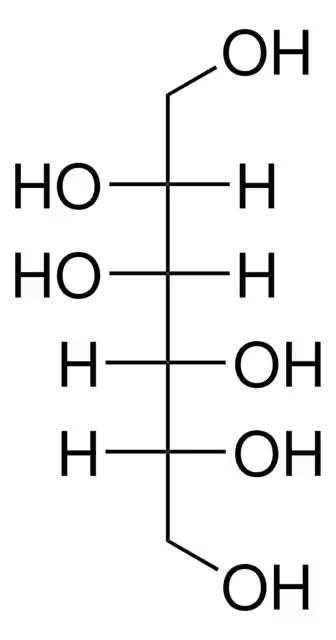
CAS Number69-65-8
SynonymsMannit p; MFCD00064287; Cytosine API; 4-aminopyrimidin-2-one; D-Mannitol; EINECS 200-711-8; (2R,3R,4R,5R)-hexane-1,2,3,4,5,6-hexol; Mannitol; Cordycepate; (2R,3R,4R,5R)-Hexan-1,2,3,4,5,6-hexol; [3H]-Cytosine; Osmitrol; manicol; [3H]-D-(-)-Mannitol; D-Mannitol (JP15); Cyt; Mannitol (USP); Maniton S; Mushroom sugar; (2R,3R,4R,5R)-1,2,3,4,5,6-Hexanehexol; Osmitrol (TN); Cytosin; Cytosinimine
Molecular FormulaC6H14O6
Molecular Weight182.17
Purity≥98 (GC)%
Density1.6±0.1 g/cm3
Boiling Point494.9±0.0 °C at 760 mmHg
Melting Point167-170 °C (lit.)
Appearancepowder
EINECS200-711-8
Symbol
Signal WordWarning
| Chemical & Physical Properties | |
|---|---|
| CAS Number | 69-65-8 |
| Catalog No. | 2A-9016986 |
| Chinese Name | 甘露醇 |
| Synonyms | Mannit p; MFCD00064287; Cytosine API; 4-aminopyrimidin-2-one; D-Mannitol; EINECS 200-711-8; (2R,3R,4R,5R)-hexane-1,2,3,4,5,6-hexol; Mannitol; Cordycepate; (2R,3R,4R,5R)-Hexan-1,2,3,4,5,6-hexol; [3H]-Cytosine; Osmitrol; manicol; [3H]-D-(-)-Mannitol; D-Mannitol (JP15); Cyt; Mannitol (USP); Maniton S; Mushroom sugar; (2R,3R,4R,5R)-1,2,3,4,5,6-Hexanehexol; Osmitrol (TN); Cytosin; Cytosinimine |
| Molecular Formula | C6H14O6 |
| Molecular Weight | 182.17 |
| Purity | ≥98 (GC) |
| Density | 1.6±0.1 g/cm3 |
| Boiling Point | 494.9±0.0 °C at 760 mmHg |
| Melting Point | 167-170 °C (lit.) |
| Appearance | powder |
| Water Solubility | Water solubility: soluble; insoluble: ether |
| Storage Condition | Food grade plastic bag coated with kraft paper bag |
| Application | D-Mannitol is an osmotic diuretic with weak renal vasodilatory activity. |
| EINECS | 200-711-8 |
| HTC | 2905430000 |
| PubChem ID | 24896902 |
| MDL Number | MFCD00064287 |
| SMILES | OC[C@@H](O)[C@@H](O)[C@H](O)[C@H](O)CO |
| InChI | 1S/C6H14O6/c7-1-3(9)5(11)6(12)4(10)2-8/h3-12H,1-2H2/t3-,4-,5-,6-/m1/s1 |
| InChI Key | FBPFZTCFMRRESA-KVTDHHQDSA-N |
| Beilstein/REAXYS | 1721898 |
| NACRES Code | NA.21 |
| UNSPSC | 12352201 |
| Hazard Symbols | Transport |
| MSDS | msds/16986_1_69_65_8.pdf |
| Bioactivity | D-Mannitol is an osmotic diuretic agent and a weak renal vasodilator.Target: OthersD(-)Mannitol is a sugar alcohol that can be used as an inert osmotic control substance. The uptake and phosphorylation of d-mannitol is catalyzed by the mannitol-specific phosphoenolpyruvate-dependent phosphotransferase systems (PTS). Mannitol can interact with neutrophils and monocytes. Experiments have shown that it is able to decrease neutrophil apoptosis in vitro. The compound has been used in studies as a stimulator of cecal microbial growth and cellulolytic activity in rabbits. It has been observed that mannitol can lower the fat digestibility and body fat accumulation in both normal and cecectomized rats, as well as upregulate monocyte HLA-DR, monocyte and neutrophil CD11b. Studies show that the mannitol operon is repressed by the transcription factor, mannitol operon repressor (MtlR) in Escherichia coli [1-3]. Related Catalog Research Areas >> Metabolic Disease Natural Products >> Others Target Human Endogenous Metabolite References [1]. Tan, K., et al., The mannitol operon repressor MtlR belongs to a new class of transcription regulators in bacteria. J Biol Chem, 2009. 284(52): p. 36670-9. [2]. Nishiyama, A., et al., Mannitol lowers fat digestibility and body fat accumulation in both normal and cecectomized rats. J Nutr Sci Vitaminol (Tokyo), 2009. 55(3): p. 242-51. [3]. Hanieh, H. and E. Sakaguchi, Effect of D-mannitol on feed digestion and cecotrophic system in rabbits. Anim Sci J, 2009. 80(2): p. 157-62. Chemical & Physical Properties Density 1.6±0.1 g/cm3 Boiling Point 494.9±0.0 °C at 760 mmHg Melting Point 167-170ºC Molecular Formula C6H14O6 Molecular Weight 182.172 Flash Point 292.5±23.3 °C Exact Mass 182.079041 PSA 121.38000 LogP -4.67 Vapour Pressure 0.0±2.8 mmHg at 25°C Index of Refraction 1.597 InChIKey FBPFZTCFMRRESA-KVTDHHQDSA-N SMILES OCC(O)C(O)C(O)C(O)CO |
| Use of | D-Mannitol is an osmotic diuretic agent and a weak renal vasodilator.Target: OthersD(-)Mannitol is a sugar alcohol that can be used as an inert osmotic control substance. The uptake and phosphorylation of d-mannitol is catalyzed by the mannitol-specific phosphoenolpyruvate-dependent phosphotransferase systems (PTS). Mannitol can interact with neutrophils and monocytes. Experiments have shown that it is able to decrease neutrophil apoptosis in vitro. The compound has been used in studies as a stimulator of cecal microbial growth and cellulolytic activity in rabbits. It has been observed that mannitol can lower the fat digestibility and body fat accumulation in both normal and cecectomized rats, as well as upregulate monocyte HLA-DR, monocyte and neutrophil CD11b. Studies show that the mannitol operon is repressed by the transcription factor, mannitol operon repressor (MtlR) in Escherichia coli [1-3]. Properties Articles573 Name D-mannitol Synonym More Synonyms D-Mannitol Biological Activity Description D-Mannitol is an osmotic diuretic agent and a weak renal vasodilator.Target: OthersD(-)Mannitol is a sugar alcohol that can be used as an inert osmotic control substance. The uptake and phosphorylation of d-mannitol is catalyzed by the mannitol-specific phosphoenolpyruvate-dependent phosphotransferase systems (PTS). Mannitol can interact with neutrophils and monocytes. Experiments have shown that it is able to decrease neutrophil apoptosis in vitro. The compound has been used in studies as a stimulator of cecal microbial growth and cellulolytic activity in rabbits. It has been observed that mannitol can lower the fat digestibility and body fat accumulation in both normal and cecectomized rats, as well as upregulate monocyte HLA-DR, monocyte and neutrophil CD11b. Studies show that the mannitol operon is repressed by the transcription factor, mannitol operon repressor (MtlR) in Escherichia coli [1-3]. Related Catalog Research Areas >> Metabolic Disease Natural Products >> Others Human Endogenous Metabolite References [1]. Tan, K., et al., The mannitol operon repressor MtlR belongs to a new class of transcription regulators in bacteria. J Biol Chem, 2009. 284(52): p. 36670-9. [2]. Nishiyama, A., et al., Mannitol lowers fat digestibility and body fat accumulation in both normal and cecectomized rats. J Nutr Sci Vitaminol (Tokyo), 2009. 55(3): p. 242-51. [3]. Hanieh, H. and E. Sakaguchi, Effect of D-mannitol on feed digestion and cecotrophic system in rabbits. Anim Sci J, 2009. 80(2): p. 157-62. Chemical & Physical Properties Molecular Formula C6H14O6 Exact Mass 182.079041 PSA 121.38000 LogP -4.67 Index of Refraction 1.597 InChIKey FBPFZTCFMRRESA-KVTDHHQDSA-N SMILES OCC(O)C(O)C(O)C(O)CO |
| Tax Rebate | 9.0% |
| Supervision | A. Customs clearance form for inbound goods B. Customs clearance form for outbound goods |
| Inspection | R. Hygiene supervision and inspection of imported food S. Hygiene supervision and inspection of exported food |
| Transport Info | Product name: Purity: 98.0% |
| MSDS Transport Info | Module 14. Shipping information 14.1 UN dangerous goods number European Land Transport Dangerous Regulations: -International Maritime Dangerous Regulations: -International Air Transport Dangerous Regulations: - 14.2 Names specified by the United Nations (UN) European Land Transport Dangerous Regulations: Non-dangerous goods IMDG Code: Non-dangerous goods International air transport dangerous goods regulations: non-dangerous goods 14.3 Transport hazard categories European Land Transport Dangerous Regulations: -International Maritime Dangerous Regulations: -International Air Transport Dangerous Regulations: - 14.4 Package group European Land Transport Dangerous Regulations: -International Maritime Dangerous Regulations: -International Air Transport Dangerous Regulations: - 14.5 Environmental hazards European Land Transport Dangerous Regulations: No International Maritime Transport Dangerous Regulations Maritime Pollutants: No International Air Transport Risk Regulations: No 14.6 Special reminder to users No data available |
| Related Products in Specialty Chemicals | ||
|---|---|---|
| Sodium citrate | 68-04-2 | 2A-9016965 |
| Tetraethylammonium iodide | 68-05-3 | 2A-9016966 |
| D-Cycloserine | 68-41-7 | 2A-9016973 |
| Hydroxyzine | 68-88-2 | 2A-9016974 |
| Acrichin dihydrochloride | 69-44-3 | 2A-9016981 |
| Cytarabine hydrochloride | 69-74-9 | 2A-9016988 |
| 3-Carboxy-4-nitrophenyl disulfide | 69-78-3 | 2A-9016989 |
| Maltose | 69-79-4 | 2A-0202342 |
| Carbazochrome | 69-81-8 | 2A-9016991 |
| Mephenoxalone | 70-07-5 | 2A-9016994 |
| Browse all Specialty Chemicals products » | ||
Phone:
630-322-8886
630-322-8887
Email:
Office Locations:
Chicago, IL, USA
San Francisco, CA, USA


 EN
EN


 SDS
SDS