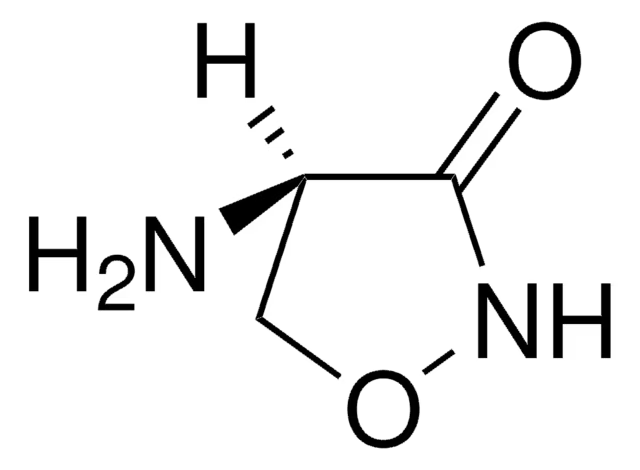
CAS Number68-41-7
Synonyms(R)-(+)-CYCLOSERINE; cycloserine; Oxamycin; (4R)-(+)-Cycloserine; Orientomycin; Cyclorin; Closina; MFCD00005353; Cyclo-D-serine; (+)-Cycloserine; (4R)-4-Amino-1,2-oxazolidin-3-one; Oxymycin; a-Cycloserine; EINECS 200-688-4; 3-keto-4,5-dihydro-isoxazolylamine; NJ-21; Seromycin; D-Cycloserine; (R)-Cycloserine; 3-Isoxazolidinone, 4-amino-, D; R-(+)-Cycloserine; I-1431; (R)-(+)-4-Amino-3-isoxazolidinone; E-733-A; DCS; UNII-95IK5KI84Z; α-Cycloserine; (+)-4-Amino-3-isoxazolidinone; E 733-A; pa94
Molecular FormulaC3H6N2O2
Molecular Weight102.09
Purity98.00%
Density1.3±0.1 g/cm3
Boiling Point267ºC
Melting Point147 °C (dec.) (lit.)
Appearancepowder
EINECS200-688-4
Symbol
Signal WordWarning
| Chemical & Physical Properties | |
|---|---|
| CAS Number | 68-41-7 |
| Catalog No. | 2A-9016973 |
| Chinese Name | D-环丝氨酸 |
| Synonyms | (R)-(+)-CYCLOSERINE; cycloserine; Oxamycin; (4R)-(+)-Cycloserine; Orientomycin; Cyclorin; Closina; MFCD00005353; Cyclo-D-serine; (+)-Cycloserine; (4R)-4-Amino-1,2-oxazolidin-3-one; Oxymycin; a-Cycloserine; EINECS 200-688-4; 3-keto-4,5-dihydro-isoxazolylamine; NJ-21; Seromycin; D-Cycloserine; (R)-Cycloserine; 3-Isoxazolidinone, 4-amino-, D; R-(+)-Cycloserine; I-1431; (R)-(+)-4-Amino-3-isoxazolidinone; E-733-A; DCS; UNII-95IK5KI84Z; α-Cycloserine; (+)-4-Amino-3-isoxazolidinone; E 733-A; pa94 |
| Molecular Formula | C3H6N2O2 |
| Molecular Weight | 102.09 |
| Purity | 98.00 |
| Density | 1.3±0.1 g/cm3 |
| Boiling Point | 267ºC |
| Melting Point | 147 °C (dec.) (lit.) |
| Appearance | powder |
| Storage Condition | This product should be sealed and stored in a cool |
| Application | D-Cycloserine is a D-type alanine analogue. |
| EINECS | 200-688-4 |
| HTC | 2934999090 |
| PubChem ID | 24892907 |
| MDL Number | MFCD00005353 |
| SMILES | N[C@@H]1CONC1=O |
| InChI | 1S/C3H6N2O2/c4-2-1-7-5-3(2)6/h2H,1,4H2,(H,5,6)/t2-/m1/s1 |
| InChI Key | DYDCUQKUCUHJBH-UWTATZPHSA-N |
| Beilstein/REAXYS | 80798 |
| NACRES Code | NA.32 |
| UNSPSC | 12352209 |
| Hazard Symbols | Transport |
| MSDS | msds/16973_1_68_41_7.pdf |
| Bioactivity | D-Cycloserine is an analog of the amino acid D-alanine.Target: AntibacterialD-Cycloserine selectively potentiated the duration of motor cortical excitability enhancements induced by anodal tDCS. D-Cycloserine alone did not modulate excitability [1]. Participants receiving d-cycloserine in addition to exposure therapy reported significantly less social anxiety compared with patients receiving exposure therapy plus placebo. Controlled effect sizes were in the medium to large range [2]. Chronic D-cycloserine significantly reduced nicotine self-administration selectively in rats with low baseline nicotine use, but was ineffective with the rats with higher levels of baseline nicotine self-administration [3]. Related Catalog Signaling Pathways >> Anti-infection >> Bacterial Research Areas >> Infection Natural Products >> Others References [1]. Nitsche, M.A., et al., Consolidation of human motor cortical neuroplasticity by D-cycloserine. Neuropsychopharmacology, 2004. 29(8): p. 1573-8. [2]. Hofmann, S.G., et al., Augmentation of exposure therapy with D-cycloserine for social anxiety disorder. Arch Gen Psychiatry, 2006. 63(3): p. 298-304. [3]. Levin, E.D., et al., D-cycloserine selectively decreases nicotine self-administration in rats with low baseline levels of response. Pharmacol Biochem Behav, 2011. 98(2): p. 210-4. Chemical & Physical Properties Density 1.3±0.1 g/cm3 Boiling Point 267ºC Melting Point 147ºC Molecular Formula C3H6N2O2 Molecular Weight 102.092 Exact Mass 102.042931 PSA 64.35000 LogP -1.84 Index of Refraction 1.475 Storage condition -20°C |
| Use of | D-Cycloserine is an analog of the amino acid D-alanine.Target: AntibacterialD-Cycloserine selectively potentiated the duration of motor cortical excitability enhancements induced by anodal tDCS. D-Cycloserine alone did not modulate excitability [1]. Participants receiving d-cycloserine in addition to exposure therapy reported significantly less social anxiety compared with patients receiving exposure therapy plus placebo. Controlled effect sizes were in the medium to large range [2]. Chronic D-cycloserine significantly reduced nicotine self-administration selectively in rats with low baseline nicotine use, but was ineffective with the rats with higher levels of baseline nicotine self-administration [3]. Properties Articles96 Name 3-Isoxazolidinone,4-amino-, (4R) Synonym More Synonyms D-Cycloserine Biological Activity Description D-Cycloserine is an analog of the amino acid D-alanine.Target: AntibacterialD-Cycloserine selectively potentiated the duration of motor cortical excitability enhancements induced by anodal tDCS. D-Cycloserine alone did not modulate excitability [1]. Participants receiving d-cycloserine in addition to exposure therapy reported significantly less social anxiety compared with patients receiving exposure therapy plus placebo. Controlled effect sizes were in the medium to large range [2]. Chronic D-cycloserine significantly reduced nicotine self-administration selectively in rats with low baseline nicotine use, but was ineffective with the rats with higher levels of baseline nicotine self-administration [3]. Related Catalog Signaling Pathways >> Anti-infection >> Bacterial Research Areas >> Infection Natural Products >> Others References [1]. Nitsche, M.A., et al., Consolidation of human motor cortical neuroplasticity by D-cycloserine. Neuropsychopharmacology, 2004. 29(8): p. 1573-8. [2]. Hofmann, S.G., et al., Augmentation of exposure therapy with D-cycloserine for social anxiety disorder. Arch Gen Psychiatry, 2006. 63(3): p. 298-304. [3]. Levin, E.D., et al., D-cycloserine selectively decreases nicotine self-administration in rats with low baseline levels of response. Pharmacol Biochem Behav, 2011. 98(2): p. 210-4. Chemical & Physical Properties Molecular Formula C3H6N2O2 Exact Mass 102.042931 PSA 64.35000 LogP -1.84 Index of Refraction 1.475 |
| Tax Rebate | 13.0% |
| Supervision | None. MFN tariff: 6.5%. Ordinary tariff: 20.0% |
| Transport Info | Shipping Name: UN |
| MSDS Transport Info | Module 14. Shipping information 14.1 UN dangerous goods number European Land Transport Dangerous Regulations: -International Maritime Dangerous Regulations: -International Air Transport Dangerous Regulations: - 14.2 United Nations shipping name European Land Transport Dangerous Regulations: Non-dangerous goods IMDG Code: Non-dangerous goods International air transport dangerous goods regulations: non-dangerous goods 14.3 Transport hazard categories European Land Transport Dangerous Regulations: -International Maritime Dangerous Regulations: -International Air Transport Dangerous Regulations: - 14.4 Package group European Land Transport Dangerous Regulations: -International Maritime Dangerous Regulations: -International Air Transport Dangerous Regulations: - 14.5 Environmental hazards European Land Transport Danger Regulations: No International Maritime Danger Regulations International Air Transport Danger Regulations: No Marine pollutants (yes/no): No 14.6 Special reminder to users No data available |
| Related Products in Specialty Chemicals | ||
|---|---|---|
| Synephrine tartrate | 67-04-9 | 2A-9016942 |
| Ethylenebis(oxyethylenenitrilo)tetraacetic acid | 67-42-5 | 2A-9016947 |
| Diethylenetriaminepentaacetic acid; DTPA | 67-43-6 | 2A-9016948 |
| Sodium citrate | 68-04-2 | 2A-9016965 |
| Tetraethylammonium iodide | 68-05-3 | 2A-9016966 |
| Hydroxyzine | 68-88-2 | 2A-9016974 |
| Acrichin dihydrochloride | 69-44-3 | 2A-9016981 |
| D-Mannitol | 69-65-8 | 2A-9016986 |
| Cytarabine hydrochloride | 69-74-9 | 2A-9016988 |
| 3-Carboxy-4-nitrophenyl disulfide | 69-78-3 | 2A-9016989 |
| Browse all Specialty Chemicals products » | ||
Phone:
630-322-8886
630-322-8887
Email:
Office Locations:
Chicago, IL, USA
San Francisco, CA, USA


 EN
EN


 SDS
SDS