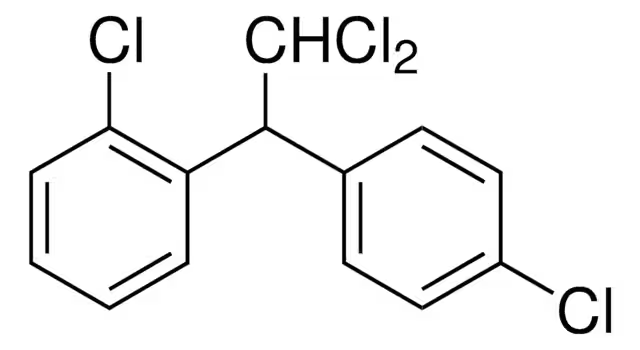
CAS Number53-19-0
Synonyms2,4'-Ddd; Khlodithan; 1-Chloro-2-[2,2-dichloro-1-(4-chlorophenyl)ethyl]benzene; Opeprim; EINECS 200-166-6; O,P'-DDD; Mitotan; o,p′-DDD; o,p'-Dichlorodiphenyldichloroethane; Mitotane (Lsodren); o,p'-TDE; Lysodren; Chlodithan; Chloditan; (2,4'-Dichlorodiphenyl)dichloroethane; Mitotane; Chlodithane; MFCD00000850
Molecular Formula(ClC6H4)2CHCHCl2
Molecular Weight320.04
Purity98.00%
Density1.4±0.1 g/cm3
Boiling Point398.9±37.0 °C at 760 mmHg
Melting Point77-78 °C(lit.)
Appearancecrystalline solid
EINECS200-166-6
Symbol
Signal WordWarning
| Chemical & Physical Properties | |
|---|---|
| CAS Number | 53-19-0 |
| Catalog No. | 2A-9016643 |
| Chinese Name | 米托坦 |
| Synonyms | 2,4'-Ddd; Khlodithan; 1-Chloro-2-[2,2-dichloro-1-(4-chlorophenyl)ethyl]benzene; Opeprim; EINECS 200-166-6; O,P'-DDD; Mitotan; o,p′-DDD; o,p'-Dichlorodiphenyldichloroethane; Mitotane (Lsodren); o,p'-TDE; Lysodren; Chlodithan; Chloditan; (2,4'-Dichlorodiphenyl)dichloroethane; Mitotane; Chlodithane; MFCD00000850 |
| Molecular Formula | (ClC6H4)2CHCHCl2 |
| Molecular Weight | 320.04 |
| Purity | 98.00 |
| Density | 1.4±0.1 g/cm3 |
| Boiling Point | 398.9±37.0 °C at 760 mmHg |
| Melting Point | 77-78 °C(lit.) |
| Appearance | crystalline solid |
| Water Solubility | <0.1 g/100 mL at 24 ºC |
| Storage Condition | Store in airtight, dark and dry place |
| Packaging | III |
| Application | Mitotane (2,4′-DDD) is an isomer of DDD and a derivative of DDT. It has anti-cancer activity and can act on adrenocortical cancer. |
| EINECS | 200-166-6 |
| HTC | 2903999090 |
| PubChem ID | 329755170 |
| MDL Number | MFCD00000850 |
| SMILES | ClC(Cl)C(c1ccc(Cl)cc1)c2ccccc2Cl |
| InChI | 1S/C14H10Cl4/c15-10-7-5-9(6-8-10)13(14(17)18)11-3-1-2-4-12(11)16/h1-8,13-14H |
| InChI Key | JWBOIMRXGHLCPP-UHFFFAOYSA-N |
| Beilstein/REAXYS | 2056007 |
| NACRES Code | NA.24 |
| UNSPSC | 41116107 |
| Hazard Symbols | 6.1(b) |
| Risk Codes | R40 |
| Safety Description | S36/37 |
| MSDS | msds/16643_1_53_19_0.pdf |
| Bioactivity | Mitotane(2,4′-DDD), an isomer of DDD and derivative of DDT, is an antineoplastic medication used in the treatment of adrenocortical carcinoma.IC50 value: Target: Mitotane alters steroid peripheral metabolism, directly suppresses the adrenal cortex and alters cortisone metabolism leading to hypocortisolism. Side effects as reported by Schteinberg et al. include anorexia and nausea (88%), diarrhea (38%), vomiting (23%), decreased memory and ability to concentrate (50%), rash (23%), gynecomastia (50%), arthralgia (19%), and leukopenia (7%). Related Catalog Signaling Pathways >> Others >> Others Research Areas >> Cancer References [1]. Gentilin E, Tagliati F, Terzolo M, Mitotane reduces human and mouse ACTH-secreting pituitary cell viability and function. J Endocrinol. 2013 Jul 29;218(3):275-285. [2]. Lehmann TP, Wrzesiński T, Jagodziński PP. The effect of mitotane on viability, steroidogenesis and gene expression in NCI H295R adrenocortical cells. Mol Med Rep. 2013 Mar;7(3):893-900. [3]. Takeshita A, Igarashi-Migitaka J, Koibuchi N, Mitotane induces CYP3A4 expression via activation of the steroid and xenobiotic receptor. J Endocrinol. 2013 Feb 15;216(3):297-305. [4]. Ederhy S, Cohen A, Dufaitre G, No evidence for relevant QT interval prolongation in mitotane-treated patients with adrenocortical carcinoma. J Endocrinol Invest. 2012 Nov;35(10):911-4. [5]. Alexandraki KI, Kaltsas GA, le Roux CW, Assessment of serum-free cortisol levels in patients with adrenocortical carcinoma treated with mitotane: a pilot study. Clin Endocrinol (Oxf). 2010 Mar;72(3):305-11. Chemical & Physical Properties Density 1.4±0.1 g/cm3 Boiling Point 398.9±37.0 °C at 760 mmHg Melting Point 77-78 °C(lit.) Molecular Formula C14H10Cl4 Molecular Weight 320.041 Flash Point 194.2±23.9 °C Exact Mass 317.953674 LogP 5.39 Vapour Pressure 0.0±0.9 mmHg at 25°C Index of Refraction 1.599 InChIKey JWBOIMRXGHLCPP-UHFFFAOYSA-N SMILES Clc1ccc(C(c2ccccc2Cl)C(Cl)Cl)cc1 Water Solubility <0.1 g/100 mL at 24 ºC |
| Use of | Mitotane(2,4′-DDD), an isomer of DDD and derivative of DDT, is an antineoplastic medication used in the treatment of adrenocortical carcinoma.IC50 value: Target: Mitotane alters steroid peripheral metabolism, directly suppresses the adrenal cortex and alters cortisone metabolism leading to hypocortisolism. Side effects as reported by Schteinberg et al. include anorexia and nausea (88%), diarrhea (38%), vomiting (23%), decreased memory and ability to concentrate (50%), rash (23%), gynecomastia (50%), arthralgia (19%), and leukopenia (7%). Properties Articles43 Name 1-chloro-2-[2,2-dichloro-1-(4-chlorophenyl)ethyl]benzene Synonym More Synonyms Mitotane Biological Activity Description Mitotane(2,4′-DDD), an isomer of DDD and derivative of DDT, is an antineoplastic medication used in the treatment of adrenocortical carcinoma.IC50 value: Target: Mitotane alters steroid peripheral metabolism, directly suppresses the adrenal cortex and alters cortisone metabolism leading to hypocortisolism. Side effects as reported by Schteinberg et al. include anorexia and nausea (88%), diarrhea (38%), vomiting (23%), decreased memory and ability to concentrate (50%), rash (23%), gynecomastia (50%), arthralgia (19%), and leukopenia (7%). Related Catalog Signaling Pathways >> Others >> Others Research Areas >> Cancer References [1]. Gentilin E, Tagliati F, Terzolo M, Mitotane reduces human and mouse ACTH-secreting pituitary cell viability and function. J Endocrinol. 2013 Jul 29;218(3):275-285. [2]. Lehmann TP, Wrzesiński T, Jagodziński PP. The effect of mitotane on viability, steroidogenesis and gene expression in NCI H295R adrenocortical cells. Mol Med Rep. 2013 Mar;7(3):893-900. [3]. Takeshita A, Igarashi-Migitaka J, Koibuchi N, Mitotane induces CYP3A4 expression via activation of the steroid and xenobiotic receptor. J Endocrinol. 2013 Feb 15;216(3):297-305. [4]. Ederhy S, Cohen A, Dufaitre G, No evidence for relevant QT interval prolongation in mitotane-treated patients with adrenocortical carcinoma. J Endocrinol Invest. 2012 Nov;35(10):911-4. [5]. Alexandraki KI, Kaltsas GA, le Roux CW, Assessment of serum-free cortisol levels in patients with adrenocortical carcinoma treated with mitotane: a pilot study. Clin Endocrinol (Oxf). 2010 Mar;72(3):305-11. Chemical & Physical Properties Exact Mass 317.953674 Index of Refraction 1.599 InChIKey JWBOIMRXGHLCPP-UHFFFAOYSA-N |
| Tax Rebate | 9.0% |
| Supervision | None MFN tariff: 5.5% Ordinary tariff: 30.0% |
| Transport Info | Product name: Purity: 98.0% |
| MSDS Transport Info | Module 14. Shipping information 14.1 UN number European Land Transport Dangerous Regulations: -International Maritime Dangerous Regulations: -International Air Transport Dangerous Regulations: - 14.2 Names specified by the United Nations (UN) European Land Transport Dangerous Regulations: No dangerous goods IMDG Code: No dangerous goods International Air Transport Dangerous Regulations: No dangerous goods 14.3 Transport hazard categories European Land Transport Dangerous Regulations: -International Maritime Dangerous Regulations: -International Air Transport Dangerous Regulations: - 14.4 Package group European Land Transport Dangerous Regulations: -International Maritime Dangerous Regulations: -International Air Transport Dangerous Regulations: - 14.5 Environmental hazards European Land Transport Dangerous Regulations: No International Maritime Transport Dangerous Regulations Maritime Pollutants: No International Air Transport Risk Regulations: No 14.6 Special precautions for users No data available |
| Related Products in Specialty Chemicals | ||
|---|---|---|
| Cycloleucine | 52-52-8 | 2A-9016631 |
| D-(-)-Penicillamine | 52-67-5 | 2A-9016633 |
| Lynestrenol | 52-76-6 | 2A-9016635 |
| L-Cysteine hydrochloride anhydrous | 52-89-1 | 2A-9016638 |
| L-Cysteine | 52-90-4 | 2A-9016639 |
| Etiocholanone | 53-42-9 | 2A-9016649 |
| Bis(2-methoxyethyl)aminosulfur trifluoride | 202289-38-1 | 2A-9016650 |
| Promazine hydrochloride | 53-60-1 | 2A-9016652 |
| Trifluorothymine | 54-20-6 | 2A-9016658 |
| Sodium salicylate | 54-21-7 | 2A-9016659 |
| Browse all Specialty Chemicals products » | ||
Phone:
630-322-8886
630-322-8887
Email:
Office Locations:
Chicago, IL, USA
San Francisco, CA, USA


 EN
EN


 SDS
SDS