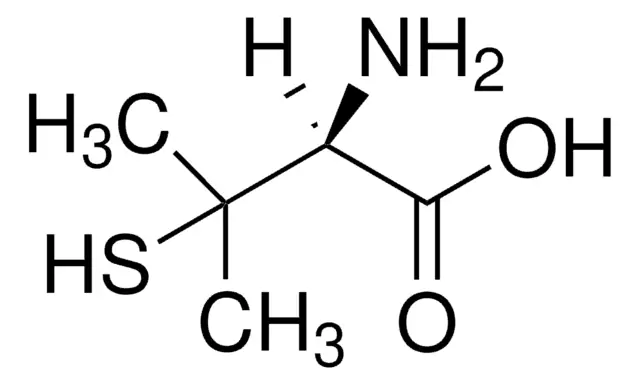
CAS Number52-67-5
Synonyms3,3-Dimethyl-D-cysteine,3-Mercapto-D-valine,D-(−)-2-Amino-3-mercapto-3-methylbutanoic acid; 3-mercapto-L-valine; H-D-Pen-OH; 3-Sulfanyl-L-valine; penicillamine; (2R)-2-amino-3-mercapto-3-methylbutanoic acid; Cuprenil; EINECS 200-148-8; Cuprimin; emtexate; Perdolat; (2S)-2-amino-3-methyl-3-sulfanylbutanoic acid; L-Penicillamine; D-β,β-Dimethylcysteine; (R)-penicillamine; Depamine; 3,3-Dimethyl-D(-)-cysteine; Sufirtan; 3-mercapto-D-valine; D(-)-Penicillamine; Depen; (2R)-2-amino-3-mercapto-3-methyl-butyric acid; d-valin; MFCD00064302; D-β-Mercaptovaline; usan; D-PenicillaMine; Artamine
Molecular Formula(CH3)2C(SH)CH(NH2)CO2H
Molecular Weight149.21
Purity98-101%
Density1.2±0.1 g/cm3
Boiling Point251.8±35.0 °C at 760 mmHg
Melting Point210 °C (dec.) (lit.)
Appearancepowder
EINECS200-148-8
Symbol
Signal WordWarning
| Chemical & Physical Properties | |
|---|---|
| CAS Number | 52-67-5 |
| Catalog No. | 2A-9016633 |
| Chinese Name | D-青霉胺 |
| Synonyms | 3,3-Dimethyl-D-cysteine,3-Mercapto-D-valine,D-(−)-2-Amino-3-mercapto-3-methylbutanoic acid; 3-mercapto-L-valine; H-D-Pen-OH; 3-Sulfanyl-L-valine; penicillamine; (2R)-2-amino-3-mercapto-3-methylbutanoic acid; Cuprenil; EINECS 200-148-8; Cuprimin; emtexate; Perdolat; (2S)-2-amino-3-methyl-3-sulfanylbutanoic acid; L-Penicillamine; D-β,β-Dimethylcysteine; (R)-penicillamine; Depamine; 3,3-Dimethyl-D(-)-cysteine; Sufirtan; 3-mercapto-D-valine; D(-)-Penicillamine; Depen; (2R)-2-amino-3-mercapto-3-methyl-butyric acid; d-valin; MFCD00064302; D-β-Mercaptovaline; usan; D-PenicillaMine; Artamine |
| Molecular Formula | (CH3)2C(SH)CH(NH2)CO2H |
| Molecular Weight | 149.21 |
| Purity | 98-101 |
| Density | 1.2±0.1 g/cm3 |
| Boiling Point | 251.8±35.0 °C at 760 mmHg |
| Melting Point | 210 °C (dec.) (lit.) |
| Appearance | powder |
| Water Solubility | 11.1 g/100 mL (20 ºC) |
| Storage Condition | Should be sealed and stored dry at 4°C. |
| Application | Penicillamine is a metabolic degradation product of penicillin and can be used as a chelating agent to treat Wilson's disease. |
| EINECS | 200-148-8 |
| HTC | 2930909090 |
| PubChem ID | 24898564 |
| MDL Number | MFCD00064302 |
| SMILES | CC(C)(S)[C@@H](N)C(O)=O |
| InChI | 1S/C5H11NO2S/c1-5(2,9)3(6)4(7)8/h3,9H,6H2,1-2H3,(H,7,8)/t3-/m0/s1 |
| InChI Key | VVNCNSJFMMFHPL-VKHMYHEASA-N |
| Beilstein/REAXYS | 1722375 |
| NACRES Code | NA.76 |
| UNSPSC | 51202303 |
| Hazard Symbols | Transport |
| Safety Description | S24/25 |
| MSDS | msds/16633_1_52_67_5.pdf |
| Bioactivity | Penicillamine is the most characteristic degradation product of the penicillin antibiotics. It is used as an antirheumatic and as a chelating agent in Wilson's disease.Target: OthersPenicillamine(Cuprimine, Depen) is used as an antirheumatic and as a chelating agent in Wilson's disease and is a chelating agent recommended for the removal of excess copper in patients with Wilson's disease. From in vitro studies which indicate that one atom of copper combines with two molecules of penicillamine. Penicillamine also reduces excess cystine excretion in cystinuria. The mechanism of action of penicillamine in rheumatoid arthritis is unknown although it appears to suppress disease activity. Unlike cytotoxic immunosuppressants, penicillamine markedly lowers IgM rheumatoid factor but produces no significant depression in absolute levels of serum immunoglobulins. Also unlike cytotoxic immunosuppressants which act on both, penicillamine in vitro depresses T-cell activity but not B-cell activity [1-3]. Related Catalog Signaling Pathways >> Others >> Others Research Areas >> Inflammation/Immunology References [1]. Peisach, J. and W.E. Blumberg, A mechanism for the action of penicillamine in the treatment of Wilson's disease. Mol Pharmacol, 1969. 5(2): p. 200-9. [2]. Jaffe, I.A., K. Altman, and P. Merryman, The Antipyridoxine Effect of Penicillamine in Man. J Clin Invest, 1964. 43: p. 1869-73. [3]. Camp, A.V., Penicillamine in the treatment of rheumatoid arthritis. Proc R Soc Med, 1977. 70(2): p. 67-9. Chemical & Physical Properties Density 1.2±0.1 g/cm3 Boiling Point 251.8±35.0 °C at 760 mmHg Melting Point 210 °C (dec.)(lit.) Molecular Formula C5H11NO2S Molecular Weight 149.211 Flash Point 106.1±25.9 °C Exact Mass 149.051056 PSA 102.12000 LogP 0.93 Vapour Pressure 0.0±1.1 mmHg at 25°C Index of Refraction 1.528 InChIKey VVNCNSJFMMFHPL-VKHMYHEASA-N SMILES CC(C)(S)C(N)C(=O)O Storage condition 2~8°C Water Solubility 11.1 g/100 mL (20 ºC) |
| Use of | Penicillamine is the most characteristic degradation product of the penicillin antibiotics. It is used as an antirheumatic and as a chelating agent in Wilson's disease.Target: OthersPenicillamine(Cuprimine, Depen) is used as an antirheumatic and as a chelating agent in Wilson's disease and is a chelating agent recommended for the removal of excess copper in patients with Wilson's disease. From in vitro studies which indicate that one atom of copper combines with two molecules of penicillamine. Penicillamine also reduces excess cystine excretion in cystinuria. The mechanism of action of penicillamine in rheumatoid arthritis is unknown although it appears to suppress disease activity. Unlike cytotoxic immunosuppressants, penicillamine markedly lowers IgM rheumatoid factor but produces no significant depression in absolute levels of serum immunoglobulins. Also unlike cytotoxic immunosuppressants which act on both, penicillamine in vitro depresses T-cell activity but not B-cell activity [1-3]. Properties Articles93 Name D-penicillamine Synonym More Synonyms D-penicillamine Biological Activity Description Penicillamine is the most characteristic degradation product of the penicillin antibiotics. It is used as an antirheumatic and as a chelating agent in Wilson's disease.Target: OthersPenicillamine(Cuprimine, Depen) is used as an antirheumatic and as a chelating agent in Wilson's disease and is a chelating agent recommended for the removal of excess copper in patients with Wilson's disease. From in vitro studies which indicate that one atom of copper combines with two molecules of penicillamine. Penicillamine also reduces excess cystine excretion in cystinuria. The mechanism of action of penicillamine in rheumatoid arthritis is unknown although it appears to suppress disease activity. Unlike cytotoxic immunosuppressants, penicillamine markedly lowers IgM rheumatoid factor but produces no significant depression in absolute levels of serum immunoglobulins. Also unlike cytotoxic immunosuppressants which act on both, penicillamine in vitro depresses T-cell activity but not B-cell activity [1-3]. Related Catalog Signaling Pathways >> Others >> Others Research Areas >> Inflammation/Immunology References [1]. Peisach, J. and W.E. Blumberg, A mechanism for the action of penicillamine in the treatment of Wilson's disease. Mol Pharmacol, 1969. 5(2): p. 200-9. [2]. Jaffe, I.A., K. Altman, and P. Merryman, The Antipyridoxine Effect of Penicillamine in Man. J Clin Invest, 1964. 43: p. 1869-73. [3]. Camp, A.V., Penicillamine in the treatment of rheumatoid arthritis. Proc R Soc Med, 1977. 70(2): p. 67-9. Chemical & Physical Properties Molecular Formula C5H11NO2S Exact Mass 149.051056 PSA 102.12000 Index of Refraction 1.528 InChIKey VVNCNSJFMMFHPL-VKHMYHEASA-N SMILES CC(C)(S)C(N)C(=O)O |
| Tax Rebate | 13.0% |
| Supervision | None. MFN tariff: 6.5%. Ordinary tariff: 30.0% |
| Transport Info | Product name: Purity: 99.0% |
| MSDS Transport Info | Module 14. Shipping information 14.1 UN dangerous goods number European Land Transport Dangerous Regulations: -International Maritime Dangerous Regulations: -International Air Transport Dangerous Regulations: - 14.2 Names specified by the United Nations (UN) European Land Transport Dangerous Regulations: Non-dangerous goods IMDG Code: Non-dangerous goods International air transport dangerous goods regulations: non-dangerous goods 14.3 Transport hazard categories European Land Transport Dangerous Regulations: -International Maritime Dangerous Regulations: -International Air Transport Dangerous Regulations: - 14.4 Package group European Land Transport Dangerous Regulations: -International Maritime Dangerous Regulations: -International Air Transport Dangerous Regulations: - 14.5 Environmental hazards European Land Transport Dangerous Regulations: No International Maritime Transport Dangerous Regulations Maritime Pollutants: No International Air Transport Risk Regulations: No 14.6 Special reminder to users No data available |
| Related Products in Specialty Chemicals | ||
|---|---|---|
| 4-Aminophenol hydrochloride | 51-78-5 | 2A-9016622 |
| Urethane | 51-79-6 | 2A-9016623 |
| Carbachol | 51-83-2 | 2A-9016624 |
| Triethylenethiophosphoramide | 52-24-4 | 2A-9016628 |
| Cycloleucine | 52-52-8 | 2A-9016631 |
| Lynestrenol | 52-76-6 | 2A-9016635 |
| L-Cysteine hydrochloride anhydrous | 52-89-1 | 2A-9016638 |
| L-Cysteine | 52-90-4 | 2A-9016639 |
| Mitotan | 53-19-0 | 2A-9016643 |
| Etiocholanone | 53-42-9 | 2A-9016649 |
| Browse all Specialty Chemicals products » | ||
Phone:
630-322-8886
630-322-8887
Email:
Office Locations:
Chicago, IL, USA
San Francisco, CA, USA


 EN
EN


 SDS
SDS