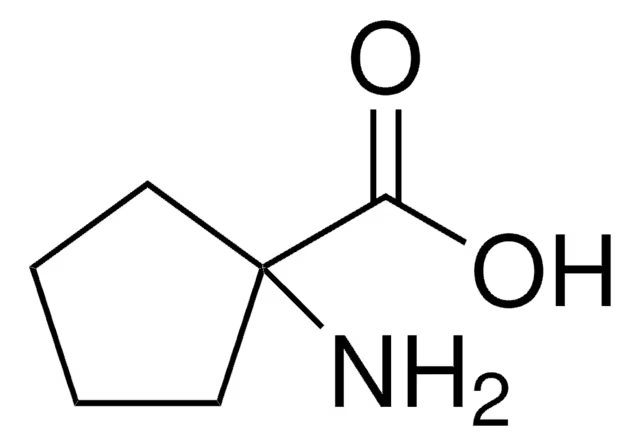
CAS Number52-52-8
Synonyms1-Aminocyclopentanecarboxylicacid; 1-aminocyclopentane-1-carboxylic acid; 1-Aminocyclopropane-1-carboxylic acid; EINECS 200-144-6; 1-amino-1-carboxylic cyclopentane; 1-Amino-1-cyclopentanecarboxylic acid; ACPC; MFCD00001381; Cycloleucine; 1-amino-1-carboxycyclopentane; Cyclolencine; 1-Aminocyclopentanecarboxylic acid; 1-Amino-1-cyclopentanecarboxylate; 1-aminocyclopentane-1-carboxylicacid
Molecular FormulaH2NC5H8CO2H
Molecular Weight129.16
Purity97%
Density1.2±0.1 g/cm3
Boiling Point256.1±23.0 °C at 760 mmHg
Melting Point320 °C (dec.) (lit.)
Appearancecrystals
EINECS200-144-6
Symbol
Signal WordWarning
| Chemical & Physical Properties | |
|---|---|
| CAS Number | 52-52-8 |
| Catalog No. | 2A-9016631 |
| Chinese Name | 环亮氨酸 |
| Synonyms | 1-Aminocyclopentanecarboxylicacid; 1-aminocyclopentane-1-carboxylic acid; 1-Aminocyclopropane-1-carboxylic acid; EINECS 200-144-6; 1-amino-1-carboxylic cyclopentane; 1-Amino-1-cyclopentanecarboxylic acid; ACPC; MFCD00001381; Cycloleucine; 1-amino-1-carboxycyclopentane; Cyclolencine; 1-Aminocyclopentanecarboxylic acid; 1-Amino-1-cyclopentanecarboxylate; 1-aminocyclopentane-1-carboxylicacid |
| Molecular Formula | H2NC5H8CO2H |
| Molecular Weight | 129.16 |
| Purity | 97 |
| Density | 1.2±0.1 g/cm3 |
| Boiling Point | 256.1±23.0 °C at 760 mmHg |
| Melting Point | 320 °C (dec.) (lit.) |
| Appearance | crystals |
| Water Solubility | 5 g/100 mL |
| Storage Condition | Should be sealed and stored in a cool, dry place. |
| Packaging | III |
| Application | Cycloleucine is a specific inhibitor of S-adenosylmethionine-mediated methylation. Cycloleucine is an antagonist of the glycine allosteric site of the NMDA receptor with a Ki value of 600 μM. Cycloleu |
| EINECS | 200-144-6 |
| HTC | 2922499990 |
| UN(IATA) | UN 2811 |
| PubChem ID | 24890914 |
| MDL Number | MFCD00001381 |
| SMILES | NC1(CCCC1)C(O)=O |
| InChI | 1S/C6H11NO2/c7-6(5(8)9)3-1-2-4-6/h1-4,7H2,(H,8,9) |
| InChI Key | NILQLFBWTXNUOE-UHFFFAOYSA-N |
| Beilstein/REAXYS | 636626 |
| NACRES Code | NA.22 |
| UNSPSC | 12352209 |
| Hazard Symbols | 6.1 |
| Risk Codes | R22 |
| Safety Description | S22;S24/25 |
| MSDS | msds/16631_1_52_52_8.pdf |
| Bioactivity | Cycloleucine is a specific inhibitor of S-adenosyl-methionine mediated methylation. Cycloleucine is antagonist of NMDA receptor associated glycine receptor, with a Ki of 600 μM. Cycloleucine is also a competitive inhibitor of ATP: L-methionine-S-adenosyl transferase in vitro. Cycloleucine has anxiolytic and cytostatic effects[1][2][3][4]. Related Catalog Signaling Pathways >> Neuronal Signaling >> iGluR Research Areas >> Cancer Research Areas >> Infection Research Areas >> Metabolic Disease Research Areas >> Neurological Disease Signaling Pathways >> Membrane Transporter/Ion Channel >> iGluR Target Ki: 600 μM (NMDA)[1][2] In Vitro Cycloleucine (4-40 mM; 3 h) blocks internal methylation of viral RNA in B77 transformed chick embryo fibroblasts[5]. Cycloleucine (40 mM; 24 h) blocks the formation of both m6A and the penultimate Gm in B77 38S RNA subunits by greater than 90%[5]. Cytostatic (10 µg/mL) inhibits the viability human KB and mouse L1210s leukemia cell lines[5]. In Vivo Cycloleucine (0.5-4 µg; intracerebroventrical injection) increases time spent in open arms, open arm entries, and extreme arrivals in rats[3]. Animal Model: Male rats bilaterally cannulated into the nucleus accumbens septi (NAS)[3] Dosage: 1 µL of 0.5, 1.0, 2.0, 4 µg/µL Administration: Intracerebroventrical injection Result: Increased time spent in the open arms and extreme arrivals at all doses. Increased open arm entries at the dose of 4 μg. References [1]. Hood WF, et, al. 1-Aminocyclobutane-1-carboxylate (ACBC): a specific antagonist of the N-methyl-D-aspartate receptor coupled glycine receptor. Eur J Pharmacol. 1989 Feb 28;161(2-3):281-2. [2]. Caboche M, et, al. RNA methylation and control of eukaryotic RNA biosynthesis. Effects of cycloleucine, a specific inhibitor of methylation, on ribosomal RNA maturation. Eur J Biochem. 1977 Mar 15;74(1):19-29. [3]. Gargiulo API, et, al. Effects of Cycloleucine in the Nucleus Accumbens Septi on the Elevated plus Maze Test in Rats. Neuropsychobiology. 2020;79(3):191-197. [4]. Duś D, et, al. Cytostatic activity in vitro of cycloleucine, aspartic acid and glutamic acid phosphonic analogues. Arch Immunol Ther Exp (Warsz). 1980;28(3):433-8. [5]. Dimock K, et, al. Cycloleucine blocks 5'-terminal and internal methylations of avian sarcoma virus genome RNA. Biochemistry. 1978 Aug 22;17(17):3627-32. Chemical & Physical Properties Density 1.2±0.1 g/cm3 Boiling Point 256.1±23.0 °C at 760 mmHg Melting Point 320 °C (dec.)(lit.) Molecular Formula C6H11NO2 Molecular Weight 129.157 Flash Point 108.7±22.6 °C Exact Mass 129.078979 PSA 63.32000 LogP -0.05 Vapour Pressure 0.0±1.1 mmHg at 25°C Index of Refraction 1.522 InChIKey NILQLFBWTXNUOE-UHFFFAOYSA-N SMILES NC1(C(=O)O)CCCC1 Water Solubility 5 g/100 mL |
| Use of | Cycloleucine is a specific inhibitor of S-adenosyl-methionine mediated methylation. Cycloleucine is antagonist of NMDA receptor associated glycine receptor, with a Ki of 600 μM. Cycloleucine is also a competitive inhibitor of ATP: L-methionine-S-adenosyl transferase in vitro. Cycloleucine has anxiolytic and cytostatic effects[1][2][3][4]. Properties Articles29 Name 1-aminocyclopentanecarboxylic acid Synonym More Synonyms Cycloleucine Biological Activity Description Cycloleucine is a specific inhibitor of S-adenosyl-methionine mediated methylation. Cycloleucine is antagonist of NMDA receptor associated glycine receptor, with a Ki of 600 μM. Cycloleucine is also a competitive inhibitor of ATP: L-methionine-S-adenosyl transferase in vitro. Cycloleucine has anxiolytic and cytostatic effects[1][2][3][4]. Related Catalog Signaling Pathways >> Neuronal Signaling >> iGluR Research Areas >> Cancer Research Areas >> Infection Research Areas >> Metabolic Disease Research Areas >> Neurological Disease Signaling Pathways >> Membrane Transporter/Ion Channel >> iGluR Ki: 600 μM (NMDA)[1][2] In Vivo Cycloleucine (0.5-4 µg; intracerebroventrical injection) increases time spent in open arms, open arm entries, and extreme arrivals in rats[3]. Animal Model: Male rats bilaterally cannulated into the nucleus accumbens septi (NAS)[3] Dosage: 1 µL of 0.5, 1.0, 2.0, 4 µg/µL Administration: Intracerebroventrical injection Result: Increased time spent in the open arms and extreme arrivals at all doses. Increased open arm entries at the dose of 4 μg. References [1]. Hood WF, et, al. 1-Aminocyclobutane-1-carboxylate (ACBC): a specific antagonist of the N-methyl-D-aspartate receptor coupled glycine receptor. Eur J Pharmacol. 1989 Feb 28;161(2-3):281-2. [2]. Caboche M, et, al. RNA methylation and control of eukaryotic RNA biosynthesis. Effects of cycloleucine, a specific inhibitor of methylation, on ribosomal RNA maturation. Eur J Biochem. 1977 Mar 15;74(1):19-29. [3]. Gargiulo API, et, al. Effects of Cycloleucine in the Nucleus Accumbens Septi on the Elevated plus Maze Test in Rats. Neuropsychobiology. 2020;79(3):191-197. [4]. Duś D, et, al. Cytostatic activity in vitro of cycloleucine, aspartic acid and glutamic acid phosphonic analogues. Arch Immunol Ther Exp (Warsz). 1980;28(3):433-8. [5]. Dimock K, et, al. Cycloleucine blocks 5'-terminal and internal methylations of avian sarcoma virus genome RNA. Biochemistry. 1978 Aug 22;17(17):3627-32. Chemical & Physical Properties Molecular Formula C6H11NO2 Exact Mass 129.078979 PSA 63.32000 LogP -0.05 Index of Refraction 1.522 InChIKey NILQLFBWTXNUOE-UHFFFAOYSA-N SMILES NC1(C(=O)O)CCCC1 |
| Tax Rebate | 9.0% |
| Supervision | A. Customs clearance form for inbound goods B. Customs clearance form for outbound goods |
| Inspection | P. Quarantine of entry animals, plants, and animal and plant products Q. Quarantine of exit animals, plants, and animal and plant products R. Hygiene supervision and inspection of imported food S. Hyg |
| Transport Info | Product name: Purity: 98.0% |
| MSDS Transport Info | Module 14. Shipping information United Nations classification: Item 1 Poisons. UN number: 2811 Proper Shipping Name: Toxic Solid, Organic, Not Otherwise Specified Packing grade: III |
| Related Products in Specialty Chemicals | ||
|---|---|---|
| Gefarnate | 51-77-4 | 2A-9016621 |
| 4-Aminophenol hydrochloride | 51-78-5 | 2A-9016622 |
| Urethane | 51-79-6 | 2A-9016623 |
| Carbachol | 51-83-2 | 2A-9016624 |
| Triethylenethiophosphoramide | 52-24-4 | 2A-9016628 |
| D-(-)-Penicillamine | 52-67-5 | 2A-9016633 |
| Lynestrenol | 52-76-6 | 2A-9016635 |
| L-Cysteine hydrochloride anhydrous | 52-89-1 | 2A-9016638 |
| L-Cysteine | 52-90-4 | 2A-9016639 |
| Mitotan | 53-19-0 | 2A-9016643 |
| Browse all Specialty Chemicals products » | ||
Phone:
630-322-8886
630-322-8887
Email:
Office Locations:
Chicago, IL, USA
San Francisco, CA, USA


 EN
EN


 SDS
SDS