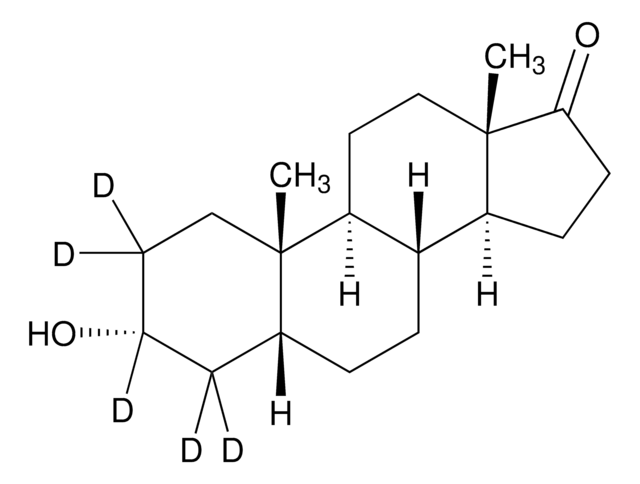
CAS Number53-42-9
Synonyms3a-Hydroxy-5b-androstane-17-one; 3alpha-hydroxy-5beta-androstan-17-one; 5β-Androsterone; (5b)-Androsterone; 5-Isoandrosterone; 3α-hydroxy-5β-androstane-17-one; 5BETA-ANDROSTERONE; MFCD00064133; (3α,5β)-3-Hydroxyandrostan-17-one; ETIOCHOLANOLON; 3α-Etiocholanolone; 19-noretiocholanolone; ETIOCHOLANONE; 3a-Etiocholanolone; 3α-hydroxy-5β-androstan-17-one; 5b-Androsterone; Etiocholan-3a-ol-17-one; Etiocholan-3α-ol-17-one; Etiocholan-3.α.-ol-17-one; EINECS 200-835-2; Etiocholanolone
Molecular FormulaC19H30O2
Molecular Weight295.47
Purity≥98 (CP)%
Density1.1±0.1 g/cm3
Boiling Point413.1±45.0 °C at 760 mmHg
Melting Point148~150°C (lit.)
Appearanceliquid
EINECS200-659-6
Symbol
Signal WordWarning
| Chemical & Physical Properties | |
|---|---|
| CAS Number | 53-42-9 |
| Catalog No. | 2A-9016649 |
| Chinese Name | 3a-羟基-5b-雄甾烷-17-酮 |
| Synonyms | 3a-Hydroxy-5b-androstane-17-one; 3alpha-hydroxy-5beta-androstan-17-one; 5β-Androsterone; (5b)-Androsterone; 5-Isoandrosterone; 3α-hydroxy-5β-androstane-17-one; 5BETA-ANDROSTERONE; MFCD00064133; (3α,5β)-3-Hydroxyandrostan-17-one; ETIOCHOLANOLON; 3α-Etiocholanolone; 19-noretiocholanolone; ETIOCHOLANONE; 3a-Etiocholanolone; 3α-hydroxy-5β-androstan-17-one; 5b-Androsterone; Etiocholan-3a-ol-17-one; Etiocholan-3α-ol-17-one; Etiocholan-3.α.-ol-17-one; EINECS 200-835-2; Etiocholanolone |
| Molecular Formula | C19H30O2 |
| Molecular Weight | 295.47 |
| Purity | ≥98 (CP) |
| Density | 1.1±0.1 g/cm3 |
| Boiling Point | 413.1±45.0 °C at 760 mmHg |
| Melting Point | 148~150°C (lit.) |
| Appearance | liquid |
| Storage Condition | 2-8°C |
| Application | Etiocholanolone (5β-Androsterone) is an excretory metabolite of testosterone and has anticonvulsant activity. Etiocholanolone is a weaker positive allosteric modulator of the neurosterol GABAA recepto |
| EINECS | 200-659-6 |
| PubChem ID | 329769194 |
| MDL Number | MFCD29472030 |
| SMILES | O=C1CC[C@@]2([H])[C@]3([H])CC[C@]4([H])C([2H])([2H])[C@]([2H])(O)C([2H])([2H])C[C@]4(C)[C@@]3([H])CC[C@@]21C |
| InChI | 1S/C19H30O2/c1-18-9-7-13(20)11-12(18)3-4-14-15-5-6-17(21)19(15,2)10-8-16(14)18/h12-16,20H,3-11H2,1-2H3/t12-,13-,14+,15+,16+,18+,19+/m1/s1/i7D2,11D2,13D |
| InChI Key | QGXBDMJGAMFCBF-JHABVYBQSA-N |
| NACRES Code | NA.12 |
| UNSPSC | 12352211 |
| Hazard Symbols | Transport |
| MSDS | msds/16649_1_53_42_9.pdf |
| Bioactivity | Etiocholanolone (5β-Androsterone) is the excreted metabolite of testosterone and has anticonvulsant activity[1]. Etiocholanolone is a less potent neurosteroid positive allosteric modulator (PAM) of the GABAA receptor than its enantiomer form[2]. Related Catalog Signaling Pathways >> Membrane Transporter/Ion Channel >> GABA Receptor Research Areas >> Neurological Disease Signaling Pathways >> Neuronal Signaling >> GABA Receptor In Vitro Etiocholanolone (10 μM) coapplication with GABA leads to an increase in the relative frequency of long openings (fraction of OT3, site A2 effect), but it is ineffective at increasing the duration of long openings (site B effect) or at decreasing the relative frequency of the activation-related closed time component (site A1 effect)[2]. In Vivo Etiocholanolone (intraperitoneal injection; 0-109.1 mg/kg; single dose) exhibits ED50 values of 57.6 and 109.1 mg/kg in the 6-Hz and PTZ tests, respectively. Protective activity in the 6-Hz test of 5β,3α-A persists for 2 h and is shorter than ent-5β,3α-A treatment (3 hours) in mice[1]. References [1]. Ping Li,et al. Natural and Enantiomeric Etiocholanolone Interact With Distinct Sites on the Rat alpha1beta2gamma2L GABAA Receptor. Mol Pharmacol. 2007 Jun;71(6):1582-90. [2]. Dorota Zolkowska, et al. Anticonvulsant Potencies of the Enantiomers of the Neurosteroids Androsterone and Etiocholanolone Exceed Those of the Natural Forms. Psychopharmacology (Berl). 2014 Sep;231(17):3325-32. Chemical & Physical Properties Density 1.1±0.1 g/cm3 Boiling Point 413.1±45.0 °C at 760 mmHg Melting Point 148~150°C (lit.) Molecular Formula C19H30O2 Molecular Weight 290.440 Flash Point 176.4±21.3 °C Exact Mass 290.224579 PSA 37.30000 LogP 3.75 Vapour Pressure 0.0±2.2 mmHg at 25°C Index of Refraction 1.536 InChIKey QGXBDMJGAMFCBF-BNSUEQOYSA-N SMILES CC12CCC3C(CCC4CC(O)CCC43C)C1CCC2=O Storage condition 2-8°C |
| Use of | Etiocholanolone (5β-Androsterone) is the excreted metabolite of testosterone and has anticonvulsant activity[1]. Etiocholanolone is a less potent neurosteroid positive allosteric modulator (PAM) of the GABAA receptor than its enantiomer form[2]. Properties Articles36 Name 3α-hydroxy-5β-androstan-17-one Synonym More Synonyms Etiocholanolone Biological Activity Description Etiocholanolone (5β-Androsterone) is the excreted metabolite of testosterone and has anticonvulsant activity[1]. Etiocholanolone is a less potent neurosteroid positive allosteric modulator (PAM) of the GABAA receptor than its enantiomer form[2]. Related Catalog Signaling Pathways >> Membrane Transporter/Ion Channel >> GABA Receptor Research Areas >> Neurological Disease Signaling Pathways >> Neuronal Signaling >> GABA Receptor In Vitro Etiocholanolone (10 μM) coapplication with GABA leads to an increase in the relative frequency of long openings (fraction of OT3, site A2 effect), but it is ineffective at increasing the duration of long openings (site B effect) or at decreasing the relative frequency of the activation-related closed time component (site A1 effect)[2]. References [2]. Dorota Zolkowska, et al. Anticonvulsant Potencies of the Enantiomers of the Neurosteroids Androsterone and Etiocholanolone Exceed Those of the Natural Forms. Psychopharmacology (Berl). 2014 Sep;231(17):3325-32. Chemical & Physical Properties Molecular Formula C19H30O2 Exact Mass 290.224579 PSA 37.30000 Index of Refraction 1.536 InChIKey QGXBDMJGAMFCBF-BNSUEQOYSA-N |
| Transport Info | Product name: Purity: 98.0% |
| MSDS Transport Info | Module 14. Shipping information 14.1 UN dangerous goods number European Land Transport Dangerous Regulations: -International Maritime Dangerous Regulations: -International Air Transport Dangerous Regulations: - 14.2 Names specified by the United Nations (UN) European Land Transport Dangerous Regulations: Non-dangerous goods IMDG Code: Non-dangerous goods International air transport dangerous goods regulations: non-dangerous goods 14.3 Transport hazard categories European Land Transport Dangerous Regulations: -International Maritime Dangerous Regulations: -International Air Transport Dangerous Regulations: - 14.4 Package group European Land Transport Dangerous Regulations: -International Maritime Dangerous Regulations: -International Air Transport Dangerous Regulations: - 14.5 Environmental hazards European Land Transport Dangerous Regulations: No International Maritime Transport Dangerous Regulations Maritime Pollutants: No International Air Transport Risk Regulations: No 14.6 Special reminder to users No data available |
| Related Products in Specialty Chemicals | ||
|---|---|---|
| D-(-)-Penicillamine | 52-67-5 | 2A-9016633 |
| Lynestrenol | 52-76-6 | 2A-9016635 |
| L-Cysteine hydrochloride anhydrous | 52-89-1 | 2A-9016638 |
| L-Cysteine | 52-90-4 | 2A-9016639 |
| Mitotan | 53-19-0 | 2A-9016643 |
| Bis(2-methoxyethyl)aminosulfur trifluoride | 202289-38-1 | 2A-9016650 |
| Promazine hydrochloride | 53-60-1 | 2A-9016652 |
| Trifluorothymine | 54-20-6 | 2A-9016658 |
| Sodium salicylate | 54-21-7 | 2A-9016659 |
| Aminopterin | 54-62-6 | 2A-9016666 |
| Browse all Specialty Chemicals products » | ||
Phone:
630-322-8886
630-322-8887
Email:
Office Locations:
Chicago, IL, USA
San Francisco, CA, USA


 EN
EN


 SDS
SDS