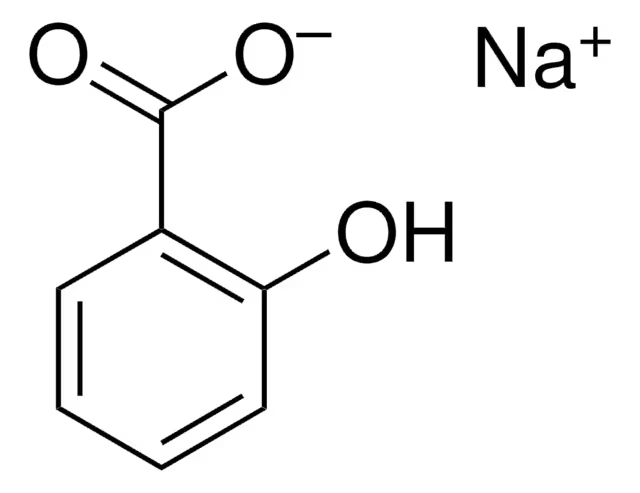
CAS Number54-21-7
Synonymsclin; nadisal; NASAL; aroall; salicylic acid sodium salt; kerosal; salisod; EINECS 200-198-0; ardall; sodium 2-hydroxybenzoate; diuretin; salicylic acid monosodium salt; magsalyl; alysine; MFCD00002440
Molecular FormulaHOC6H4COONa
Molecular Weight160.10
Purity≥99.5 (titration)%
Boiling Point336.3ºC at 760mmHg
Melting Point>300 °C (lit.)
Appearancecrystalline
EINECS200-198-0
Symbol
Signal WordWarning


Please Login or Create an Account to: See VlP prices and availability
US Stock: ship in 0-1 business day
Global Stock: ship in 5-7 days
| Chemical & Physical Properties | |
|---|---|
| CAS Number | 54-21-7 |
| Catalog No. | 2A-9016659 |
| Chinese Name | 水杨酸钠 |
| Synonyms | clin; nadisal; NASAL; aroall; salicylic acid sodium salt; kerosal; salisod; EINECS 200-198-0; ardall; sodium 2-hydroxybenzoate; diuretin; salicylic acid monosodium salt; magsalyl; alysine; MFCD00002440 |
| Molecular Formula | HOC6H4COONa |
| Molecular Weight | 160.10 |
| Purity | ≥99.5 (titration) |
| Boiling Point | 336.3ºC at 760mmHg |
| Melting Point | >300 °C (lit.) |
| Appearance | crystalline |
| Water Solubility | 1000 g/L (20 ºC) |
| Storage Condition | Store away from light. |
| Application | Sodium Salicylate inhibits COX-2 activity independent of transcription factor (NF-κB) activation. |
| EINECS | 200-198-0 |
| HTC | 2918211000 |
| PubChem ID | 24899540 |
| MDL Number | MFCD00002440 |
| SMILES | [Na+].Oc1ccccc1C([O-])=O |
| InChI | 1S/C7H6O3.Na/c8-6-4-2-1-3-5(6)7(9)10;/h1-4,8H,(H,9,10);/q;+1/p-1 |
| InChI Key | ABBQHOQBGMUPJH-UHFFFAOYSA-M |
| Beilstein/REAXYS | 3732792 |
| NACRES Code | NA.25 |
| UNSPSC | 12352302 |
| Hazard Symbols | Xn |
| Risk Codes | R22 |
| MSDS | msds/16659_1_54_21_7.pdf |
| Bioactivity | Sodium Salicylate inhibits cyclo-oxygenase-2 (COX-2) activity independently of transcription factor (NF-κB) activation. Related Catalog Signaling Pathways >> Autophagy >> Autophagy Research Areas >> Inflammation/Immunology Target COX-2 Autophagy In Vitro Sodium Salicylate is an effective inhibitor of COX-2 activity at concentrations far below those required to inhibit NF-κB (20 mg/mL) activation. Sodium Salicylate inhibits prostaglandin E2 release when add together with interleukin 1β for 24 hr with an IC50 value of 5 μg/mL, an effect that is independent of NF-κB activation or COX-2 transcription or translation. Sodium Salicylate acutely (30 min) also causes a concentration-dependent inhibition of COX-2 activity measured in the presence of 0, 1, or 10 μM exogenous arachidonic acid. In contrast, when exogenous arachidonic acid is increased to 30 μM, Sodium Salicylate is a very weak inhibitor of COX-2 activity with an IC50 of >100 μg/mL. When added together with IL-1β for 24 hr, Sodium Salicylate causes a concentration-dependent inhibition of PGE2 release with an apparent IC50 value of approximately 5 μg/mL. The ability of Sodium Salicylate to directly inhibit COX-2 activity in A549 cells is tested after a 30-min exposure period, followed by the addition of different concentrations of exogenous arachidonic acid (1, 10, and 30 μM). Sodium Salicylate causes a concentration-dependent inhibition of COX-2 activity in the absence of added arachidonic acid or in the presence of 1 or 10 μM exogenous substrate with an apparent IC50 value of approximately 5 μg/mL. However, when the same experiments are performed using 30 μM arachidonic acid, Sodium Salicylate is an ineffective inhibitor of COX-2 activity, with an apparent IC50 value of more than 100 μg/mL, and achieves a maximal inhibition of less than 50%[1]. In Vivo In C57Bl/6 DIO mice, Salicylate decreases both fasting and postprandial plasma glucose levels. Furthermore, there is a trend to reduce plasma triglyceride levels after Salicylate treatment in C57Bl/6 DIO mice (P=0.059). Salicylate significantly reduces 11β-HSD1 mRNA in omental adipose tissue in C57Bl/6 DIO mice, with a similar trend in mesenteric adipose (P=0.057). In mesenteric adipose of C57Bl/6 DIO mice, Salicylate also reduces 11β-HSD1 enzyme activity[2]. Kinase Assay Human purified COX-2 are and the cofactors Glutathione (5 mM), Adrenaline (5 mM), and Hematin (1 μM) are dissolved in 50 mM Tris buffer (pH 7.5). Hematin is first dissolved in a concentrated stock of 100 mM in 1 M NaOH before being further diluted in Tris buffer. Enzyme reactions are carried out in individual wells of 96-well plates with a final reaction volume of 200 μL. Different concentrations of Sodium Salicylate are added to the plate, followed by the addition of 10 units of enzyme (180 μL). The plates are incubated at 37° for 30 min before Arachidonic acid (10 nM to 30 μM) is added for a further 15 min. The reaction is stopped by heating the plate to 100°C for 5 min. The 96-well plate is then centrifuged at 10,000 × g for 10 min, and appropriated samples are removed and added into the radioimmunoassay[1]. Cell Assay To assess the direct effect of Sodium Salicylate on COX-2 activity after induction has occurred, A549 cells are first treated with IL-1β for 24 hr, and the culture medium is replaced with DMEM containing different concentrations of Sodium Salicylate(10, 100 and 1000 μg/mL). Cells are incubated at 37°C for 30 min. Arachidonic acid (1-30 μM) is then added for 15 min, and the medium is removed for the measurement of PGE2[1]. Animal Admin Mice[2] Adult male C57Bl/6 mice are at age 12 weeks. Diet-induced obese C57Bl/6 mice (C57Bl/6 DIO) are given 10 weeks of high-fat diet (58% fat, 12% sucrose) before treatment. Sodium Salicylate (120 mg/kg/day) or distilled water (vehicle) is administered from 1 week after arriving (C57Bl/6 Lean), after 10 weeks of high-fat feeding (C57Bl/6 DIO), or after achieving target weight (HSD1KO-DIO) for 4 weeks to groups of n=8 via osmotic minipumps implant subcutaneously between the scapulae. References [1]. Mitchell JA, et al. Sodium salicylate inhibits cyclo-oxygenase-2 activity independently of transcription factor (nuclear factor kappaB) activation: role of arachidonic acid. Mol Pharmacol. 1997 Jun;51(6):907-12. [2]. Nixon M, et al. Salicylate downregulates 11β-HSD1 expression in adipose tissue in obese mice and in humans, mediating insulin sensitization. Diabetes. 2012 Apr;61(4):790-6. Chemical & Physical Properties Boiling Point 336.3ºC at 760mmHg Melting Point >300 °C(lit.) Molecular Formula C7H5NaO3 Molecular Weight 160.103 Flash Point 144.5ºC Exact Mass 160.013641 PSA 60.36000 Index of Refraction 1.435 InChIKey ABBQHOQBGMUPJH-UHFFFAOYSA-M SMILES O=C([O-])c1ccccc1O.[Na+] Stability Stable. Incompatible with mineral acids, metallic salts, iodine. May be light-sensitive. Water Solubility 1000 g/L (20 ºC) |
| Use of | Sodium Salicylate inhibits cyclo-oxygenase-2 (COX-2) activity independently of transcription factor (NF-κB) activation. Properties Articles54 Name Sodium salicylate Synonym More Synonyms Sodium Salicylate Biological Activity Description Sodium Salicylate inhibits cyclo-oxygenase-2 (COX-2) activity independently of transcription factor (NF-κB) activation. Related Catalog Signaling Pathways >> Autophagy >> Autophagy Research Areas >> Inflammation/Immunology References [1]. Mitchell JA, et al. Sodium salicylate inhibits cyclo-oxygenase-2 activity independently of transcription factor (nuclear factor kappaB) activation: role of arachidonic acid. Mol Pharmacol. 1997 Jun;51(6):907-12. [2]. Nixon M, et al. Salicylate downregulates 11β-HSD1 expression in adipose tissue in obese mice and in humans, mediating insulin sensitization. Diabetes. 2012 Apr;61(4):790-6. Chemical & Physical Properties Molecular Formula C7H5NaO3 Exact Mass 160.013641 PSA 60.36000 Index of Refraction 1.435 InChIKey ABBQHOQBGMUPJH-UHFFFAOYSA-M Stability Stable. Incompatible with mineral acids, metallic salts, iodine. May be light-sensitive. |
| Tax Rebate | 9.0% |
| Supervision | None. Minimum tariff: 6.5%. Ordinary tariff: 20.0% |
| Transport Info | Product name: Chemical name |
| Related Products in Specialty Chemicals | ||
|---|---|---|
| Mitotan | 53-19-0 | 2A-9016643 |
| Etiocholanone | 53-42-9 | 2A-9016649 |
| Bis(2-methoxyethyl)aminosulfur trifluoride | 202289-38-1 | 2A-9016650 |
| Promazine hydrochloride | 53-60-1 | 2A-9016652 |
| Trifluorothymine | 54-20-6 | 2A-9016658 |
| Aminopterin | 54-62-6 | 2A-9016666 |
| Pentetrazol | 54-95-5 | 2A-9016670 |
| 4-Hydroxy-3-methoxymandelic acid | 55-10-7 | 2A-9016674 |
| (-)-Scopolamine hydrochloride | 55-16-3 | 2A-9016675 |
| DL-Norepinephrine hydrochloride | 55-27-6 | 2A-9016678 |
| Browse all Specialty Chemicals products » | ||
Phone:
630-322-8886
630-322-8887
Email:
Office Locations:
Chicago, IL, USA
San Francisco, CA, USA


 EN
EN

 SDS
SDS