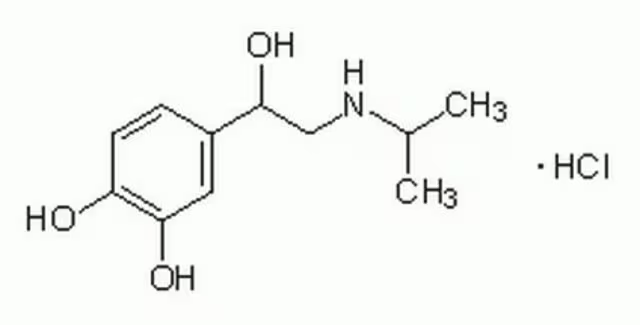
CAS Number51-30-9
SynonymsIsoproterenol hydrochloride; Pyrocatechol, 4-(1-hydroxy-2-(isopropylamino)ethyl)-, hydrochloride; Mistarel; 4-(1-Hydroxy-2-(isopropylamino)ethyl)pyrocatechol hydrochloride; 3,4-Dihydroxy-α-[(isopropylamino)methyl]benzyl alcohol hydrochloride; 4-{1-hydroxy-2-[(1-methylethyl)amino]ethyl}benzene-1,2-diol hydrochloride; Isovon; euspiran; Isoprenaline HCl; 1,2-benzenediol, 4-[1-hydroxy-2-[(1-methylethyl)amino]ethyl]-, hydrochloride; 1,2-Benzenediol, 4-[1-hydroxy-2-[(1-methylethyl)amino]ethyl]-, hydrochloride (1:1); EINECS 200-089-8; Saventrine IV; (±)-Isoproterenol hydrochloride; Suscardia; 4-[1-hydroxy-2-(isopropylamino)ethyl]benzene-1,2-diol hydrochloride; isoprenaline; 4-[1-Hydroxy-2-(isopropylamino)ethyl]-1,2-benzenediol hydrochloride (1:1); Isomenyl; 4-[1-Hydroxy-2-(isopropylamino)ethyl]be
Molecular FormulaC11H18ClNO3
Molecular Weight211.26 (free base basis)
Purity≥99 (TLC)%
Density1.324 g/cm3
Boiling Point417.5ºC at 760 mmHg
Melting Point165-175 °C (dec.)(lit.)
Appearancesolid
EINECS200-089-8
Symbol
Signal WordWarning
| Chemical & Physical Properties | |
|---|---|
| CAS Number | 51-30-9 |
| Catalog No. | 2A-9016598 |
| Chinese Name | 盐酸异丙肾上腺素 |
| Synonyms | Isoproterenol hydrochloride; Pyrocatechol, 4-(1-hydroxy-2-(isopropylamino)ethyl)-, hydrochloride; Mistarel; 4-(1-Hydroxy-2-(isopropylamino)ethyl)pyrocatechol hydrochloride; 3,4-Dihydroxy-α-[(isopropylamino)methyl]benzyl alcohol hydrochloride; 4-{1-hydroxy-2-[(1-methylethyl)amino]ethyl}benzene-1,2-diol hydrochloride; Isovon; euspiran; Isoprenaline HCl; 1,2-benzenediol, 4-[1-hydroxy-2-[(1-methylethyl)amino]ethyl]-, hydrochloride; 1,2-Benzenediol, 4-[1-hydroxy-2-[(1-methylethyl)amino]ethyl]-, hydrochloride (1:1); EINECS 200-089-8; Saventrine IV; (±)-Isoproterenol hydrochloride; Suscardia; 4-[1-hydroxy-2-(isopropylamino)ethyl]benzene-1,2-diol hydrochloride; isoprenaline; 4-[1-Hydroxy-2-(isopropylamino)ethyl]-1,2-benzenediol hydrochloride (1:1); Isomenyl; 4-[1-Hydroxy-2-(isopropylamino)ethyl]be |
| Molecular Formula | C11H18ClNO3 |
| Molecular Weight | 211.26 (free base basis) |
| Purity | ≥99 (TLC) |
| Density | 1.324 g/cm3 |
| Boiling Point | 417.5ºC at 760 mmHg |
| Melting Point | 165-175 °C (dec.)(lit.) |
| Appearance | solid |
| Water Solubility | Soluble |
| Storage Condition | This product should be sealed and stored in a cool |
| Application | Isoprenaline hydrochloride is a non-selective beta-adrenoceptor agonist with potent peripheral vasodilator, bronchodilator and cardiostimulatory activity. |
| EINECS | 200-089-8 |
| MDL Number | MFCD00012603 |
| SMILES | [Cl-].N(C(C)C)CC(O)c1cc(c(cc1)O)O.[H+] |
| InChI | 1S/C11H17NO3.ClH/c1-7(2)12-6-11(15)8-3-4-9(13)10(14)5-8;/h3-5,7,11-15H,6H2,1-2H3;1H |
| InChI Key | IROWCYIEJAOFOW-UHFFFAOYSA-N |
| NACRES Code | NA.77 |
| UNSPSC | 12352200 |
| Hazard Symbols | Transport |
| Risk Codes | R36/37/38 |
| Safety Description | S26;S36 |
| MSDS | msds/16598_1_51_30_9.pdf |
| Bioactivity | Isoprenaline hydrochloride is a non-selective beta-adrenergic receptor agonist with potent peripheral vasodilator, bronchodilator, and cardiac stimulating activities. Related Catalog Signaling Pathways >> GPCR/G Protein >> Adrenergic Receptor Research Areas >> Cardiovascular Disease Target Beta-adrenergic receptor[1] In Vitro Isoprenaline (300 nM, 3 min) increases particulate cGMP- and cilostamide-inhibited, low-Km cAMP phosphodiesterase (cAMP-PDE) activity by about 100% in intact rat fat cells[1]. Isoprenaline inhibits insulin-stimulated glucose transport activity in rat adipocytes. Isoprenaline, in the absence of adenosine, promotes a time-dependent (t1/2 approximately 2 min) decrease in the accessibility of insulin-stimulated cell surface GLUT4 of > 50%, which directly correlated with the observed inhibition of transport activity[2]. Isoprenaline (5 nM and 10 mM) increases cyclic AMP levels and this effect is potentiated by cilostamide (10 mM), by rolipram, a cyclic AMP-specific PDE (PDE 4) inhibitor (10 mM) and by cyclic GMP-elevating agents (50 nM ANF or 30 nM SNP plus 100 nM DMPPO)[3]. Isoprenaline increases the transcriptional activity of Gi alpha-2 gene to 140% of the control value, whereas gene specific hybridization for Gs alpha remains unchanged[4]. Isoprenaline (20 nM) increases the amplitude of total iK and causes a negative shift of approximately 10 mV in the activation curve for iK, both in the absence and in the presence of 300 nM nisoldipine to block the L-type Ca2+ current. Isoprenaline (20 nM) increases the spontaneous pacemaker rate of sino-atrial node pacemaker cells by 16% in rabbit isolated pacemaker cells[5]. Cell Assay Cells are seeded in 24-well culture dishes at a density of 2 to 5×10⁴ cells per well. Experiments are performed after 3 to 5 days in culture when cells has reached confluence. Culture medium is aspirated and replaced by 0.5 mL of PBS containing the pharmacological agents. Treatments are performed in quadruplicate at 37°C. The type 3, 4 and 5 PDE inhibitors cilostamide (10 gM), rolipram (10 pM) and DMPPO (10 gM), respectively, are incubated with cells for 30 min before addition of adenylate or guanylate cyclase activators. Cyclic GMP and cyclic AMP are respectively increased in RASMC by stimulation of particulate guanylate cyclase with ANF (50 nM for 10 min) or fl-adrenoceptors with isoprenaline (5 nm for 5 min). At the end of the incubation period, the medium is removed and intracellular cyclic nucleotides are extracted by two ethanolic (65%) ishes at 4°C for 5 min. Ethanolic extracts are pooled, evaporated to dryness by a Speed-Vac system. The dried extract is dissolved in a suitable amount of assay buffer and cyclic nucleotide levels are measured by scintillation proximity assay. References [1]. Degerman E, et al. Evidence that insulin and isoprenaline activate the cGMP-inhibited low-Km cAMP phosphodiesterase in rat fat cells by phosphorylation. Proc Natl Acad Sci U S A. 1990 Jan;87(2):533-7 [2]. Vannucci SJ, et al. Cell surface accessibility of GLUT4 glucose transporters in insulin-stimulated rat adipose cells. Modulation by isoprenaline and adenosine. Biochem J. 1992 Nov 15;288 (Pt 1):325-30. [3]. Delpy E, et al. Effects of cyclic GMP elevation on isoprenaline-induced increase in cyclic AMP and relaxation in rat aortic smooth muscle: role of phosphodiesterase 3. Br J Pharmacol. 1996 Oct;119(3):471-8. [4]. Muller FU, et al. Isoprenaline stimulates gene transcription of the inhibitory G protein alpha-subunit Gi alpha-2 in rat heart. Circ Res. 1993 Mar;72(3):696-700. [5]. Lei M, et al. Modulation of delayed rectifier potassium current, iK, by isoprenaline in rabbit isolated pacemaker cells. Exp Physiol. 2000 Jan;85(1):27-35. Chemical & Physical Properties Density 1.324 g/cm3 Boiling Point 417.5ºC at 760 mmHg Melting Point 165-175 °C (dec.)(lit.) Molecular Formula C11H18ClNO3 Molecular Weight 247.719 Flash Point 179.7ºC Exact Mass 247.097519 PSA 72.72000 LogP 2.32210 InChIKey IROWCYIEJAOFOW-UHFFFAOYSA-N SMILES CC(C)NCC(O)c1ccc(O)c(O)c1.Cl Storage condition Store at RT Stability Stable, but may be air and light sensitive. Incompatible with strong oxidizing agents. Water Solubility Soluble |
| Use of | Isoprenaline hydrochloride is a non-selective beta-adrenergic receptor agonist with potent peripheral vasodilator, bronchodilator, and cardiac stimulating activities. Properties Articles90 Name Isoprenaline hydrochloride Synonym More Synonyms Isoprenaline hydrochloride Biological Activity Description Isoprenaline hydrochloride is a non-selective beta-adrenergic receptor agonist with potent peripheral vasodilator, bronchodilator, and cardiac stimulating activities. Related Catalog Signaling Pathways >> GPCR/G Protein >> Adrenergic Receptor Research Areas >> Cardiovascular Disease Beta-adrenergic receptor[1] References [1]. Degerman E, et al. Evidence that insulin and isoprenaline activate the cGMP-inhibited low-Km cAMP phosphodiesterase in rat fat cells by phosphorylation. Proc Natl Acad Sci U S A. 1990 Jan;87(2):533-7 [3]. Delpy E, et al. Effects of cyclic GMP elevation on isoprenaline-induced increase in cyclic AMP and relaxation in rat aortic smooth muscle: role of phosphodiesterase 3. Br J Pharmacol. 1996 Oct;119(3):471-8. [4]. Muller FU, et al. Isoprenaline stimulates gene transcription of the inhibitory G protein alpha-subunit Gi alpha-2 in rat heart. Circ Res. 1993 Mar;72(3):696-700. [5]. Lei M, et al. Modulation of delayed rectifier potassium current, iK, by isoprenaline in rabbit isolated pacemaker cells. Exp Physiol. 2000 Jan;85(1):27-35. Chemical & Physical Properties Exact Mass 247.097519 PSA 72.72000 LogP 2.32210 InChIKey IROWCYIEJAOFOW-UHFFFAOYSA-N Storage condition Store at RT Stability Stable, but may be air and light sensitive. Incompatible with strong oxidizing agents. Water Solubility Soluble |
| Transport Info | Shipping Name: UN |
| MSDS Transport Info | Module 14. Shipping information 14.1 UN dangerous goods number European Land Transport Dangerous Regulations: -International Maritime Dangerous Regulations: -International Air Transport Dangerous Regulations: - 14.2 United Nations shipping name European Land Transport Dangerous Regulations: Non-dangerous goods IMDG Code: Non-dangerous goods International air transport dangerous goods regulations: non-dangerous goods 14.3 Transport hazard categories European Land Transport Dangerous Regulations: -International Maritime Dangerous Regulations: -International Air Transport Dangerous Regulations: - 14.4 Package group European Land Transport Dangerous Regulations: -International Maritime Dangerous Regulations: -International Air Transport Dangerous Regulations: - 14.5 Environmental hazards European Land Transport Danger Regulations: No International Maritime Danger Regulations International Air Transport Danger Regulations: No Marine pollutants (yes/no): No 14.6 Special reminder to users No data available |
| Related Products in Specialty Chemicals | ||
|---|---|---|
| 4-Acetamidosalicylic acid | 50-86-2 | 2A-9016584 |
| D(+)-Glucose | 50-99-7 | 2A-9016588 |
| Piperonyl butoxide | 51-03-6 | 2A-9016589 |
| Procaine hydrochloride | 51-05-8 | 2A-9016590 |
| Tiratricol | 51-24-1 | 2A-9016596 |
| Scopolamine | 51-34-3 | 2A-0202158 |
| Epinephrine bitartrate | 51-42-3 | 2A-9016603 |
| L(-)-Epinephrine | 51-43-4 | 2A-9016604 |
| 3,4-Dichlorobenzoic acid | 51-44-5 | 2A-9016605 |
| Histamine | 51-45-6 | 2A-9016606 |
| Browse all Specialty Chemicals products » | ||
Phone:
630-322-8886
630-322-8887
Email:
Office Locations:
Chicago, IL, USA
San Francisco, CA, USA


 EN
EN


 SDS
SDS