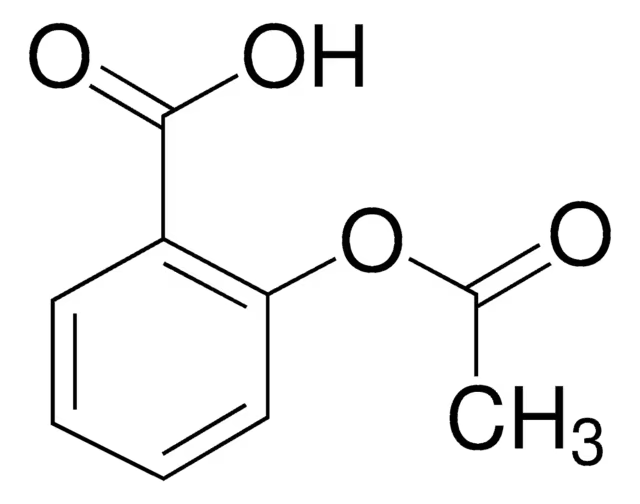
CAS Number50-78-2
SynonymsAdiro; 2-Acetoxybenzoic acid,O-Acetylsalicyl; Acetyonyl; EINECS 200-064-1; ronal; Miniasal; Acetoxybenzoic acid; Melhoral; Aspr; A.S.A.; o-Acetylsalicylic acid; Triaminicin; ASA; Acesan; Asatard; Acetysalicylic acid; Aspro; Rhodine NC RP; 2-Carboxyphenyl acetate; O-acetyl salicylic acid; Aspropharm; o-(Acetyloxy)benzoic Acid; Xaxa; 2-Acetoxybenzoic acid,O-Acetylsalicylic acid,ASA; Aspirin; Cardioaspirina; Toldex; acetyl salicylic acid; Acetard; Bayer
Molecular Formula2-(CH3CO2)C6H4CO2H
Molecular Weight180.16
Purity≥99.0%
Density1.3±0.1 g/cm3
Boiling Point321.4±25.0 °C at 760 mmHg
Melting Point134-136 °C (lit.)
Appearancepowder
EINECS200-064-1
Symbol
Signal WordWarning
| Chemical & Physical Properties | |
|---|---|
| CAS Number | 50-78-2 |
| Catalog No. | 2A-9016578 |
| Chinese Name | 阿司匹林 |
| Synonyms | Adiro; 2-Acetoxybenzoic acid,O-Acetylsalicyl; Acetyonyl; EINECS 200-064-1; ronal; Miniasal; Acetoxybenzoic acid; Melhoral; Aspr; A.S.A.; o-Acetylsalicylic acid; Triaminicin; ASA; Acesan; Asatard; Acetysalicylic acid; Aspro; Rhodine NC RP; 2-Carboxyphenyl acetate; O-acetyl salicylic acid; Aspropharm; o-(Acetyloxy)benzoic Acid; Xaxa; 2-Acetoxybenzoic acid,O-Acetylsalicylic acid,ASA; Aspirin; Cardioaspirina; Toldex; acetyl salicylic acid; Acetard; Bayer |
| Molecular Formula | 2-(CH3CO2)C6H4CO2H |
| Molecular Weight | 180.16 |
| Purity | ≥99.0 |
| Density | 1.3±0.1 g/cm3 |
| Boiling Point | 321.4±25.0 °C at 760 mmHg |
| Melting Point | 134-136 °C (lit.) |
| Appearance | powder |
| Water Solubility | 3.3 g/L (20 ºC) |
| Storage Condition | 1. Production equipment should be sealed and good |
| Packaging | III |
| Application | Aspirin is a non-selective and irreversible COX-1 and COX-2 inhibitor with IC50 of 5,210 μg/mL respectively. |
| EINECS | 200-064-1 |
| HTC | 3004909090 |
| UN(IATA) | UN 1851 |
| PubChem ID | 24278218 |
| MDL Number | MFCD00002430 |
| SMILES | CC(=O)Oc1ccccc1C(O)=O |
| InChI | 1S/C9H8O4/c1-6(10)13-8-5-3-2-4-7(8)9(11)12/h2-5H,1H3,(H,11,12) |
| InChI Key | BSYNRYMUTXBXSQ-UHFFFAOYSA-N |
| Beilstein/REAXYS | 779271 |
| NACRES Code | NA.21 |
| UNSPSC | 12352106 |
| Hazard Symbols | Transport |
| Risk Codes | R22;R36/37/38 |
| Safety Description | S26;S36/37/39 |
| MSDS | msds/16578_1_50_78_2.pdf |
| Bioactivity | Aspirin is a non-selective and irreversible inhibitor of COX-1 and COX-2 with IC50s of 5 and 210 μg/mL. Related Catalog Signaling Pathways >> Autophagy >> Autophagy Signaling Pathways >> Immunology/Inflammation >> COX Signaling Pathways >> Autophagy >> Mitophagy Research Areas >> Inflammation/Immunology Target COX-1:27.75 μM (IC50) COX-2:1.17 mM (IC50) In Vitro Aspirin and other non-steroid anti-inflammatory drugs inhibit the activity of cyclooxygenase (COX) which leads to the formation of prostaglandins (PGs) that cause inflammation, swelling, pain and fever[2]. Aspirin acetylates serine-530 of cyclooxygenase-1 (COX-1), thereby blocking thromboxane A synthesis in platelets and reducing platelet aggregation. This mechanism of action accounts for the effect of aspirin on prevention of coronary artery and cerebrovascular thrombosis. Aspirin is less effective in inhibiting COX-2 activity. Aspirin and salicylate inhibit COX-2 protein expression through interference with binding of CCAAT/enhancer binding protein beta (C/EBPbeta) to its cognate site on COX-2 promoter/enhancer[3]. Aspirin inhibits the activation of NF-κB. This inhibition prevents the degradation of the NF-κB inhibitor, 1κB, and therefore NF-κB is retained in the cytosol. Aspirin also inhibits NF-κB-dependent transcription from the lgκ enhancer and the human immunodeficiency virus (HIV) long terminal repeat (LTR) in transfected T cells[4]. Aspirin inhibits COX-1 and COX-2 with IC50 values of 3.57 μM and 29.3 μM, respectively in human articular chondrocytes[5]. Cell Assay Chondrocytes are isolated from articular cartilage of donors with no articular disease. Unstimulated and interleukin 1 (IL-1) stimulated chondrocytes are used as models to study the effects of drugs on COX-1 and COX-2. Cells are incubated with vehicle or drugs (Asprin); supernatants are removed and the level of prostaglandin E2 (PGE2) in each sample is determined by enzyme immunoassay. IC50s are calculated from the reduction in PGE2 content by different concentrations of the test substance by linear regression analysis[5]. References [1]. Mitchell JA, et al. Selectivity of nonsteroidal antiinflammatory drugs as inhibitors of constitutive and induciblecyclooxygenase. Proc Natl Acad Sci U S A. 1993 Dec 15;90(24):11693-7. [2]. Vane JR, et al. The mechanism of action of aspirin. Thromb Res. 2003 Jun 15;110(5-6):255-8. [3]. Wu KK, et al. Aspirin and other cyclooxygenase inhibitors: new therapeutic insights. Semin Vasc Med. 2003 May;3(2):107-12. [4]. Kopp E, et al. Inhibition of NF-kappa B by sodium salicylate and aspirin. Science. 1994 Aug 12;265(5174):956-9. [5]. Blanco FJ, et al. Effect of antiinflammatory drugs on COX-1 and COX-2 activity in human articular chondrocytes. J Rheumatol. 1999 Jun;26(6):1366-73. Chemical & Physical Properties Density 1.3±0.1 g/cm3 Boiling Point 321.4±25.0 °C at 760 mmHg Melting Point 134-136 °C(lit.) Molecular Formula C9H8O4 Molecular Weight 180.157 Flash Point 131.2±16.7 °C Exact Mass 180.042252 PSA 63.60000 LogP 1.19 Vapour Pressure 0.0±0.7 mmHg at 25°C Index of Refraction 1.551 InChIKey BSYNRYMUTXBXSQ-UHFFFAOYSA-N SMILES CC(=O)Oc1ccccc1C(=O)O Stability Stable. Keep dry. Incompatible with strong oxidizing agents, strong bases, strong acids, various other compounds such as iodides, iron salts, quinine salts, etc. Water Solubility 3.3 g/L (20 ºC) |
| Use of | Aspirin is a non-selective and irreversible inhibitor of COX-1 and COX-2 with IC50s of 5 and 210 μg/mL. Properties Articles683 Name acetylsalicylic acid Synonym More Synonyms Aspirin Biological Activity Description Aspirin is a non-selective and irreversible inhibitor of COX-1 and COX-2 with IC50s of 5 and 210 μg/mL. Related Catalog Signaling Pathways >> Autophagy >> Autophagy Signaling Pathways >> Immunology/Inflammation >> COX Signaling Pathways >> Autophagy >> Mitophagy Research Areas >> Inflammation/Immunology COX-1:27.75 μM (IC50) In Vitro Aspirin and other non-steroid anti-inflammatory drugs inhibit the activity of cyclooxygenase (COX) which leads to the formation of prostaglandins (PGs) that cause inflammation, swelling, pain and fever[2]. Aspirin acetylates serine-530 of cyclooxygenase-1 (COX-1), thereby blocking thromboxane A synthesis in platelets and reducing platelet aggregation. This mechanism of action accounts for the effect of aspirin on prevention of coronary artery and cerebrovascular thrombosis. Aspirin is less effective in inhibiting COX-2 activity. Aspirin and salicylate inhibit COX-2 protein expression through interference with binding of CCAAT/enhancer binding protein beta (C/EBPbeta) to its cognate site on COX-2 promoter/enhancer[3]. Aspirin inhibits the activation of NF-κB. This inhibition prevents the degradation of the NF-κB inhibitor, 1κB, and therefore NF-κB is retained in the cytosol. Aspirin also inhibits NF-κB-dependent transcription from the lgκ enhancer and the human immunodeficiency virus (HIV) long terminal repeat (LTR) in transfected T cells[4]. Aspirin inhibits COX-1 and COX-2 with IC50 values of 3.57 μM and 29.3 μM, respectively in human articular chondrocytes[5]. References [1]. Mitchell JA, et al. Selectivity of nonsteroidal antiinflammatory drugs as inhibitors of constitutive and induciblecyclooxygenase. Proc Natl Acad Sci U S A. 1993 Dec 15;90(24):11693-7. [2]. Vane JR, et al. The mechanism of action of aspirin. Thromb Res. 2003 Jun 15;110(5-6):255-8. [3]. Wu KK, et al. Aspirin and other cyclooxygenase inhibitors: new therapeutic insights. Semin Vasc Med. 2003 May;3(2):107-12. [4]. Kopp E, et al. Inhibition of NF-kappa B by sodium salicylate and aspirin. Science. 1994 Aug 12;265(5174):956-9. [5]. Blanco FJ, et al. Effect of antiinflammatory drugs on COX-1 and COX-2 activity in human articular chondrocytes. J Rheumatol. 1999 Jun;26(6):1366-73. Chemical & Physical Properties Molecular Formula C9H8O4 Exact Mass 180.042252 PSA 63.60000 Index of Refraction 1.551 InChIKey BSYNRYMUTXBXSQ-UHFFFAOYSA-N Stability Stable. Keep dry. Incompatible with strong oxidizing agents, strong bases, strong acids, various other compounds such as iodides, iron salts, quinine salts, etc. |
| Tax Rebate | 0.0% |
| Supervision | S. Import and export pesticide registration certificate |
| Transport Info | Shipping Name: UN |
| MSDS Transport Info | Module 14. Shipping information 14.1 UN dangerous goods number European Land Transport Dangerous Regulations: -International Maritime Dangerous Regulations: -International Air Transport Dangerous Regulations: - 14.2 United Nations shipping name European Land Transport Dangerous Regulations: Non-dangerous goods IMDG Code: Non-dangerous goods International air transport dangerous goods regulations: non-dangerous goods 14.3 Transport hazard categories European Land Transport Dangerous Regulations: -International Maritime Dangerous Regulations: -International Air Transport Dangerous Regulations: - 14.4 Package group European Land Transport Dangerous Regulations: -International Maritime Dangerous Regulations: -International Air Transport Dangerous Regulations: - 14.5 Environmental hazards European Land Transport Danger Regulations: No International Maritime Danger Regulations International Air Transport Danger Regulations: No Marine pollutants (yes/no): No 14.6 Special reminder to users No data available |
| Related Products in API & Advanced Intermediates | ||
|---|---|---|
| Amitriptyline | 50-48-6 | 2A-9016558 |
| Imipramine | 50-49-7 | 2A-9016559 |
| Estradiol benzoate | 50-50-0 | 2A-9016560 |
| Thioridazine | 50-52-2 | 2A-9016561 |
| Chlorpromazine | 50-53-3 | 2A-9016562 |
| Prednisolone acetate | 52-21-1 | 2A-9016627 |
| Haloperidol | 52-86-8 | 2A-9016637 |
| Prednisone | 53-03-2 | 2A-9016641 |
| Estrone | 53-16-7 | 2A-9016642 |
| Fluprednisolone | 53-34-9 | 2A-9016645 |
| Browse all API & Advanced Intermediates products » | ||
Phone:
630-322-8886
630-322-8887
Email:
Office Locations:
Chicago, IL, USA
San Francisco, CA, USA


 EN
EN


 SDS
SDS