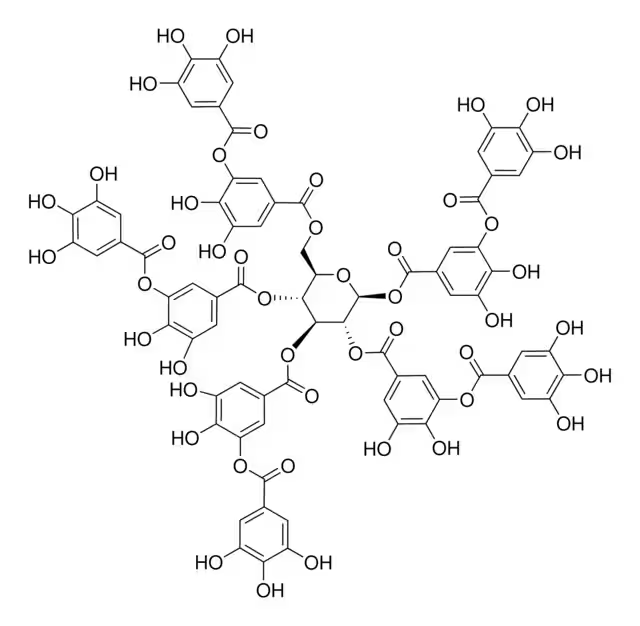
CAS Number1401-55-4
SynonymsTannic acid; Gallotannin,Tannin; MFCD00066397; EINECS 215-753-2; Gallotannin Tannin; Glycerite
Molecular FormulaC76H52O46
Molecular Weight1701.20
Purity81%
Density2.1±0.1 g/cm3
Melting Point218 °C (lit.)
Appearancepowder or solid
EINECS215-753-2
Symbol
Signal WordWarning
| Chemical & Physical Properties | |
|---|---|
| CAS Number | 1401-55-4 |
| Catalog No. | 2A-9015839 |
| Chinese Name | 单宁酸 |
| Synonyms | Tannic acid; Gallotannin,Tannin; MFCD00066397; EINECS 215-753-2; Gallotannin Tannin; Glycerite |
| Molecular Formula | C76H52O46 |
| Molecular Weight | 1701.20 |
| Purity | 81 |
| Density | 2.1±0.1 g/cm3 |
| Melting Point | 218 °C (lit.) |
| Appearance | powder or solid |
| Water Solubility | 250 g/L (20 ºC) |
| Storage Condition | 1. Packed in non-toxic plastic bags or glass bottl |
| Application | Tannic acid is a new hERG channel blocker with an IC50 value of 3.4 μM. |
| EINECS | 215-753-2 |
| HTC | 3201909000 |
| PubChem ID | 24865158 |
| MDL Number | MFCD00066397 |
| SMILES | Oc1cc(cc(O)c1O)C(=O)Oc2cc(cc(O)c2O)C(=O)OC[C@H]3O[C@@H](OC(=O)c4cc(O)c(O)c(OC(=O)c5cc(O)c(O)c(O)c5)c4)[C@H](OC(=O)c6cc(O)c(O)c(OC(=O)c7cc(O)c(O)c(O)c7)c6)[C@@H](OC(=O)c8cc(O)c(O)c(OC(=O)c9cc(O)c(O)c(O)c9)c8)[C@@H]3OC(=O)c%10cc(O)c(O)c(OC(=O)c%11cc(O)c(O)c(O)c%11)c%10 |
| InChI | 1S/C76H52O46/c77-32-1-22(2-33(78)53(32)92)67(103)113-47-16-27(11-42(87)58(47)97)66(102)112-21-52-63(119-72(108)28-12-43(88)59(98)48(17-28)114-68(104)23-3-34(79)54(93)35(80)4-23)64(120-73(109)29-13-44(89)60(99)49(18-29)115-69(105)24-5-36(81)55(94)37(82)6-24)65(121-74(110)30-14-45(90)61(100)50(19-30)116-70(106)25-7-38(83)56(95)39(84)8-25)76(118-52)122-75(111)31-15-46(91)62(101)51(20-31)117-71(107)26-9-40(85)57(96)41(86)10-26/h1-20,52,63-65,76-101H,21H2/t52-,63-,64+,65-,76+/m1/s1 |
| InChI Key | LRBQNJMCXXYXIU-PPKXGCFTSA-N |
| Beilstein/REAXYS | 8186396 |
| NACRES Code | NA.21 |
| UNSPSC | 12352100 |
| Hazard Symbols | Transport |
| MSDS | msds/15839_1_1401_55_4.pdf |
| Bioactivity | Tannic acid is a novel hERG channel blocker with IC50 of 3.4 μM. Related Catalog Signaling Pathways >> Membrane Transporter/Ion Channel >> Potassium Channel Natural Products >> Phenols Research Areas >> Cancer Research Areas >> Inflammation/Immunology Target IC50: 3.4 μM (hERG channel)[1] In Vivo During the course of treatment, tannic acid significantly ameliorates these phenotypes in AD skin lesions. Tannic acid treatment aslo reduces these dermal changes compare with AD mice. Treatment with tannic acid increases PPARγ expression in AD skin sections. The PPARγ protein expression is suppressed in vehicle-treated AD mice, but when treats with tannic acid, its expression is increased dramatically. The IL-1β, TNFα, TNFR1, and COX2 protein expressions are significantly up-regulated in vehicle-treated AD mice, but significantly suppressed by tannic acid treatment[2]. Animal Admin Specific pathogen-free female 6 weeks old mice are used. The animals are maintained in a controlled room (temperature 23±2 °C, humidity 55±15%, 12 h light cycle). After 1 week, the mice arer andomly divided into 3 groups, untreated group-receive vehicle (distill water) (Normal, n=5); DfE cream treated mice (100 mg/mouse) is divided into two groups and each receives vehicle (distill water) (AD, n=5) or Tannic acid (80 mg/kg/day, per oral) (AD+Tannic acid, n=5) and are allowed free access to drinking water and standard laboratory diet[2]. References [1]. Xi Chu, et al. Effects of Tannic Acid, Green Tea and Red Wine on hERG Channels Expressed in HEK293 Cells. PLoS One. 2015; 10(12): e0143797. [2]. Karuppagounder V, et al. Tannic acid modulates NFκB signaling pathway and skin inflammation in NC/Nga mice through PPARγ expression. Cytokine. 2015 Dec;76(2):206-13. Chemical & Physical Properties Density 2.1±0.1 g/cm3 Melting Point 218 °C(lit.) Molecular Formula C76H52O46 Molecular Weight 1701.198 Flash Point 198°C Exact Mass 1700.172974 PSA 777.98000 LogP 13.33 Index of Refraction 1.927 InChIKey LRBQNJMCXXYXIU-PPKXGCFTSA-N SMILES O=C(OCC1OC(OC(=O)c2cc(O)c(O)c(OC(=O)c3cc(O)c(O)c(O)c3)c2)C(OC(=O)c2cc(O)c(O)c(OC(=O)c3cc(O)c(O)c(O)c3)c2)C(OC(=O)c2cc(O)c(O)c(OC(=O)c3cc(O)c(O)c(O)c3)c2)C1OC(=O)c1cc(O)c(O)c(OC(=O)c2cc(O)c(O)c(O)c2)c1)c1cc(O)c(O)c(OC(=O)c2cc(O)c(O)c(O)c2)c1 Stability Stable. Incompatible with metallic salts, strong oxidizing agents, iron and other heavy metals. Water Solubility 250 g/L (20 ºC) |
| Use of | Tannic acid is a novel hERG channel blocker with IC50 of 3.4 μM. Properties Articles73 Name tannic acid Synonym More Synonyms Tannic acid Biological Activity Description Tannic acid is a novel hERG channel blocker with IC50 of 3.4 μM. Related Catalog Signaling Pathways >> Membrane Transporter/Ion Channel >> Potassium Channel Natural Products >> Phenols Research Areas >> Cancer Research Areas >> Inflammation/Immunology IC50: 3.4 μM (hERG channel)[1] In Vivo During the course of treatment, tannic acid significantly ameliorates these phenotypes in AD skin lesions. Tannic acid treatment aslo reduces these dermal changes compare with AD mice. Treatment with tannic acid increases PPARγ expression in AD skin sections. The PPARγ protein expression is suppressed in vehicle-treated AD mice, but when treats with tannic acid, its expression is increased dramatically. The IL-1β, TNFα, TNFR1, and COX2 protein expressions are significantly up-regulated in vehicle-treated AD mice, but significantly suppressed by tannic acid treatment[2]. References [2]. Karuppagounder V, et al. Tannic acid modulates NFκB signaling pathway and skin inflammation in NC/Nga mice through PPARγ expression. Cytokine. 2015 Dec;76(2):206-13. Chemical & Physical Properties Molecular Formula C76H52O46 Exact Mass 1700.172974 PSA 777.98000 LogP 13.33 Index of Refraction 1.927 InChIKey LRBQNJMCXXYXIU-PPKXGCFTSA-N Stability Stable. Incompatible with metallic salts, strong oxidizing agents, iron and other heavy metals. |
| Transport Info | Shipping Name: UN |
| MSDS Transport Info | Module 14. Shipping information 14.1 United Nations number European Land Transport Dangerous Regulations: -International Maritime Dangerous Regulations: -International Air Transport Dangerous Regulations: - 14.2 United Nations shipping name European Land Transport Dangerous Regulations: Non-dangerous goods IMDG Code: Non-dangerous goods International air transport dangerous goods regulations: non-dangerous goods 14.3 Transport hazard categories European Land Transport Dangerous Regulations: -International Maritime Dangerous Regulations: -International Air Transport Dangerous Regulations: - 14.4 Package group European Land Transport Dangerous Regulations: -International Maritime Dangerous Regulations: -International Air Transport Dangerous Regulations: - 14.5 Environmental hazards European Land Transport Danger Regulations: No International Maritime Danger Regulations International Air Transport Danger Regulations: No Marine pollutants (yes/no): No 14.6 Special precautions No data available |
| Related Products in Botanical Reference Standards | ||
|---|---|---|
| 1,8-Dinitroanthraquinone | 129-39-5 | 2A-9013105 |
| 4,4-Dinitrostilbene-2,2-Disulphonic acid | 128-42-7 | 2A-9013471 |
| Anthraquinone | 84-65-1 | 2A-9013732 |
| Anthraquinone-1,5-disulfonic acid | 117-14-6 | 2A-9013733 |
| Gallic acid | 149-91-7 | 2A-9014493 |
| Dihydrotachysterol | 67-96-9 | 2A-9016963 |
| 1,2-Dihydroxy anthraquinone | 72-48-0 | 2A-9017031 |
| Dihydrocholesterol | 80-97-7 | 2A-9017326 |
| 1,8-Dihydroxy-4,5-dinitroanthraquinone | 81-55-0 | 2A-9017349 |
| 1,4,5,8-Tetrachloroanthraquinone | 81-58-3 | 2A-9017350 |
| Browse all Botanical Reference Standards products » | ||
Phone:
630-322-8886
630-322-8887
Email:
Office Locations:
Chicago, IL, USA
San Francisco, CA, USA


 EN
EN


 SDS
SDS