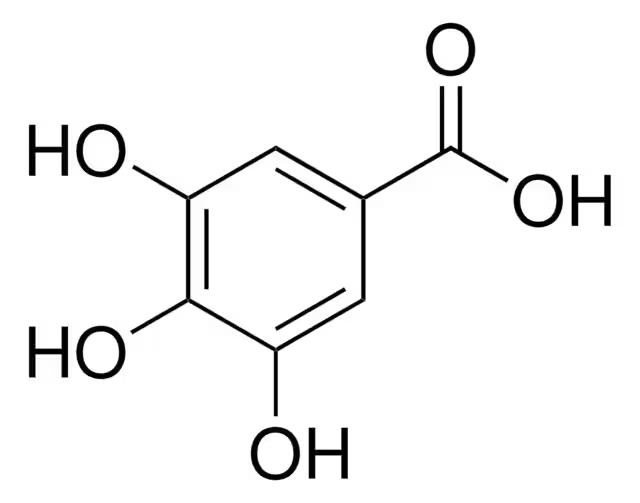
CAS Number149-91-7
Synonyms3,4,5-trihydroxybenzenoic Acid; Gallic acid; graphite oxide; kyselinagallova; 3,4,5-Trihydroxy-benzoic acid; Acid, Gallic; BETZ 0276; 3,4,5-Trihydroxybenzoic acid; gallic; Galloyl alcohol; MFCD00002510; Gallussaure; graphitic acid; 3-10-00-02070 (Beilstein Handbook Reference); EINECS 205-749-9
Molecular Formula(HO)3C6H2CO2H
Molecular Weight170.12
Purity97.5-102.5 (titration)%
Density1.7±0.1 g/cm3
Boiling Point501.1±50.0 °C at 760 mmHg
Melting Point251 °C (dec.) (lit.)
Appearancepowder
EINECS205-749-9
Symbol
Signal WordWarning


Please Login or Create an Account to: See VlP prices and availability
US Stock: ship in 0-1 business day
Global Stock: ship in 5-7 days
| Chemical & Physical Properties | |
|---|---|
| CAS Number | 149-91-7 |
| Catalog No. | 2A-9014493 |
| Chinese Name | 没食子酸; 3,4,5-三羟基苯甲酸 |
| Synonyms | 3,4,5-trihydroxybenzenoic Acid; Gallic acid; graphite oxide; kyselinagallova; 3,4,5-Trihydroxy-benzoic acid; Acid, Gallic; BETZ 0276; 3,4,5-Trihydroxybenzoic acid; gallic; Galloyl alcohol; MFCD00002510; Gallussaure; graphitic acid; 3-10-00-02070 (Beilstein Handbook Reference); EINECS 205-749-9 |
| Molecular Formula | (HO)3C6H2CO2H |
| Molecular Weight | 170.12 |
| Purity | 97.5-102.5 (titration) |
| Density | 1.7±0.1 g/cm3 |
| Boiling Point | 501.1±50.0 °C at 760 mmHg |
| Melting Point | 251 °C (dec.) (lit.) |
| Appearance | powder |
| Water Solubility | 12 g/L cold water |
| Storage Condition | Store in a dry and cool place. |
| Application | Gallic acid is a COX-2 inhibitor. |
| EINECS | 205-749-9 |
| HTC | 2918290000 |
| PubChem ID | 24895304 |
| MDL Number | MFCD00002510 |
| SMILES | OC(=O)c1cc(O)c(O)c(O)c1 |
| InChI | 1S/C7H6O5/c8-4-1-3(7(11)12)2-5(9)6(4)10/h1-2,8-10H,(H,11,12) |
| InChI Key | LNTHITQWFMADLM-UHFFFAOYSA-N |
| Beilstein/REAXYS | 2050274 |
| NACRES Code | NA.25 |
| UNSPSC | 12352205 |
| Hazard Symbols | Transport |
| MSDS | msds/14493_1_149_91_7.pdf |
| Bioactivity | Gallic acid is an antioxidant which can inhibit both COX-2. Related Catalog Research Areas >> Metabolic Disease Research Areas >> Cancer Natural Products >> Phenols Target COX-2 In Vitro Gallic acid is an antioxidant which can inhibit both COX-2[1]. After 18 h treatment with Gallic acid, the number of viable neutrophils is dramatically decreased from 40.3% to 27.7%, highly comparable with 26.4% for untreated neutrophils. Gallic acid fails to attenuate isoproterenol-induced myocytolysis[3]. In Vivo The food intake (2.6±0.08 g/day, p=0.69) and the body weight (2.5±0.69 g, p=0.76) of the Gallic acid group do not differ significantly from those of the control group (food intake; 2.41±0.14 g/day and the body weight; 2.83±0.84 g/day). The blood glucose tolerance in the Gallic acid group is significantly improved after 2 weeks of treatment. The blood glucose tolerance of the Gallic acid group after a treatment period of 2 weeks is also significantly better than that of the control group at 90 and 120 min ( p<0.05). The serum triglyceride concentration in the Gallic acid group (0.67±0.03 mM, p<0.05) is significantly reduced relative to that of the control group (1.08±0.20 mM). The total cholesterol concentration is similar in the control (3.19±0.27 mM) and Gallic acid (3.01±0.18 mM) groups[2]. Cell Assay Neutrophils are treated with 8 μg/mL Gallic acid in RPMI1640/10% FBS for 3, 6, 9, and 18 h. At the end of Gallic acid treatment, the cells are stained with Annexin V-FITC and PI according to manufacturer's instructions. Briefly, the cells are washed twice with ice-cold PBS and resuspended in 1× Binding Buffer at a concentration of 1×10⁶ cells/mL. Cell suspensions (1×10⁵ cells in 100 μL) are incubated with 5 μL of Annexin V-FITC and 10 μL PI in a 5 mL culture tube at room temperature for 20 min. The stained cells are immediately analyzed on flow cytometry system[3]. Animal Admin Five-week-old male C57BL/6 mice are used in this study. The animals are maintained in a temperature-controlled room at 22° C on a 12 h light-dark photocycle. The mice are divided into the control vehicle group and the Gallic acid group. For 2 weeks, the mice are administered intraperitoneal treatment on a daily basis with vehicle (10% alcohol, 10% tween 80, and 80% saline) alone or with 10 mg/kg Gallic acid. After this treatment, GTTs are again conducted, and the blood samples are taken for subsequent biochemical analysis. Over the experimental period, food intake and body weight are measured on a daily basis[2]. References [1]. Amaravani M, et al. COX-2 structural analysis and docking studies with gallic acid structural analogues. Springerplus. 2012 Dec;1(1):58. [2]. Bak EJ, et al. Gallic acid improves glucose tolerance and triglyceride concentration in diet-induced obesity mice. Scand J Clin Lab Invest. 2013 Dec;73(8):607-14. [3]. Cheng Y, et al. Plant Natural Products Calycosin and Gallic Acid Synergistically Attenuate Neutrophil Infiltration and Subsequent Injury in Isoproterenol-Induced Myocardial Infarction: A Possible Role for Leukotriene B4 12-Hydroxydehydrogenase? Oxid Med Cell Longev. 2015;2015:434052. Chemical & Physical Properties Density 1.7±0.1 g/cm3 Boiling Point 501.1±50.0 °C at 760 mmHg Melting Point 252 °C (dec.)(lit.) Molecular Formula C7H6O5 Molecular Weight 170.120 Flash Point 271.0±26.6 °C Exact Mass 170.021530 PSA 97.99000 LogP 0.91 Vapour Pressure 0.0±1.4 mmHg at 25°C Index of Refraction 1.730 Stability Stability Stable, but may discolour upon exposure to light. Hygroscopic. Incompatible with strong oxidizing agents, strong bases, acid chlorides, acid anhydrides. Water Solubility 12 g/L cold water |
| Use of | Gallic acid is an antioxidant which can inhibit both COX-2. Properties Articles394 Name gallic acid Synonym More Synonyms Gallic acid Biological Activity Description Gallic acid is an antioxidant which can inhibit both COX-2. Related Catalog Research Areas >> Metabolic Disease Research Areas >> Cancer Natural Products >> Phenols In Vitro Gallic acid is an antioxidant which can inhibit both COX-2[1]. After 18 h treatment with Gallic acid, the number of viable neutrophils is dramatically decreased from 40.3% to 27.7%, highly comparable with 26.4% for untreated neutrophils. Gallic acid fails to attenuate isoproterenol-induced myocytolysis[3]. References [1]. Amaravani M, et al. COX-2 structural analysis and docking studies with gallic acid structural analogues. Springerplus. 2012 Dec;1(1):58. [2]. Bak EJ, et al. Gallic acid improves glucose tolerance and triglyceride concentration in diet-induced obesity mice. Scand J Clin Lab Invest. 2013 Dec;73(8):607-14. [3]. Cheng Y, et al. Plant Natural Products Calycosin and Gallic Acid Synergistically Attenuate Neutrophil Infiltration and Subsequent Injury in Isoproterenol-Induced Myocardial Infarction: A Possible Role for Leukotriene B4 12-Hydroxydehydrogenase? Oxid Med Cell Longev. 2015;2015:434052. Chemical & Physical Properties Molecular Formula C7H6O5 Exact Mass 170.021530 PSA 97.99000 Index of Refraction 1.730 Stability Stability Stable, but may discolour upon exposure to light. Hygroscopic. Incompatible with strong oxidizing agents, strong bases, acid chlorides, acid anhydrides. |
| Tax Rebate | 9.0% |
| Supervision | A. Customs clearance form for inbound goods B. Customs clearance form for outbound goods |
| Inspection | R. Hygiene supervision and inspection of imported food S. Hygiene supervision and inspection of exported food |
| Transport Info | Product name: Purity: 0.0% |
| MSDS Transport Info | Module 14. Shipping information 14.1 UN dangerous goods number European Land Transport Dangerous Regulations: -International Maritime Dangerous Regulations: -International Air Transport Dangerous Regulations: - 14.2 Names specified by the United Nations (UN) European Land Transport Dangerous Regulations: Non-dangerous goods IMDG Code: Non-dangerous goods International air transport dangerous goods regulations: non-dangerous goods 14.3 Transport hazard categories European Land Transport Dangerous Regulations: -International Maritime Dangerous Regulations: -International Air Transport Dangerous Regulations: - 14.4 Package group European Land Transport Dangerous Regulations: -International Maritime Dangerous Regulations: -International Air Transport Dangerous Regulations: - 14.5 Environmental hazards European Land Transport Dangerous Regulations: No International Maritime Transport Dangerous Regulations Maritime Pollutants: No International Air Transport Risk Regulations: No 14.6 Special reminder to users No data available |
| Related Products in Botanical Reference Standards | ||
|---|---|---|
| 1,5-dinitroanthraquinone | 82-35-9 | 2A-9013098 |
| 1,8-Dinitroanthraquinone | 129-39-5 | 2A-9013105 |
| 4,4-Dinitrostilbene-2,2-Disulphonic acid | 128-42-7 | 2A-9013471 |
| Anthraquinone | 84-65-1 | 2A-9013732 |
| Anthraquinone-1,5-disulfonic acid | 117-14-6 | 2A-9013733 |
| Tannic acid | 1401-55-4 | 2A-9015839 |
| Dihydrotachysterol | 67-96-9 | 2A-9016963 |
| 1,2-Dihydroxy anthraquinone | 72-48-0 | 2A-9017031 |
| Dihydrocholesterol | 80-97-7 | 2A-9017326 |
| 1,8-Dihydroxy-4,5-dinitroanthraquinone | 81-55-0 | 2A-9017349 |
| Browse all Botanical Reference Standards products » | ||
Phone:
630-322-8886
630-322-8887
Email:
Office Locations:
Chicago, IL, USA
San Francisco, CA, USA


 EN
EN

 SDS
SDS