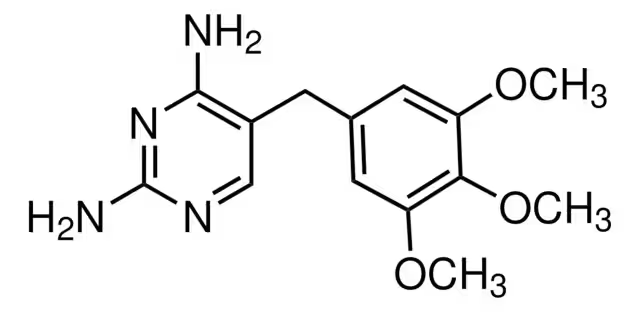
CAS Number738-70-5
SynonymsEINECS 212-006-2; Trimanyl; Triprim; Instalac; Trimethoprim; Monotrimin; MFCD00036761; 5-(3,4,5-trimethoxybenzyl)pyrimidine-2,4-diamine; Trimogal; 5-[(3,4,5-trimethoxyphenyl)methyl]pyrimidine-2,4-diamine; WELLCOPRIM; Proloprim; Trimpex; Monotrim; TCMDC-125538; Uretrim; Bactramin; 5-(3,4,5-Trimethoxybenzyl)-2,4-pyrimidinediamine; 5-{[3,4,5-tris(methyloxy)phenyl]methyl}pyrimidine-2,4-diamine; Trimopan; Syraprim; Tiempe; UNII-AN164J8Y0X
Molecular FormulaC14H18N4O3
Molecular Weight290.32
Purity≥98.5%
Density1.3±0.1 g/cm3
Boiling Point405.2±55.0 °C at 760 mmHg
Melting Point199-203 °C
Appearancepowder
EINECS212-006-2
Symbol
Signal WordWarning
| Chemical & Physical Properties | |
|---|---|
| CAS Number | 738-70-5 |
| Catalog No. | 2A-9012849 |
| Chinese Name | 甲氧苄氨嘧啶 |
| Synonyms | EINECS 212-006-2; Trimanyl; Triprim; Instalac; Trimethoprim; Monotrimin; MFCD00036761; 5-(3,4,5-trimethoxybenzyl)pyrimidine-2,4-diamine; Trimogal; 5-[(3,4,5-trimethoxyphenyl)methyl]pyrimidine-2,4-diamine; WELLCOPRIM; Proloprim; Trimpex; Monotrim; TCMDC-125538; Uretrim; Bactramin; 5-(3,4,5-Trimethoxybenzyl)-2,4-pyrimidinediamine; 5-{[3,4,5-tris(methyloxy)phenyl]methyl}pyrimidine-2,4-diamine; Trimopan; Syraprim; Tiempe; UNII-AN164J8Y0X |
| Molecular Formula | C14H18N4O3 |
| Molecular Weight | 290.32 |
| Purity | ≥98.5 |
| Density | 1.3±0.1 g/cm3 |
| Boiling Point | 405.2±55.0 °C at 760 mmHg |
| Melting Point | 199-203 °C |
| Appearance | powder |
| Water Solubility | DMSO: soluble | <0.1 g/100 mL at 24 ºC |
| Storage Condition | Store in cold, dry conditions, in a ventilated are |
| Packaging | III |
| Application | Trimethoprim is an antibiotic that can treat urinary tract infections. |
| EINECS | 212-006-2 |
| HTC | 2933599090 |
| PubChem ID | 24278201 |
| MDL Number | MFCD00036761 |
| SMILES | COc1cc(Cc2cnc(N)nc2N)cc(OC)c1OC |
| InChI | 1S/C14H18N4O3/c1-19-10-5-8(6-11(20-2)12(10)21-3)4-9-7-17-14(16)18-13(9)15/h5-7H,4H2,1-3H3,(H4,15,16,17,18) |
| InChI Key | IEDVJHCEMCRBQM-UHFFFAOYSA-N |
| Beilstein/REAXYS | 625127 |
| NACRES Code | NA.85 |
| UNSPSC | 51285203 |
| Hazard Symbols | 6.1(b) |
| MSDS | msds/12849_1_738_70_5.pdf |
| Bioactivity | Trimethoprim is a bacteriostatic antibiotic used mainly in the prophylaxis and treatment of urinary tract infections.Target: DHFRTrimethoprim (TMP), an inhibitor of dihydrofolate reductase, decreases the level of tetrahydrofolate supplying one-carbon units for biosynthesis of nucleotides, proteins, and panthotenate. TMP caused induction of DnaK, DnaJ, GroEL, ClpB, and IbpA/B Hsps. Among these Hsps, IbpA/B were most efficiently induced by TMP and coaggregated with the insoluble proteins [1]. Trimethoprim binds to dihydrofolate reductase and inhibits the reduction of dihydrofolic acid (DHF) to tetrahydrofolic acid (THF). THF is an essential precursor in the thymidine synthesis pathway and interference with this pathway inhibits bacterial DNA synthesis. Trimethoprim's affinity for bacterial dihydrofolate reductase is several thousand times greater than its affinity for human dihydrofolate reductase. Sulfamethoxazole inhibits dihydropteroate synthetase, an enzyme involved further upstream in the same pathway. Trimethoprim and sulfamethoxazole are commonly used in combination due to their synergistic effects. This drug combination also reduces the development of resistance that is seen when either drug is used alone [2]. Related Catalog Signaling Pathways >> Cell Cycle/DNA Damage >> Antifolate Research Areas >> Inflammation/Immunology References [1]. Laskowska, E., et al., Trimethoprim induces heat shock proteins and protein aggregation in E. coli cells. Curr Microbiol, 2003. 47(4): p. 286-9. [2]. Brogden, R.N., et al., Trimethoprim: a review of its antibacterial activity, pharmacokinetics and therapeutic use in urinary tract infections. Drugs, 1982. 23(6): p. 405-30. Chemical & Physical Properties Density 1.3±0.1 g/cm3 Boiling Point 405.2±55.0 °C at 760 mmHg Melting Point 199-203 °C Molecular Formula C14H18N4O3 Molecular Weight 290.318 Flash Point 198.8±31.5 °C Exact Mass 290.137878 PSA 105.51000 LogP 0.38 Vapour Pressure 0.0±0.9 mmHg at 25°C Index of Refraction 1.600 InChIKey IEDVJHCEMCRBQM-UHFFFAOYSA-N SMILES COc1cc(Cc2cnc(N)nc2N)cc(OC)c1OC Storage condition 2-8°C Stability Stable. Incompatible with strong oxidizing agents, acids. Water Solubility DMSO: soluble | <0.1 g/100 mL at 24 ºC |
| Use of | Trimethoprim is a bacteriostatic antibiotic used mainly in the prophylaxis and treatment of urinary tract infections.Target: DHFRTrimethoprim (TMP), an inhibitor of dihydrofolate reductase, decreases the level of tetrahydrofolate supplying one-carbon units for biosynthesis of nucleotides, proteins, and panthotenate. TMP caused induction of DnaK, DnaJ, GroEL, ClpB, and IbpA/B Hsps. Among these Hsps, IbpA/B were most efficiently induced by TMP and coaggregated with the insoluble proteins [1]. Trimethoprim binds to dihydrofolate reductase and inhibits the reduction of dihydrofolic acid (DHF) to tetrahydrofolic acid (THF). THF is an essential precursor in the thymidine synthesis pathway and interference with this pathway inhibits bacterial DNA synthesis. Trimethoprim's affinity for bacterial dihydrofolate reductase is several thousand times greater than its affinity for human dihydrofolate reductase. Sulfamethoxazole inhibits dihydropteroate synthetase, an enzyme involved further upstream in the same pathway. Trimethoprim and sulfamethoxazole are commonly used in combination due to their synergistic effects. This drug combination also reduces the development of resistance that is seen when either drug is used alone [2]. Properties Articles291 Name trimethoprim Synonym More Synonyms Trimethoprim Biological Activity Description Trimethoprim is a bacteriostatic antibiotic used mainly in the prophylaxis and treatment of urinary tract infections.Target: DHFRTrimethoprim (TMP), an inhibitor of dihydrofolate reductase, decreases the level of tetrahydrofolate supplying one-carbon units for biosynthesis of nucleotides, proteins, and panthotenate. TMP caused induction of DnaK, DnaJ, GroEL, ClpB, and IbpA/B Hsps. Among these Hsps, IbpA/B were most efficiently induced by TMP and coaggregated with the insoluble proteins [1]. Trimethoprim binds to dihydrofolate reductase and inhibits the reduction of dihydrofolic acid (DHF) to tetrahydrofolic acid (THF). THF is an essential precursor in the thymidine synthesis pathway and interference with this pathway inhibits bacterial DNA synthesis. Trimethoprim's affinity for bacterial dihydrofolate reductase is several thousand times greater than its affinity for human dihydrofolate reductase. Sulfamethoxazole inhibits dihydropteroate synthetase, an enzyme involved further upstream in the same pathway. Trimethoprim and sulfamethoxazole are commonly used in combination due to their synergistic effects. This drug combination also reduces the development of resistance that is seen when either drug is used alone [2]. Related Catalog Signaling Pathways >> Cell Cycle/DNA Damage >> Antifolate Research Areas >> Inflammation/Immunology References [1]. Laskowska, E., et al., Trimethoprim induces heat shock proteins and protein aggregation in E. coli cells. Curr Microbiol, 2003. 47(4): p. 286-9. [2]. Brogden, R.N., et al., Trimethoprim: a review of its antibacterial activity, pharmacokinetics and therapeutic use in urinary tract infections. Drugs, 1982. 23(6): p. 405-30. Chemical & Physical Properties Molecular Formula C14H18N4O3 Exact Mass 290.137878 PSA 105.51000 Index of Refraction 1.600 InChIKey IEDVJHCEMCRBQM-UHFFFAOYSA-N Stability Stable. Incompatible with strong oxidizing agents, acids. |
| Tax Rebate | 13.0% |
| Supervision | None. MFN tariff: 6.5%. Ordinary tariff: 20.0% |
| Transport Info | Product name: Purity: 0.0% |
| MSDS Transport Info | Module 14. Shipping information 14.1 UN dangerous goods number European Land Transport Dangerous Regulations: -International Maritime Dangerous Regulations: -International Air Transport Dangerous Regulations: - 14.2 Names specified by the United Nations (UN) European Land Transport Dangerous Regulations: Non-dangerous goods IMDG Code: Non-dangerous goods International air transport dangerous goods regulations: non-dangerous goods 14.3 Transport hazard categories European Land Transport Dangerous Regulations: -International Maritime Dangerous Regulations: -International Air Transport Dangerous Regulations: - 14.4 Package group European Land Transport Dangerous Regulations: -International Maritime Dangerous Regulations: -International Air Transport Dangerous Regulations: - 14.5 Environmental hazards European Land Transport Dangerous Regulations: No International Maritime Transport Dangerous Regulations Maritime Pollutants: No International Air Transport Risk Regulations: No 14.6 Special reminder to users No data available |
| Related Products in API & Advanced Intermediates | ||
|---|---|---|
| Topotecan | 123948-87-8 | 2A-9012779 |
| Topotecan hydrochloride | 119413-54-6 | 2A-9012780 |
| Trandolapril | 87679-37-6 | 2A-9012794 |
| Trandolaprilat | 87679-71-8 | 2A-9012795 |
| Triamcinolone hexacetonide | 5611-51-8 | 2A-9012811 |
| Trimethoprim lactate | 23256-42-0 | 2A-9012850 |
| Valaciclovir | 124832-26-4 | 2A-9012898 |
| valaciclovir hydrochloride | 124832-27-5 | 2A-9012899 |
| Valganciclovir | 175865-60-8 | 2A-9012903 |
| Valganciclovir Hydrochloride | 175865-59-5 | 2A-0201620 |
| Browse all API & Advanced Intermediates products » | ||
Phone:
630-322-8886
630-322-8887
Email:
Office Locations:
Chicago, IL, USA
San Francisco, CA, USA


 EN
EN


 SDS
SDS