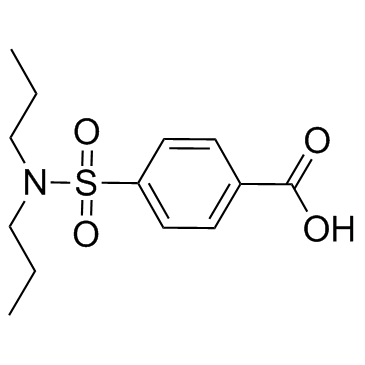
CAS Number57-66-9
SynonymsProben; benacen; Benuryl; EINECS 200-344-3; 4-[(di-n-propylamino)sulphonyl]benzoic Acid; 4-(Dipropylsulfamoyl)benzoic acid; Apurina; MFCD00038402; probalan; Probecid; 4-dipropylsulfamoyl-benzoic acid; Probexin; probenid; 4-(N,N-dipropylaminosulphonyl)benzoic acid; benemide; Benemid; Probenecid
Molecular FormulaC13H19NO4S
Molecular Weight285.359
Purity98%
Density1.2±0.1 g/cm3
Boiling Point438.0±47.0 °C at 760 mmHg
Melting Point194-196°C
AppearanceWhite crystalline powder
Symbol
Signal WordWarning
| Chemical & Physical Properties | |
|---|---|
| CAS Number | 57-66-9 |
| Catalog No. | 2A-9012127 |
| Chinese Name | 丙磺舒 |
| Synonyms | Proben; benacen; Benuryl; EINECS 200-344-3; 4-[(di-n-propylamino)sulphonyl]benzoic Acid; 4-(Dipropylsulfamoyl)benzoic acid; Apurina; MFCD00038402; probalan; Probecid; 4-dipropylsulfamoyl-benzoic acid; Probexin; probenid; 4-(N,N-dipropylaminosulphonyl)benzoic acid; benemide; Benemid; Probenecid |
| Molecular Formula | C13H19NO4S |
| Molecular Weight | 285.359 |
| Purity | 98 |
| Density | 1.2±0.1 g/cm3 |
| Boiling Point | 438.0±47.0 °C at 760 mmHg |
| Melting Point | 194-196°C |
| Appearance | White crystalline powder |
| Water Solubility | <0.1 g/100 mL at 20 ºC |
| Storage Condition | This product should be sealed and stored dry at 4° |
| Application | Probenecid is a potent and selective transient receptor potential vanilloid receptor channel 2 (TRPV2) agonist. |
| HTC | 2935009090 |
| SMILES | CCCN(CCC)S(=O)(=O)c1ccc(C(=O)O)cc1 |
| InChI | InChI=1S/C13H19NO4S/c1-3-9-14(10-4-2)19(17,18)12-7-5-11(6-8-12)13(15)16/h5-8H,3-4,9-10H2,1-2H3,(H,15,16) |
| InChI Key | DBABZHXKTCFAPX-UHFFFAOYSA-N |
| Hazard Symbols | Transport |
| MSDS | msds/12127_2_57_66_9.pdf |
| Bioactivity | Probenecid is a potent and selective agonist of transient receptor potential vanilloid 2 (TRPV2) channels. Related Catalog Signaling Pathways >> Membrane Transporter/Ion Channel >> TRP Channel Research Areas >> Metabolic Disease Target TRPV2[1] In Vitro Probenecid efficiently inhibits ATP-dependent active vesicular N-ethylmaleimide glutathione (NEM-GS) uptake by both MRP1 and MRP2. A significant inhibition of the MRP1-ATPase is observed at higher organic anion concentrations. In contrast, the ATPase activity of MRP2 is strongly stimulated by both Probenecid (approximate KACT=250 μM), sulfinpyrazone (KACT=300 μM), and indomethacin (KACT=150 μM), and ATPase activation is even stronger than in the case of NEM-GS. The organic anion activation of the MRP2-ATPase followed bell-shaped curves, with maximum values obtained at about 2 mM for Probenecid, 800 μM for sulfinpyrazone, and 400 μM for indomethacin[2]. Probenecid is an inhibitor of the hTAS2R16, hTAS2R38, and hTAS2R43 bitter taste receptors. Probenecid acts on a subset of TAS2Rs and inhibits through a novel, allosteric mechanism of action. Probenecid is also commonly used to enhance cellular signals in GPCR calcium mobilization assays. Probenecid specifically inhibits the cellular response mediated by the bitter taste receptor hTAS2R16 and provide molecular and pharmacological evidence for direct interaction with this GPCR using a non-competitive (allosteric) mechanism[3]. In Vivo Administration of Probenecid to WT mice results in increased contractility as measured via ejection fraction (EF) relative to EF in control mice given saline. The increased contractility is noted within 5 minutes of the bolus injection with all doses at or above 75 mg/kg (peak change of 5.26±3.35, 8.40±2.80, 7.32±2.52 for 75mg/kg, 100mg/kg and 200mg/kg, respectively). The measured change in contractility as measured at 5 minute intervals (for 30 minutes total) revealed a dose dependent increase in contractility with an estimated EC50 of 49.33 mg/kg. The EF remained at an elevated state for at least 1 hour on subjects (n=5, dose of 200 mg/kg IV) that are evaluated for a longer period of time (average increase in EF over baseline of 8.9±2.57)[1]. Cell Assay HEK-293T cells are transfected with hTAS2R expression constructs using Lipofectamine 2000 in poly-lysine coated, black 384-well plates with clear bottoms and incubated for 22 hours at 37°C. Growth media is removed and cells are washed twice with HBSS containing 20 mM HEPES, then loaded with a calcium indicator dye in HBSS containing 20 mM HEPES (Calcium 4 Assay kit) with or without 1 mM Probenecid. Cells are incubated at 37°C for 1 hour in the presence of both dye and Probenecid, then moved to a Flexstation II-384 set for 32°C. After a 15-minute temperature equilibration (without washout), indicated compounds are injected (at t=~25 seconds) and fluorescence is measured for 100 to 180 seconds, reading every 3 seconds. Data sets are analyzed and represented as % over baseline signal using Prism 5.0 software. For Schild plots, replicates of raw calcium flux values are expressed as % over baseline signal. The mean value at 36 seconds (corresponding to the maximum flux signal) for each concentration of TAS2R ligand in the presence of the indicated concentration of Probenecid is plotted against the log of ligand concentration. Data points are fit using non-linear regression in GraphPad Prism[1]. Animal Admin Mice[1] In order to obtain a dose response curve, male C57 WT (n=39) mice 12-16 weeks of age are anesthetized with isoflurane while intravenous jugular access (IV) is obtained under a microscope. Subsequently, an echocardiographic study with both M-mode and B-mode is obtained in parasternal long axis (PSLAX) as described below. Either saline or different doses of Probenecid (increasing from 2 to 200mg/kg) are injected (bolus IV) for the initial contractility studies in WT mice. References [1]. Koch SE, et al. Probenecid: novel use as a non-injurious positive inotrope acting via cardiac TRPV2 stimulation. J Mol Cell Cardiol. 2012 Jul;53(1):134-44. [2]. Bakos E, et al. Interactions of the human multidrug resistance proteins MRP1 and MRP2 with organic anions. Mol Pharmacol. 2000 Apr;57(4):760-8. [3]. Greene TA, et al. Probenecid inhibits the human bitter taste receptor TAS2R16 and suppresses bitter perception of salicin. PLoS One. 2011;6(5):e20123. Chemical & Physical Properties Density 1.2±0.1 g/cm3 Boiling Point 438.0±47.0 °C at 760 mmHg Melting Point 194-196°C Molecular Formula C13H19NO4S Molecular Weight 285.359 Flash Point 218.7±29.3 °C Exact Mass 285.103485 PSA 83.06000 LogP 3.30 Vapour Pressure 0.0±1.1 mmHg at 25°C Index of Refraction 1.542 InChIKey DBABZHXKTCFAPX-UHFFFAOYSA-N SMILES CCCN(CCC)S(=O)(=O)c1ccc(C(=O)O)cc1 Storage condition Store at RT Stability Stable, but may be light sensitive. Incompatible with strong oxidizing agents. Water Solubility <0.1 g/100 mL at 20 ºC |
| Use of | Probenecid is a potent and selective agonist of transient receptor potential vanilloid 2 (TRPV2) channels. Properties Articles63 Name probenecid Synonym More Synonyms probenecid Biological Activity Description Probenecid is a potent and selective agonist of transient receptor potential vanilloid 2 (TRPV2) channels. Related Catalog Signaling Pathways >> Membrane Transporter/Ion Channel >> TRP Channel Research Areas >> Metabolic Disease References [1]. Koch SE, et al. Probenecid: novel use as a non-injurious positive inotrope acting via cardiac TRPV2 stimulation. J Mol Cell Cardiol. 2012 Jul;53(1):134-44. [2]. Bakos E, et al. Interactions of the human multidrug resistance proteins MRP1 and MRP2 with organic anions. Mol Pharmacol. 2000 Apr;57(4):760-8. [3]. Greene TA, et al. Probenecid inhibits the human bitter taste receptor TAS2R16 and suppresses bitter perception of salicin. PLoS One. 2011;6(5):e20123. Chemical & Physical Properties Molecular Formula C13H19NO4S Exact Mass 285.103485 PSA 83.06000 Index of Refraction 1.542 InChIKey DBABZHXKTCFAPX-UHFFFAOYSA-N Storage condition Store at RT Stability Stable, but may be light sensitive. Incompatible with strong oxidizing agents. |
| Tax Rebate | 9.0% |
| Supervision | None MFN tariff: 6.5% Ordinary tariff: 35.0% |
| Transport Info | Product name: Purity: 98.0% |
| MSDS Transport Info | Module 14. Shipping information 14.1 UN dangerous goods number European Land Transport Dangerous Regulations: -International Maritime Dangerous Regulations: -International Air Transport Dangerous Regulations: - 14.2 Names specified by the United Nations (UN) European Land Transport Dangerous Regulations: Non-dangerous goods IMDG Code: Non-dangerous goods International air transport dangerous goods regulations: non-dangerous goods 14.3 Transport hazard categories European Land Transport Dangerous Regulations: -International Maritime Dangerous Regulations: -International Air Transport Dangerous Regulations: - 14.4 Package group European Land Transport Dangerous Regulations: -International Maritime Dangerous Regulations: -International Air Transport Dangerous Regulations: - 14.5 Environmental hazards European Land Transport Dangerous Regulations: No International Maritime Transport Dangerous Regulations Maritime Pollutants: No International Air Transport Risk Regulations: No 14.6 Special reminder to users No data available |
| Related Products in API & Advanced Intermediates | ||
|---|---|---|
| Potassium benzylpenicillin | 113-98-4 | 2A-9012085 |
| Pramipexole | 104632-26-0 | 2A-9012094 |
| Pravastatin | 81093-37-0 | 2A-9012101 |
| Pravastatin sodium | 81131-70-6 | 2A-9012102 |
| Praziquantel | 55268-74-1 | 2A-9012104 |
| Procaine penicillin G | 54-35-3 | 2A-9012131 |
| Propranolol hydrochloride | 318-98-9 | 2A-9012171 |
| Protected Imipenem | 98367-45-4 | 2A-9012184 |
| Protected meropenem | 96036-02-1 | 2A-9012185 |
| Quetiapine | 111974-69-7 | 2A-9012225 |
| Browse all API & Advanced Intermediates products » | ||
Phone:
630-322-8886
630-322-8887
Email:
Office Locations:
Chicago, IL, USA
San Francisco, CA, USA


 EN
EN


 SDS
SDS