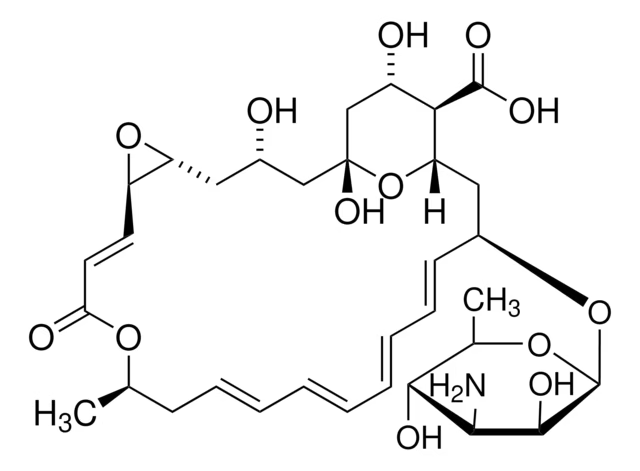
CAS Number7681-93-8
SynonymsNatamycin; Synogil; Pimaricin; EINECS 231-683-5; PIMAFUCIN; myprozine; MFCD00135085; delvocid; antibiotic A 5283; mycophyt; delvopos; natacyn; delvolan; cl12,625
Molecular FormulaC33H47NO13
Molecular Weight665.73
Purity≥95 (HPLC)%
Density1.4±0.1 g/cm3
Boiling Point952.2±65.0 °C at 760 mmHg
Melting Point2000ºC
Appearancelyophilized powder
EINECS231-683-5
| Chemical & Physical Properties | |
|---|---|
| CAS Number | 7681-93-8 |
| Catalog No. | 2A-0201795 |
| Chinese Name | 纳他霉素 |
| Synonyms | Natamycin; Synogil; Pimaricin; EINECS 231-683-5; PIMAFUCIN; myprozine; MFCD00135085; delvocid; antibiotic A 5283; mycophyt; delvopos; natacyn; delvolan; cl12,625 |
| Molecular Formula | C33H47NO13 |
| Molecular Weight | 665.73 |
| Purity | ≥95 (HPLC) |
| Density | 1.4±0.1 g/cm3 |
| Boiling Point | 952.2±65.0 °C at 760 mmHg |
| Melting Point | 2000ºC |
| Appearance | lyophilized powder |
| Storage Condition | 2-8℃ |
| Application | Natamycin (pimaricin) is an antifungal compound. |
| EINECS | 231-683-5 |
| PubChem ID | 24899055 |
| MDL Number | MFCD00135085 |
| SMILES | C[C@@H]1C\C=C\C=C\C=C\C=C\[C@@H](C[C@@H]2O[C@](O)(C[C@@H](O)C[C@H]3O[C@@H]3\C=C\C(=O)O1)C[C@H](O)[C@H]2C(O)=O)O[C@@H]4O[C@H](C)[C@@H](O)[C@H](N)[C@@H]4O |
| InChI | 1S/C33H47NO13/c1-18-10-8-6-4-3-5-7-9-11-21(45-32-30(39)28(34)29(38)19(2)44-32)15-25-27(31(40)41)22(36)17-33(42,47-25)16-20(35)14-24-23(46-24)12-13-26(37)43-18/h3-9,11-13,18-25,27-30,32,35-36,38-39,42H,10,14-17,34H2,1-2H3,(H,40,41)/b4-3+,7-5+,8-6+,11-9+,13-12+/t18-,19-,20+,21+,22+,23-,24-,25+,27-,28+,29-,30+,32+,33-/m1/s1 |
| InChI Key | NCXMLFZGDNKEPB-FFPOYIOWSA-N |
| NACRES Code | NA.85 |
| UNSPSC | 51102829 |
| MSDS | msds/11586_1_7681_93_8.pdf |
| Bioactivity | Natamycin (pimaricin) is an antifungal macrolide polyene that binds to cell membrane sterols.Target: AntifungalNatamycin (INN), also known as pimaricin and sometimes sold as Natacyn, is a naturally occurring antifungal agent produced during fermentation by the bacterium Streptomyces natalensis, commonly found in soil. Natamycin has a very low solubility in water; however, natamycin is effective at very low levels. There is an MIC (minimum inhibitory concentration) of less than 10 ppm for most molds. Natamycin is classified as a macrolide polyene antifungal and, as a drug, is used to treat fungal keratitis. It is especially effective against Aspergillus and Fusarium corneal infections. Other common members of the polyene macrolide antifungal family are amphotericin B, nystatin, and filipin. Natamycin is also used in the food industry as a natural preservative.Natamycin is used to treat fungal infections, including Candida, Aspergillus, Cephalosporium, Fusarium and Penicillium. It is applied as a cream, in eyedrops, or (for oral infections) in a lozenge. Natamycin shows negligible absorption into the body when administered in these ways. When taken orally, little or none is absorbed from the gastrointestinal tract, making it inappropriate for systemic infections. Related Catalog Signaling Pathways >> Anti-infection >> Fungal Research Areas >> Infection Natural Products >> Others References [1]. Wu H, et al. SlnM gene overexpression with different promoters on natamycin production in Streptomyces lydicus A02. J Ind Microbiol Biotechnol. 2014 Jan;41(1):163-72. [2]. Eady RA, et al. A pilot trial of natamycin. A topical antifungal agent. Practitioner. 1969 Nov;203(217):670-3. Chemical & Physical Properties Density 1.4±0.1 g/cm3 Boiling Point 952.2±65.0 °C at 760 mmHg Melting Point 2000ºC Molecular Formula C33H47NO13 Molecular Weight 665.725 Flash Point 529.7±34.3 °C Exact Mass 665.304749 PSA 230.99000 LogP 0.74 Vapour Pressure 0.0±0.6 mmHg at 25°C Index of Refraction 1.620 InChIKey NCXMLFZGDNKEPB-YWDKRKKXSA-N SMILES CC1CC=CC=CC=CC=CC(OC2OC(C)C(O)C(N)C2O)CC2OC(O)(CC(O)CC3OC3C=CC(=O)O1)CC(O)C2C(=O)O Storage condition 2~8°C |
| Use of | Natamycin (pimaricin) is an antifungal macrolide polyene that binds to cell membrane sterols.Target: AntifungalNatamycin (INN), also known as pimaricin and sometimes sold as Natacyn, is a naturally occurring antifungal agent produced during fermentation by the bacterium Streptomyces natalensis, commonly found in soil. Natamycin has a very low solubility in water; however, natamycin is effective at very low levels. There is an MIC (minimum inhibitory concentration) of less than 10 ppm for most molds. Natamycin is classified as a macrolide polyene antifungal and, as a drug, is used to treat fungal keratitis. It is especially effective against Aspergillus and Fusarium corneal infections. Other common members of the polyene macrolide antifungal family are amphotericin B, nystatin, and filipin. Natamycin is also used in the food industry as a natural preservative.Natamycin is used to treat fungal infections, including Candida, Aspergillus, Cephalosporium, Fusarium and Penicillium. It is applied as a cream, in eyedrops, or (for oral infections) in a lozenge. Natamycin shows negligible absorption into the body when administered in these ways. When taken orally, little or none is absorbed from the gastrointestinal tract, making it inappropriate for systemic infections. Properties Articles49 Name natamycin Synonym More Synonyms Pimaricin Biological Activity Description Natamycin (pimaricin) is an antifungal macrolide polyene that binds to cell membrane sterols.Target: AntifungalNatamycin (INN), also known as pimaricin and sometimes sold as Natacyn, is a naturally occurring antifungal agent produced during fermentation by the bacterium Streptomyces natalensis, commonly found in soil. Natamycin has a very low solubility in water; however, natamycin is effective at very low levels. There is an MIC (minimum inhibitory concentration) of less than 10 ppm for most molds. Natamycin is classified as a macrolide polyene antifungal and, as a drug, is used to treat fungal keratitis. It is especially effective against Aspergillus and Fusarium corneal infections. Other common members of the polyene macrolide antifungal family are amphotericin B, nystatin, and filipin. Natamycin is also used in the food industry as a natural preservative.Natamycin is used to treat fungal infections, including Candida, Aspergillus, Cephalosporium, Fusarium and Penicillium. It is applied as a cream, in eyedrops, or (for oral infections) in a lozenge. Natamycin shows negligible absorption into the body when administered in these ways. When taken orally, little or none is absorbed from the gastrointestinal tract, making it inappropriate for systemic infections. Related Catalog Signaling Pathways >> Anti-infection >> Fungal Research Areas >> Infection Natural Products >> Others References [1]. Wu H, et al. SlnM gene overexpression with different promoters on natamycin production in Streptomyces lydicus A02. J Ind Microbiol Biotechnol. 2014 Jan;41(1):163-72. [2]. Eady RA, et al. A pilot trial of natamycin. A topical antifungal agent. Practitioner. 1969 Nov;203(217):670-3. Chemical & Physical Properties Molecular Formula C33H47NO13 Exact Mass 665.304749 PSA 230.99000 Index of Refraction 1.620 InChIKey NCXMLFZGDNKEPB-YWDKRKKXSA-N |
| Transport Info | Product Name: Natamycin |
| Related Products in Specialty Chemicals | ||
|---|---|---|
| Naphazoline | 835-31-4 | 2A-9011573 |
| Naphazoline hydrochloride | 550-99-2 | 2A-9011574 |
| Naphazoline nitrate | 5144-52-5 | 2A-9011575 |
| Napropamide | 15299-99-7 | 2A-9011576 |
| Naroparcil | 120819-70-7 | 2A-9011584 |
| Nateglinide | 105816-04-4 | 2A-9011587 |
| Natural Indigo | 2A-302671 | 2A-9011588 |
| Neamine | 3947-65-7 | 2A-9011589 |
| Nebacumab | 138661-01-5 | 2A-9011590 |
| Nebidrazine | 55248-23-2 | 2A-9011591 |
| Browse all Specialty Chemicals products » | ||
Phone:
630-322-8886
630-322-8887
Email:
Office Locations:
Chicago, IL, USA
San Francisco, CA, USA


 EN
EN


 SDS
SDS