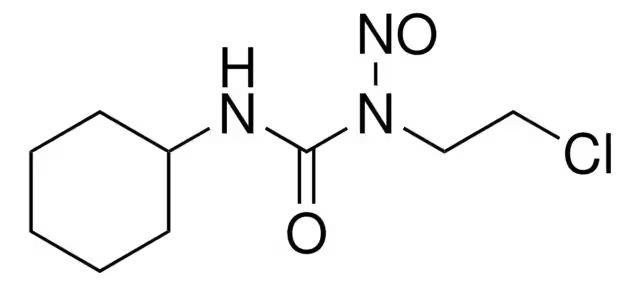
CAS Number13010-47-4
Synonyms1-chloroethyl-3-cyclohexyl-1-nitrosourea; MFCD00012392; EINECS 235-859-2; Lomustinum; CINU; CeeNU; 1-(2-Chloroethyl)-3-cyclohexyl-1-nitrosourea; Lomustine; CCNU; Cecenu; Lomustina; Belustine
Molecular FormulaC9H16ClN3O2
Molecular Weight233.70
Purity≥98%
Density1.4±0.1 g/cm3
Melting Point88-90
Appearanceyellow powder
EINECS235-859-2
Symbol
Signal WordWarning
| Chemical & Physical Properties | |
|---|---|
| CAS Number | 13010-47-4 |
| Catalog No. | 2A-9011224 |
| Chinese Name | 洛莫司汀 |
| Synonyms | 1-chloroethyl-3-cyclohexyl-1-nitrosourea; MFCD00012392; EINECS 235-859-2; Lomustinum; CINU; CeeNU; 1-(2-Chloroethyl)-3-cyclohexyl-1-nitrosourea; Lomustine; CCNU; Cecenu; Lomustina; Belustine |
| Molecular Formula | C9H16ClN3O2 |
| Molecular Weight | 233.70 |
| Purity | ≥98 |
| Density | 1.4±0.1 g/cm3 |
| Melting Point | 88-90 |
| Appearance | yellow powder |
| Storage Condition | Sealed in a cool, dry environment at -20 ºC |
| Packaging | II |
| Application | Lomustine is a DNA alkylating agent with anti-tumor activity. |
| EINECS | 235-859-2 |
| HTC | 2924299090 |
| PubChem ID | 329817632 |
| MDL Number | MFCD00012392 |
| SMILES | ClCCN(N=O)C(=O)NC1CCCCC1 |
| InChI | 1S/C9H16ClN3O2/c10-6-7-13(12-15)9(14)11-8-4-2-1-3-5-8/h8H,1-7H2,(H,11,14) |
| InChI Key | GQYIWUVLTXOXAJ-UHFFFAOYSA-N |
| NACRES Code | NA.25 |
| UNSPSC | 12352100 |
| Hazard Symbols | 6.1(a) |
| MSDS | msds/11224_1_13010_47_4.pdf |
| Bioactivity | Lomustine is a DNA alkylating agent, with antitumor activity. Related Catalog Signaling Pathways >> Autophagy >> Autophagy Signaling Pathways >> Cell Cycle/DNA Damage >> DNA Alkylator/Crosslinker Research Areas >> Cancer Target DNA Alkylator[1] In Vitro Lomustine is a DNA alkylating agent. Lomustine (CCNU, 0-250 μM) is cytotoxic to the U87-MG cells expressing tumor-derived mutant IDH1, and has little effect on the expression of wild-type IDH1. The combination of Lomustine and procarbazine or vincristine has no additive effect on the killing of cells expressing mutant or wild-type IDH1. Moreover, overexpression of either ALKBH2 or ALKBH3 partially reduces the death HT1080 cells exposed to Lomustine[1]. Lomustine suppresses U87-MG growth with an ED50 of 68.1 μM. Lomustine (30, 40 μM) in combination with docosahexaenoic acid (DHA) darmatically inhibits 2 additional human-derived glioblastoma cell lines, and induces U87-MG apoptosis and necrosis. Lomustine (30 μM) causes G2/M arrest[2]. Lomustine reduces the viability of F98 rat orthotopic glioma cells and Tu-2449 mouse glioma cell line, with IC50s of 20.8 µM and 18.6 µM, respectively[3]. In Vivo Lomustine (30 mg/kg) in combination with Toca 511 + 5-FC prolongs survival in rats bearing F98 tumor cells. Lomustine (30 mg/kg) combined with Toca-511 + 5-FC also exhibits antitumor activity in the B6C3F1 mice bearing Tu-2449 glioma cells[3]. Kinase Assay In brief, the oligo substrate (5'-FAM-TAGACATTGCCATTCTCGATAGGXTCCGGTCAAATCTAGACGAATTCCG, X=1-MedA) is used in the assay. ALKBH2 and ALKBH3 is assayed in 50 mM Hepes K (pH 8.0), 50 μM (NH4)2Fe(SO4)2, 50 μM α-KG, 2 mM ascorbic acid, 10 μM oligo substrate, 3 μM enzyme, 50 μg/mL BSA, and 10 mM MgCl2. The reaction is carried out at 37°C and stopped by heating at 95°C for at least 5 min. The oligo substrate is annealed to a reverse complementary oligo, and subjected to extensive DpnII digestion. The digested DNA is separated on 15% TBE-Urea-PAGE gel, and imaged using a Typhoon Scanner[1]. Cell Assay Initially, cells (5000 cells/well) are cultured in 96-well flat-bottom plates overnight in complete medium to establish a linear growth rate. Spent medium is replaced with new medium supplemented with 2% FBS and varying treatments (100 μL total volume/well). Ethanol-supplemented cells (< 0.5%) serve as the vehicle control. Cells are maintained at 37°C in 5% CO2 in a humidified atmosphere for 24 hours prior to assessment of cell growth with the WST-1 assay reagent. Medium alone combined with the WST-1 assay reagent establishes nonspecific values that are subtracted from the experimental optical density (OD) readings (OD at 450 nm). Vehicle control OD readings serve as standard proliferative potential normalized to 100%. The proliferation index is calculated by dividing the average OD treatment reading by the average OD vehicle reading and multiplying by 100[2]. Animal Admin Mice[3] Groups of B6C3F1 mice receive PBS or 5-FC only as a control during the study (n = 8 per group). One group of mice (Lomustine Day 1 + PBS) receive one dose of Lomustine (30 mg/kg) on day 1 and a total of six cycles of PBS (800 μL/day, BID for 4 consecutive days every 10 days). The rest of the mice receive 5-FC (500 mg/kg/dose, IP, BID) for 4 consecutive days, plus Lomustine at day 1 (Lomustine Day 1 + 5-FC) or day 43 (Lomustine Day 43 + 5-FC). Cycles of 4-days on, 10-days off 5-FC or PBS are repeated a total of 6 times. Each experiment is terminated at the end of the last 5-FC treatment. All tissues are collected and saved for histopathology. Toxicity in groups receiving Lomustine is compared to the groups receiving PBS or 5-FC alone or in combination with 5-FC at designated time points[3]. Rats[3] Groups of rats receive PBS or 5-FC only as controls during the study (n = 8 per group). One group of rats (Lomustine Day 1 + PBS) receive one dose of Lomustine (30 mg/kg) at day 1 and a total of six cycles of PBS (8 mL/day, BID). The rest of the rats receive 5-FC (500 mg/kg/dose, IP, BID) for 5 consecutive days, followed by 2 days off drug, plus Lomustine on day 1 (Lomustine Day 1 + 5-FC) or day 22 (Lomustine Day 22 + 5-FC). Cycles of 5-days on, 2-days off 5-FC or PBS are repeated a total of 6 times[3]. References [1]. Wang P, et al. Oncometabolite D-2-Hydroxyglutarate Inhibits ALKBH DNA Repair Enzymes and Sensitizes IDH Mutant Cells to Alkylating Agents. Cell Rep. 2015 Dec 22;13(11):2353-2361. [2]. Harvey KA, et al. Enhanced anticancer properties of lomustine in conjunction with docosahexaenoic acid in glioblastoma cell lines. J Neurosurg. 2015 Mar;122(3):547-56. [3]. Yagiz K, et al. Toca 511 plus 5-fluorocytosine in combination with lomustine shows chemotoxic and immunotherapeutic activity with no additive toxicity in rodent glioblastoma models. Neuro Oncol. 2016 Oct;18(10):1390-401. Chemical & Physical Properties Density 1.4±0.1 g/cm3 Melting Point 88-90 Molecular Formula C9H16ClN3O2 Molecular Weight 233.695 Exact Mass 233.093109 PSA 61.77000 LogP 2.76 Vapour Pressure 0.00142mmHg at 25°C Index of Refraction 1.583 InChIKey GQYIWUVLTXOXAJ-UHFFFAOYSA-N SMILES O=NN(CCCl)C(=O)NC1CCCCC1 |
| Use of | Lomustine is a DNA alkylating agent, with antitumor activity. Properties Articles34 Name lomustine Synonym More Synonyms Lomustine Biological Activity Description Lomustine is a DNA alkylating agent, with antitumor activity. Related Catalog Signaling Pathways >> Autophagy >> Autophagy Signaling Pathways >> Cell Cycle/DNA Damage >> DNA Alkylator/Crosslinker Research Areas >> Cancer DNA Alkylator[1] References [1]. Wang P, et al. Oncometabolite D-2-Hydroxyglutarate Inhibits ALKBH DNA Repair Enzymes and Sensitizes IDH Mutant Cells to Alkylating Agents. Cell Rep. 2015 Dec 22;13(11):2353-2361. [2]. Harvey KA, et al. Enhanced anticancer properties of lomustine in conjunction with docosahexaenoic acid in glioblastoma cell lines. J Neurosurg. 2015 Mar;122(3):547-56. [3]. Yagiz K, et al. Toca 511 plus 5-fluorocytosine in combination with lomustine shows chemotoxic and immunotherapeutic activity with no additive toxicity in rodent glioblastoma models. Neuro Oncol. 2016 Oct;18(10):1390-401. Chemical & Physical Properties Exact Mass 233.093109 PSA 61.77000 Index of Refraction 1.583 InChIKey GQYIWUVLTXOXAJ-UHFFFAOYSA-N |
| Tax Rebate | 13.0% |
| Supervision | None. MFN tariff: 6.5%. Ordinary tariff: 30.0% |
| Transport Info | Product name: Purity: 98.0% |
| MSDS Transport Info | Module 14. Shipping information United Nations classification: Item 1 Poisons. UN number: 2811 Proper Shipping Name: Toxic Solid, Organic, Not Otherwise Specified Packing grade: III |
| Related Products in Specialty Chemicals | ||
|---|---|---|
| Lomefloxacin | 98079-51-7 | 2A-9011218 |
| Lomefloxacin hydrochloride | 98079-52-8 | 2A-9011219 |
| Lomerizine | 101477-55-8 | 2A-9011220 |
| Lomerizine Hydrochlortde | 101477-54-7 | 2A-9011221 |
| Lomifylline | 10226-54-7 | 2A-9011222 |
| Lonidamine | 50264-69-2 | 2A-9011225 |
| Loperamide | 53179-11-6 | 2A-9011226 |
| Loperamide hydrochloride | 34552-83-5 | 2A-9011227 |
| lopronic acid | 37723-78-7 | 2A-9011229 |
| Loquat leave | 2A-302313 | 2A-9011230 |
| Browse all Specialty Chemicals products » | ||
Phone:
630-322-8886
630-322-8887
Email:
Office Locations:
Chicago, IL, USA
San Francisco, CA, USA


 EN
EN


 SDS
SDS