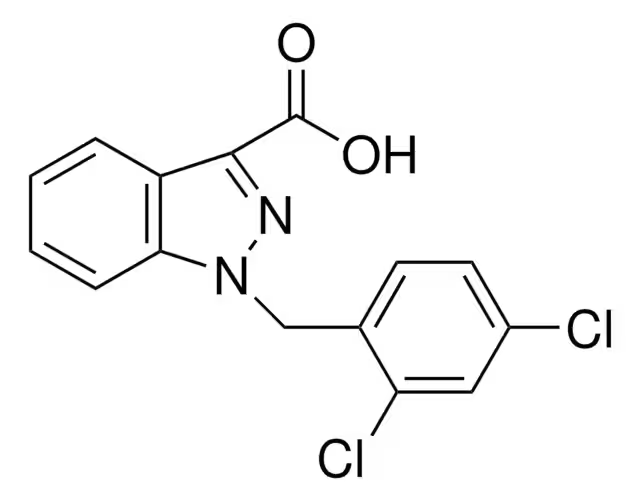
CAS Number50264-69-2
Synonyms1-(2,4-Dichlorobenzyl)-1H-indazole-3-carboxylic acid; DICA; Lonidaminum; Lonidamin; Lonidaminum [INN-Latin]; MFCD00866285; Diclondazolic acid; Lonidamine; EINECS 256-510-0; 1-[(2,4-dichlorophenyl)methyl]indazole-3-carboxylic acid; 1-[(2,4-dichlorophenyl)methyl]-1H-indazole-3-carboxylic acid; Lonidamina; 1-(2,4-Dichlorobenzyl)-1H-indazole-3-carboxylic acid Diclondazolic acid; Doridamina
Molecular FormulaC15H10Cl2N2O2
Molecular Weight321.16
Purity≥98 (TLC)%
Density1.5±0.1 g/cm3
Boiling Point537.9±45.0 °C at 760 mmHg
Melting Point207-209°C
Appearancepowder
EINECS256-510-0
Symbol
Signal WordWarning
| Chemical & Physical Properties | |
|---|---|
| CAS Number | 50264-69-2 |
| Catalog No. | 2A-9011225 |
| Chinese Name | 氯尼达明 |
| Synonyms | 1-(2,4-Dichlorobenzyl)-1H-indazole-3-carboxylic acid; DICA; Lonidaminum; Lonidamin; Lonidaminum [INN-Latin]; MFCD00866285; Diclondazolic acid; Lonidamine; EINECS 256-510-0; 1-[(2,4-dichlorophenyl)methyl]indazole-3-carboxylic acid; 1-[(2,4-dichlorophenyl)methyl]-1H-indazole-3-carboxylic acid; Lonidamina; 1-(2,4-Dichlorobenzyl)-1H-indazole-3-carboxylic acid Diclondazolic acid; Doridamina |
| Molecular Formula | C15H10Cl2N2O2 |
| Molecular Weight | 321.16 |
| Purity | ≥98 (TLC) |
| Density | 1.5±0.1 g/cm3 |
| Boiling Point | 537.9±45.0 °C at 760 mmHg |
| Melting Point | 207-209°C |
| Appearance | powder |
| Storage Condition | Store at RT |
| Application | Lonidamine is an orally active hexokinase inhibitor. |
| EINECS | 256-510-0 |
| HTC | 2933990090 |
| PubChem ID | 24278515 |
| MDL Number | MFCD00866285 |
| SMILES | OC(=O)c1nn(Cc2ccc(Cl)cc2Cl)c3ccccc13 |
| InChI | 1S/C15H10Cl2N2O2/c16-10-6-5-9(12(17)7-10)8-19-13-4-2-1-3-11(13)14(18-19)15(20)21/h1-7H,8H2,(H,20,21) |
| InChI Key | WDRYRZXSPDWGEB-UHFFFAOYSA-N |
| NACRES Code | NA.77 |
| UNSPSC | 12352202 |
| Hazard Symbols | Transport |
| MSDS | msds/11225_1_50264_69_2.pdf |
| Bioactivity | Lonidamine is an orally administered small molecule hexokinase inactivator.Target: OthersLonidamine is a derivative of indazole-3-carboxylic acid, which for a long time, has been known to inhibit aerobic glycolysis in cancer cells. It seems to enhance aerobic glycolysis in normal cells, but suppress glycolysis in cancer cells. This is most likely through the inhibition of the mitochondrially bound hexokinase. Later studies in Ehrlich ascites tumor cells showed that lonidamine inhibits both respiration and glycolysis leading to a decrease in cellular ATP. Clinical trials of lonidamine in combination with other anticancer agents for a variety of cancers has begun. Lonidamine has been used in the treatment of brain tumours in combination with radiotherapy and temozolomide. Results showed that a combination of temozolomide and lonidamine at clinically achievable, low plasma concentrations, could inhibit tumour growth, and lonidamine could reduce the dose of temozolomide required for radiosensitization of brain tumours. From Wikipedia. Related Catalog Signaling Pathways >> Metabolic Enzyme/Protease >> Hexokinase Research Areas >> Cancer References [1]. http://en.wikipedia.org/wiki/Lonidamine Chemical & Physical Properties Density 1.5±0.1 g/cm3 Boiling Point 537.9±45.0 °C at 760 mmHg Melting Point 207-209°C Molecular Formula C15H10Cl2N2O2 Molecular Weight 321.158 Flash Point 279.1±28.7 °C Exact Mass 320.011932 PSA 55.12000 LogP 4.32 Vapour Pressure 0.0±1.5 mmHg at 25°C Index of Refraction 1.678 InChIKey WDRYRZXSPDWGEB-UHFFFAOYSA-N SMILES O=C(O)c1nn(Cc2ccc(Cl)cc2Cl)c2ccccc12 Storage condition Store at RT |
| Use of | Lonidamine is an orally administered small molecule hexokinase inactivator.Target: OthersLonidamine is a derivative of indazole-3-carboxylic acid, which for a long time, has been known to inhibit aerobic glycolysis in cancer cells. It seems to enhance aerobic glycolysis in normal cells, but suppress glycolysis in cancer cells. This is most likely through the inhibition of the mitochondrially bound hexokinase. Later studies in Ehrlich ascites tumor cells showed that lonidamine inhibits both respiration and glycolysis leading to a decrease in cellular ATP. Clinical trials of lonidamine in combination with other anticancer agents for a variety of cancers has begun. Lonidamine has been used in the treatment of brain tumours in combination with radiotherapy and temozolomide. Results showed that a combination of temozolomide and lonidamine at clinically achievable, low plasma concentrations, could inhibit tumour growth, and lonidamine could reduce the dose of temozolomide required for radiosensitization of brain tumours. From Wikipedia. Properties Articles47 Name lonidamine Synonym More Synonyms Lonidamine Biological Activity Description Lonidamine is an orally administered small molecule hexokinase inactivator.Target: OthersLonidamine is a derivative of indazole-3-carboxylic acid, which for a long time, has been known to inhibit aerobic glycolysis in cancer cells. It seems to enhance aerobic glycolysis in normal cells, but suppress glycolysis in cancer cells. This is most likely through the inhibition of the mitochondrially bound hexokinase. Later studies in Ehrlich ascites tumor cells showed that lonidamine inhibits both respiration and glycolysis leading to a decrease in cellular ATP. Clinical trials of lonidamine in combination with other anticancer agents for a variety of cancers has begun. Lonidamine has been used in the treatment of brain tumours in combination with radiotherapy and temozolomide. Results showed that a combination of temozolomide and lonidamine at clinically achievable, low plasma concentrations, could inhibit tumour growth, and lonidamine could reduce the dose of temozolomide required for radiosensitization of brain tumours. From Wikipedia. Related Catalog Signaling Pathways >> Metabolic Enzyme/Protease >> Hexokinase Research Areas >> Cancer References [1]. http://en.wikipedia.org/wiki/Lonidamine Chemical & Physical Properties Exact Mass 320.011932 PSA 55.12000 Index of Refraction 1.678 InChIKey WDRYRZXSPDWGEB-UHFFFAOYSA-N Storage condition Store at RT |
| Tax Rebate | 13.0% |
| Supervision | None. MFN tariff: 6.5%. Ordinary tariff: 20.0% |
| Transport Info | Product name: Purity: 99.0% |
| MSDS Transport Info | Module 14. Shipping information 14.1 UN dangerous goods number European Land Transport Dangerous Regulations: -International Maritime Dangerous Regulations: -International Air Transport Dangerous Regulations: - 14.2 Names specified by the United Nations (UN) European Land Transport Dangerous Regulations: Non-dangerous goods IMDG Code: Non-dangerous goods International air transport dangerous goods regulations: non-dangerous goods 14.3 Transport hazard categories European Land Transport Dangerous Regulations: -International Maritime Dangerous Regulations: -International Air Transport Dangerous Regulations: - 14.4 Package group European Land Transport Dangerous Regulations: -International Maritime Dangerous Regulations: -International Air Transport Dangerous Regulations: - 14.5 Environmental hazards European Land Transport Dangerous Regulations: No International Maritime Transport Dangerous Regulations Maritime Pollutants: No International Air Transport Risk Regulations: No 14.6 Special reminder to users No data available See reverse side of invoice or packing slip. |
| Related Products in Specialty Chemicals | ||
|---|---|---|
| Lomefloxacin hydrochloride | 98079-52-8 | 2A-9011219 |
| Lomerizine | 101477-55-8 | 2A-9011220 |
| Lomerizine Hydrochlortde | 101477-54-7 | 2A-9011221 |
| Lomifylline | 10226-54-7 | 2A-9011222 |
| Lomustine | 13010-47-4 | 2A-9011224 |
| Loperamide | 53179-11-6 | 2A-9011226 |
| Loperamide hydrochloride | 34552-83-5 | 2A-9011227 |
| lopronic acid | 37723-78-7 | 2A-9011229 |
| Loquat leave | 2A-302313 | 2A-9011230 |
| Lorajmine | 47562-08-3 | 2A-9011231 |
| Browse all Specialty Chemicals products » | ||
Phone:
630-322-8886
630-322-8887
Email:
Office Locations:
Chicago, IL, USA
San Francisco, CA, USA


 EN
EN


 SDS
SDS