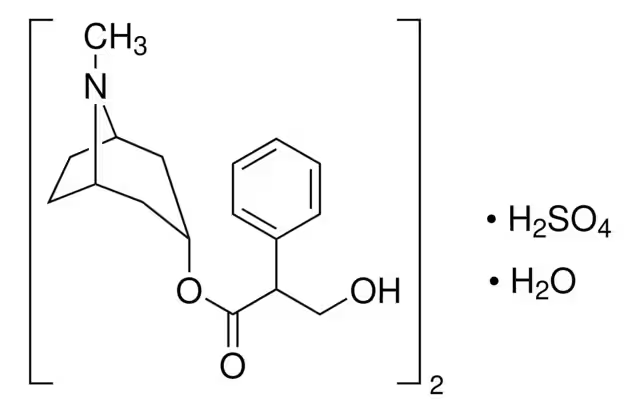
CAS Number5908-99-6
SynonymsMFCD00074815; AtropineSulphateGrPuriss; Atropina Solfato; racemic anisodamine; atropine sulphate; atropin sulfate; Atropsiol; AtropineSulfat; TROPINI SULFAS; ATROPINI SULFAS; Atropt; Atropinsulfat; EINECS 200-235-0
Molecular Formula(C17H23NO3)2 · H2SO4 · H2O
Molecular Weight694.83
Purity98.5%
Boiling Point429.8ºC at 760mmHg
Melting Point189-192 °C (A) (lit.)
Appearancesolid
EINECS200-235-0
Symbol
Signal WordWarning
| Chemical & Physical Properties | |
|---|---|
| CAS Number | 5908-99-6 |
| Catalog No. | 2A-9009264 |
| Chinese Name | 一水硫酸阿托品 |
| Synonyms | MFCD00074815; AtropineSulphateGrPuriss; Atropina Solfato; racemic anisodamine; atropine sulphate; atropin sulfate; Atropsiol; AtropineSulfat; TROPINI SULFAS; ATROPINI SULFAS; Atropt; Atropinsulfat; EINECS 200-235-0 |
| Molecular Formula | (C17H23NO3)2 · H2SO4 · H2O |
| Molecular Weight | 694.83 |
| Purity | 98.5 |
| Boiling Point | 429.8ºC at 760mmHg |
| Melting Point | 189-192 °C (A) (lit.) |
| Appearance | solid |
| Water Solubility | soluble |
| Storage Condition | Keep away from light, cool and dry place, sealed a |
| Packaging | II |
| Application | Atropine sulfate monohydrate is a muscarinic acetylcholine receptor antagonist. |
| EINECS | 200-235-0 |
| HTC | 29399900 |
| MDL Number | MFCD00074815 |
| SMILES | O.OS(O)(=O)=O.CN1[C@H]2CC[C@@H]1C[C@@H](C2)OC(=O)C(CO)c3ccccc3.CN4[C@H]5CC[C@@H]4C[C@@H](C5)OC(=O)C(CO)c6ccccc6 |
| InChI | 1S/2C17H23NO3.H2O4S.H2O/c2*1-18-13-7-8-14(18)10-15(9-13)21-17(20)16(11-19)12-5-3-2-4-6-12;1-5(2,3)4;/h2*2-6,13-16,19H,7-11H2,1H3;(H2,1,2,3,4);1H2/t2*13-,14+,15+,16?;; |
| InChI Key | JPKKQJKQTPNWTR-CHYDPLAESA-N |
| Beilstein/REAXYS | 6109275 |
| NACRES Code | NA.24 |
| UNSPSC | 12352210 |
| Hazard Symbols | 6.1 |
| MSDS | msds/9264_1_5908_99_6.pdf |
| Bioactivity | Atropine sulfate monohydrate is a competitive muscarinic acetylcholine receptor antagonist.Target: mAChRAtropine is a naturally occurring tropane alkaloid extracted from deadly nightshade (Atropa belladonna), Jimson weed (Datura stramonium), mandrake (Mandragora officinarum) and other plants of the family Solanaceae. Atropine is a competitive antagonist of the muscarinic acetylcholine receptors (acetylcholine being the main neurotransmitter used by the parasympathetic nervous system). Atropine dilates the pupils, increases heart rate, and reduces salivation and other secretions [1]. Related Catalog Signaling Pathways >> Autophagy >> Autophagy Signaling Pathways >> GPCR/G Protein >> mAChR Signaling Pathways >> Neuronal Signaling >> mAChR Research Areas >> Neurological Disease Natural Products >> Alkaloid References [1]. http://en.wikipedia.org/wiki/Atropine Chemical & Physical Properties Boiling Point 429.8ºC at 760mmHg Melting Point 189-192 °C (A)(lit.) Molecular Formula C17H25NO7S Molecular Weight 387.45 Flash Point 213.7ºC PSA 191.75000 LogP 4.10130 InChIKey JPKKQJKQTPNWTR-BRYCGAMXSA-N SMILES CN1C2CCC1CC(OC(=O)C(CO)c1ccccc1)C2.CN1C2CCC1CC(OC(=O)C(CO)c1ccccc1)C2.O.O=S(=O)(O)O Water Solubility soluble |
| Use of | Atropine sulfate monohydrate is a competitive muscarinic acetylcholine receptor antagonist.Target: mAChRAtropine is a naturally occurring tropane alkaloid extracted from deadly nightshade (Atropa belladonna), Jimson weed (Datura stramonium), mandrake (Mandragora officinarum) and other plants of the family Solanaceae. Atropine is a competitive antagonist of the muscarinic acetylcholine receptors (acetylcholine being the main neurotransmitter used by the parasympathetic nervous system). Atropine dilates the pupils, increases heart rate, and reduces salivation and other secretions [1]. Properties Articles65 Name Atropine sulfate monohydrate Synonym More Synonyms Atropine sulfate monohydrate Biological Activity Description Atropine sulfate monohydrate is a competitive muscarinic acetylcholine receptor antagonist.Target: mAChRAtropine is a naturally occurring tropane alkaloid extracted from deadly nightshade (Atropa belladonna), Jimson weed (Datura stramonium), mandrake (Mandragora officinarum) and other plants of the family Solanaceae. Atropine is a competitive antagonist of the muscarinic acetylcholine receptors (acetylcholine being the main neurotransmitter used by the parasympathetic nervous system). Atropine dilates the pupils, increases heart rate, and reduces salivation and other secretions [1]. Related Catalog Signaling Pathways >> Autophagy >> Autophagy Signaling Pathways >> GPCR/G Protein >> mAChR Signaling Pathways >> Neuronal Signaling >> mAChR Research Areas >> Neurological Disease Natural Products >> Alkaloid References [1]. http://en.wikipedia.org/wiki/Atropine Chemical & Physical Properties Molecular Formula C17H25NO7S PSA 191.75000 LogP 4.10130 InChIKey JPKKQJKQTPNWTR-BRYCGAMXSA-N Water Solubility soluble |
| Transport Info | Product name: Chinese name Atropine sulfate English name Atropine sulfate monohydrate Chinese alias DL-Hyoscyamine sulfate English aliases more |
| Related Products in Specialty Chemicals | ||
|---|---|---|
| Astemisinin | 63968-64-9 | 2A-9009252 |
| Astrasieversianin XIV | 84687-43-4 | 2A-9009255 |
| Atiprosine | 89303-63-9 | 2A-9009257 |
| Atovaquone | 95233-18-4 | 2A-9009261 |
| Atropine | 51-55-8 | 2A-9009263 |
| Aurantiol | 89-43-0 | 2A-9009266 |
| Avenge | 43222-48-6 | 2A-9009267 |
| Avicularin | 572-30-5 | 2A-9009268 |
| Azaclorzine | 49864-70-2 | 2A-9009269 |
| Azaconazole | 60207-31-0 | 2A-9009270 |
| Browse all Specialty Chemicals products » | ||
Phone:
630-322-8886
630-322-8887
Email:
Office Locations:
Chicago, IL, USA
San Francisco, CA, USA


 EN
EN


 SDS
SDS