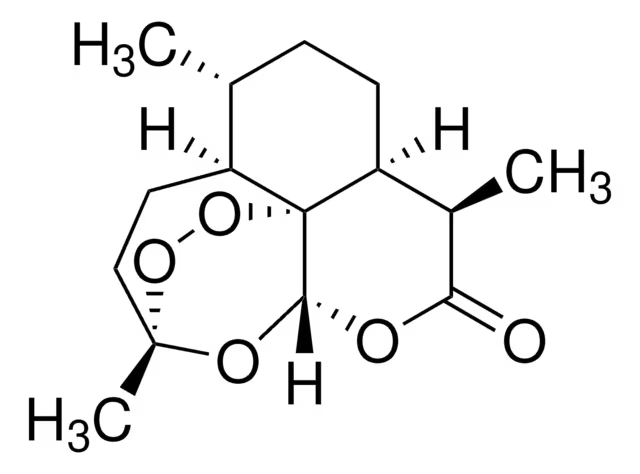
CAS Number63968-64-9
Synonyms(4S,5R,8S,9R,12S,13R)-1,5,9-Trimethyl-11,14,15,16-tetraoxatetracyclo[10.3.1.0.0]hexadecan-10-one; artemisininum; qinghausu; Artemisinin; UNII-9RMU91N5K2; ARTEANUIN; Quinghaosu; qinghaosu; QINGHAOSA; artemisinine; (+)-artemisinin; MFCD00081057; qinghausau; ARTEMISINE; QHS; qinghosu; Arteannuin
Molecular FormulaC15H22O5
Molecular Weight282.33
Purity98%
Density1.2±0.1 g/cm3
Boiling Point389.9±42.0 °C at 760 mmHg
Melting Point156-157 °C (lit.)
Appearancesolid
Symbol
Signal WordWarning
| Chemical & Physical Properties | |
|---|---|
| CAS Number | 63968-64-9 |
| Catalog No. | 2A-9009252 |
| Chinese Name | 青蒿素 |
| Synonyms | (4S,5R,8S,9R,12S,13R)-1,5,9-Trimethyl-11,14,15,16-tetraoxatetracyclo[10.3.1.0.0]hexadecan-10-one; artemisininum; qinghausu; Artemisinin; UNII-9RMU91N5K2; ARTEANUIN; Quinghaosu; qinghaosu; QINGHAOSA; artemisinine; (+)-artemisinin; MFCD00081057; qinghausau; ARTEMISINE; QHS; qinghosu; Arteannuin |
| Molecular Formula | C15H22O5 |
| Molecular Weight | 282.33 |
| Purity | 98 |
| Density | 1.2±0.1 g/cm3 |
| Boiling Point | 389.9±42.0 °C at 760 mmHg |
| Melting Point | 156-157 °C (lit.) |
| Appearance | solid |
| Water Solubility | Soluble in: methanol |
| Storage Condition | Brown glass light-sealed packaging. Store in low t |
| Application | Artemisinin is an antimalarial drug isolated from the aerial parts of the Artemisia annua L. plant. |
| HTC | 2932999099 |
| PubChem ID | 57649481 |
| MDL Number | MFCD00081057 |
| SMILES | C[C@@H]1CC[C@H]2[C@@H](C)C(=O)O[C@@H]3OC4(C)CC[C@@H]1[C@@]23OO4 |
| InChI | 1S/C15H22O5/c1-8-4-5-11-9(2)12(16)17-13-15(11)10(8)6-7-14(3,18-13)19-20-15/h8-11,13H,4-7H2,1-3H3/t8-,9-,10+,11+,13-,14-,15-/m1/s1 |
| InChI Key | BLUAFEHZUWYNDE-NNWCWBAJSA-N |
| NACRES Code | NA.79 |
| UNSPSC | 12352205 |
| Hazard Symbols | Transport |
| MSDS | msds/9252_1_63968_64_9.pdf |
| Bioactivity | Artemisinin is an anti-malarial drug isolated from the aerial parts of Artemisia annua L. plants. Related Catalog Signaling Pathways >> Anti-infection >> HCV Signaling Pathways >> Anti-infection >> Parasite Research Areas >> Infection Natural Products >> Terpenoids and Glycosides In Vitro Artemisinin (3.125-100 μM) concentration-dependently suppresses Aβ25-35 induced cytotoxicity in PC12 cells. Artemisinin (25 μM) suppresses Aβ25-35-induced LDH release, apoptosis and ROS production, attenuates Aβ-induced mitochondrial membrane potential loss and caspase 3/7 activity increase, and stimulates the phosphorylation of ERK1/2 in a time- and concentration-dependent manner in PC12 cell. ERK 1/2 pathway mediates the protect effects of artemisinin in PC12 cells[1]. Artemisinin shows cytotoxic activity in MCF-7/Dox cell line with IC50 of 3.7±0.4 μg/mL after 24 h treatment. Besides, Artemisinin treatment of MCF-7 cells, sensitive and resistant to Dox and DDP, causes a decrease in expression of proteins such as LF, FTH1, and HEP. Artemisinin activates p38 MAPK-kinase cascade regardless of the oxidative stress due to inhibition of VEGF expression and cell migration[2]. Artemisinin (50, 100 or 200 mg) significantly inhibits isoflurane-induced hippocampal neuronal loss, decreases caspase-3-positive cell counts and also cleaves caspase-3 expression, and modulates the expression of apoptosis pathway proteins. Artemisinin modulates JNK/ERK 1/2 signalling and histone acetylation[3]. Artemisinin inhibits HCV replication in a dose-dependent manner with EC50 value of 167±38 µM. Artemisinin and its most potent analogues partially inhibit the in vitro replication of HCV by induction of reactive oxygen species (ROS)[4]. Artemisinin significantly inhibits VSMC proliferation in a dose-dependent manner. Artemisinin (1 mM) for 72 h significantly reduces the expression of proliferating cell nuclear antigen messenger RNA[5]. In Vivo Artemisinin (50, 100 or 200 mg/kg b.wt/day, p.o.) prevents isoflurane-induced working memory impairments as observed in T-maze test. Artemisinin enhances spatial navigation and memory of rats exposed to isoflurane. Artemisinin-treated rats exhibit markedly better performance in comparison with isoflurane-alone-exposed rats[3]. Kinase Assay Briefly, PC12 cells are lysed in lysis buffer and centrifuged at 12,500×g for 5 min 15 mL of cell lysate is incubated with 50 mL of 2X substrate working solution at room temperature for 30 min in 96-well plates. The fluorescence intensity is then determined by Infinite M200 PRO Multimode Microplate at an excitation wavelength of 490 nm and emission at 520 nm. The fluorescence intensity of each sample is normalized to the protein concentration of sample. All values of % caspase 3/7 activities are normalized to the control group. Cell Assay For this purpose, cells are cultivated in 96-well plates in DMEM, supplemented with insulin. The artemisinin, Dox, and DDP are added to media at different concentrations and the cells are cultivated for either 24 or 48 h. For this purpose artemisinin is diluted in 0.01% DMSO in media. After this time, 10 µL of the MTT dye solution (5 mg/mL in phosphate buffer saline) is added to the cells; the cells are incubated at the same conditions for 3 h. After centrifugation (1500 rpm, 5 min) the supernatant is removed. 100 μL of dimethyl sulfoxide is added to each well, to dissolve formazan. The absorption is measured, using a multi-well spectrophotometer at a wavelength of 540 nm. Animal Admin Separate group of rat pups (total rat pups 80; n = 16 per group) is administered artemisinin (50, 100 or 200 mg/kg body weight) via oral gavage, every day from P2 to P21. On P7, the pups are exposed to isoflurane (0.75% in 30% oxygen or air) for 6 h in a temperature-controlled chamber. Animals that are not exposed to anaesthesia nor given artemisinin served as control group, while rats that receive isoflurane alone are grouped as anaesthetic-controls. References [1]. Zeng Z, et al. Artemisinin protects PC12 cells against β-amyloid-induced apoptosis through activation of the ERK1/2 signaling pathway. Redox Biol. 2017 Apr 4;12:625-633. [2]. Chekhun VF, et al. Artemisinin modulating effect on human breast cancer cell lines with different sensitivity to cytostatics. Exp Oncol. 2017 Mar;39(1):25-29. [3]. Xu G, et al. Neuroprotective effects of artemisinin against isoflurane-induced cognitive impairments and neuronal cell death involve JNK/ERK1/2 signalling and improved hippocampal histone acetylation in neonatal rats. J Pharm Pharmacol. 2017 Mar 12. [4]. Obeid S, et al. Artemisinin analogues as potent inhibitors of in vitro hepatitis C virus replication. PLoS One. 2013 Dec 11;8(12):e81783. [5]. Wang HY, et al. The effects of artemisinin on the proliferation and apoptosis of vascular smooth muscle cells of rats. Cell Biochem Funct. 2013 Sep 17. Chemical & Physical Properties Density 1.2±0.1 g/cm3 Boiling Point 389.9±42.0 °C at 760 mmHg Melting Point 156-157ºC Molecular Formula C15H22O5 Molecular Weight 282.332 Flash Point 172.0±27.9 °C Exact Mass 282.146729 PSA 53.99000 LogP 2.27 Vapour Pressure 0.0±0.9 mmHg at 25°C Index of Refraction 1.533 InChIKey BLUAFEHZUWYNDE-DKGJTOOQSA-N SMILES CC1CCC2C(C)C(=O)OC3OC4(C)CCC1C32OO4 |
| Use of | Artemisinin is an anti-malarial drug isolated from the aerial parts of Artemisia annua L. plants. Properties Articles114 Name (+)-artemisinin Synonym More Synonyms Artemisinin Biological Activity Description Artemisinin is an anti-malarial drug isolated from the aerial parts of Artemisia annua L. plants. Related Catalog Signaling Pathways >> Anti-infection >> HCV Signaling Pathways >> Anti-infection >> Parasite Research Areas >> Infection Natural Products >> Terpenoids and Glycosides References [2]. Chekhun VF, et al. Artemisinin modulating effect on human breast cancer cell lines with different sensitivity to cytostatics. Exp Oncol. 2017 Mar;39(1):25-29. [4]. Obeid S, et al. Artemisinin analogues as potent inhibitors of in vitro hepatitis C virus replication. PLoS One. 2013 Dec 11;8(12):e81783. [5]. Wang HY, et al. The effects of artemisinin on the proliferation and apoptosis of vascular smooth muscle cells of rats. Cell Biochem Funct. 2013 Sep 17. Chemical & Physical Properties Molecular Formula C15H22O5 Exact Mass 282.146729 PSA 53.99000 Index of Refraction 1.533 InChIKey BLUAFEHZUWYNDE-DKGJTOOQSA-N |
| Tax Rebate | 13.0% |
| Supervision | None. MFN tariff: 6.5%. Ordinary tariff: 20.0% |
| Transport Info | Shipping Name: UN |
| MSDS Transport Info | Module 14. Shipping information 14.1 UN dangerous goods number European Land Transport Dangerous Regulations: -International Maritime Dangerous Regulations: -International Air Transport Dangerous Regulations: - 14.2 United Nations shipping name European Land Transport Dangerous Regulations: Non-dangerous goods IMDG Code: Non-dangerous goods International air transport dangerous goods regulations: non-dangerous goods 14.3 Transport hazard categories European Land Transport Dangerous Regulations: -International Maritime Dangerous Regulations: -International Air Transport Dangerous Regulations: - 14.4 Package group European Land Transport Dangerous Regulations: -International Maritime Dangerous Regulations: -International Air Transport Dangerous Regulations: - 14.5 Environmental hazards European Land Transport Danger Regulations: No International Maritime Danger Regulations International Air Transport Danger Regulations: No Marine pollutants (yes/no): No 14.6 Special reminder to users No data available |
| Related Products in Specialty Chemicals | ||
|---|---|---|
| Arteannuic acid | 2A-300324 | 2A-9009241 |
| Asimadoline | 153205-46-0 | 2A-9009247 |
| Asocainol | 77400-65-8 | 2A-9009248 |
| Asparagus Root P.E. | 2A-300332 | 2A-9009249 |
| Aspidospermine | 466-49-9 | 2A-9009250 |
| Astrasieversianin XIV | 84687-43-4 | 2A-9009255 |
| Atiprosine | 89303-63-9 | 2A-9009257 |
| Atovaquone | 95233-18-4 | 2A-9009261 |
| Atropine | 51-55-8 | 2A-9009263 |
| Atropine sulfate monohydrate | 5908-99-6 | 2A-9009264 |
| Browse all Specialty Chemicals products » | ||
Phone:
630-322-8886
630-322-8887
Email:
Office Locations:
Chicago, IL, USA
San Francisco, CA, USA


 EN
EN


 SDS
SDS