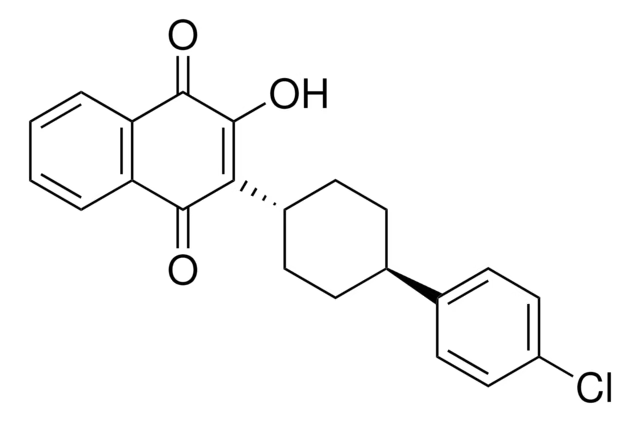
CAS Number95233-18-4
Synonyms2-Propanol,1-[2-(4-methyl-1,3-dioxolan-2-yl)ethoxy]; 2-[trans-4-(4'-chlorophenyl)cyclohexyl]-3-hydroxy-1,4-naphthoquinone; MFCD00889188; 3-(4-(4-chlorophenyl)cyclohexyl)-4-hydroxy-naphthalene-1,2-dione; trans-2-[2-(2-hydroxypropoxy)-ethyl]-4-methyl-1,3-dioxolane; Atovaquone; trans-2-[4-(4-chlorophenyl)cyclohexyl]-3-hydroxy-1,4-naphthoquinone; 3-[4-(4-Chlorophenyl)cyclohexyl]-4-hydroxy-1,2-naphthalenedione; 2-(trans-4-(4-chlorophenyl)cyclohexyl)-3-hydroxy-1,4-naphthalenedione; (trans-2-hydroxy-3-(4-(4-chlorophenyl)cyclohexyl)-1,4-naphthoquinone)
Molecular FormulaC22H19ClO3
Molecular Weight366.84
Purity98%
Density1.4±0.1 g/cm3
Boiling Point542.2±50.0 °C at 760 mmHg
Melting Point216-2190C
AppearanceYellow to orange crystalline solid
| Chemical & Physical Properties | |
|---|---|
| CAS Number | 95233-18-4 |
| Catalog No. | 2A-9009261 |
| Chinese Name | 阿托伐醌 |
| Synonyms | 2-Propanol,1-[2-(4-methyl-1,3-dioxolan-2-yl)ethoxy]; 2-[trans-4-(4'-chlorophenyl)cyclohexyl]-3-hydroxy-1,4-naphthoquinone; MFCD00889188; 3-(4-(4-chlorophenyl)cyclohexyl)-4-hydroxy-naphthalene-1,2-dione; trans-2-[2-(2-hydroxypropoxy)-ethyl]-4-methyl-1,3-dioxolane; Atovaquone; trans-2-[4-(4-chlorophenyl)cyclohexyl]-3-hydroxy-1,4-naphthoquinone; 3-[4-(4-Chlorophenyl)cyclohexyl]-4-hydroxy-1,2-naphthalenedione; 2-(trans-4-(4-chlorophenyl)cyclohexyl)-3-hydroxy-1,4-naphthalenedione; (trans-2-hydroxy-3-(4-(4-chlorophenyl)cyclohexyl)-1,4-naphthoquinone) |
| Molecular Formula | C22H19ClO3 |
| Molecular Weight | 366.84 |
| Purity | 98 |
| Density | 1.4±0.1 g/cm3 |
| Boiling Point | 542.2±50.0 °C at 760 mmHg |
| Melting Point | 216-2190C |
| Appearance | Yellow to orange crystalline solid |
| Water Solubility | Water solubility: insoluble; easily soluble in: te |
| Storage Condition | -20°C Freezer |
| Application | Atovaquone fights parasites. |
| HTC | 2942000000 |
| MDL Number | MFCD00889188 |
| SMILES | OC1=C([C@H]2CC[C@@H](CC2)c3ccc(Cl)cc3)C(=O)c4ccccc4C1=O |
| InChI | 1S/C22H19ClO3/c23-16-11-9-14(10-12-16)13-5-7-15(8-6-13)19-20(24)17-3-1-2-4-18(17)21(25)22(19)26/h1-4,9-13,15,26H,5-8H2/t13-,15- |
| InChI Key | KUCQYCKVKVOKAY-CTYIDZIISA-N |
| NACRES Code | NA.24 |
| UNSPSC | 41116107 |
| MSDS | msds/9261_1_95233_18_4.pdf |
| Bioactivity | Atovaquone is a medication used to treat or prevent for pneumocystis pneumonia, toxoplasmosis, malaria, and babesia.Target: AntiparasiticAtovaquone (atavaquone) is a chemical compound that belongs to the class of naphthalenes. Atovaquone is a hydroxy-1,4-naphthoquinone, an analog of ubiquinone, with antipneumocystic activity [1]. Atovaquone is an anti-protozoal mitochondrial electron transport inhibitor; Antimalarial; Antipneumocystic, and has also been used to treat toxoplasmosis. It acts by inhibiting the cytochrome bc(1) complex via interactions with the Rieske iron-sulfur protein and cytochrome b in the ubiquinol oxidation pocket [2]. Atovaquone is a unique naphthoquinone with broad-spectrum antiprotozoal activity. It is effective for the treatment and prevention of Pneumocystis carinii pneumonia (PCP), it is effective in combination with proguanil for the treatment and prevention of malaria, and it is effective in combination with azithromycin for the treatment of babesiosis [3]. Related Catalog Signaling Pathways >> Anti-infection >> Parasite Research Areas >> Infection References [1]. Looareesuwan, S., et al., Clinical studies of atovaquone, alone or in combination with other antimalarial drugs, for treatment of acute uncomplicated malaria in Thailand. Am J Trop Med Hyg, 1996. 54(1): p. 62-6. [2]. Kessl, J.J., et al., Molecular basis for atovaquone binding to the cytochrome bc1 complex. J Biol Chem, 2003. 278(33): p. 31312-8. [3]. Baggish, A.L. and D.R. Hill, Antiparasitic agent atovaquone. Antimicrobial agents and chemotherapy, 2002. 46(5): p. 1163-1173. Chemical & Physical Properties Density 1.4±0.1 g/cm3 Boiling Point 542.2±50.0 °C at 760 mmHg Melting Point 216-2190C Molecular Formula C22H19ClO3 Molecular Weight 366.837 Flash Point 281.7±30.1 °C Exact Mass 366.102264 PSA 54.37000 LogP 5.86 Vapour Pressure 0.0±1.5 mmHg at 25°C Index of Refraction 1.653 Storage condition -20°C Freezer |
| Use of | Atovaquone is a medication used to treat or prevent for pneumocystis pneumonia, toxoplasmosis, malaria, and babesia.Target: AntiparasiticAtovaquone (atavaquone) is a chemical compound that belongs to the class of naphthalenes. Atovaquone is a hydroxy-1,4-naphthoquinone, an analog of ubiquinone, with antipneumocystic activity [1]. Atovaquone is an anti-protozoal mitochondrial electron transport inhibitor; Antimalarial; Antipneumocystic, and has also been used to treat toxoplasmosis. It acts by inhibiting the cytochrome bc(1) complex via interactions with the Rieske iron-sulfur protein and cytochrome b in the ubiquinol oxidation pocket [2]. Atovaquone is a unique naphthoquinone with broad-spectrum antiprotozoal activity. It is effective for the treatment and prevention of Pneumocystis carinii pneumonia (PCP), it is effective in combination with proguanil for the treatment and prevention of malaria, and it is effective in combination with azithromycin for the treatment of babesiosis [3]. Properties Articles15 Name atovaquone Synonym More Synonyms Atovaquone Biological Activity Description Atovaquone is a medication used to treat or prevent for pneumocystis pneumonia, toxoplasmosis, malaria, and babesia.Target: AntiparasiticAtovaquone (atavaquone) is a chemical compound that belongs to the class of naphthalenes. Atovaquone is a hydroxy-1,4-naphthoquinone, an analog of ubiquinone, with antipneumocystic activity [1]. Atovaquone is an anti-protozoal mitochondrial electron transport inhibitor; Antimalarial; Antipneumocystic, and has also been used to treat toxoplasmosis. It acts by inhibiting the cytochrome bc(1) complex via interactions with the Rieske iron-sulfur protein and cytochrome b in the ubiquinol oxidation pocket [2]. Atovaquone is a unique naphthoquinone with broad-spectrum antiprotozoal activity. It is effective for the treatment and prevention of Pneumocystis carinii pneumonia (PCP), it is effective in combination with proguanil for the treatment and prevention of malaria, and it is effective in combination with azithromycin for the treatment of babesiosis [3]. Related Catalog Signaling Pathways >> Anti-infection >> Parasite Research Areas >> Infection References [1]. Looareesuwan, S., et al., Clinical studies of atovaquone, alone or in combination with other antimalarial drugs, for treatment of acute uncomplicated malaria in Thailand. Am J Trop Med Hyg, 1996. 54(1): p. 62-6. [3]. Baggish, A.L. and D.R. Hill, Antiparasitic agent atovaquone. Antimicrobial agents and chemotherapy, 2002. 46(5): p. 1163-1173. Chemical & Physical Properties Exact Mass 366.102264 PSA 54.37000 Index of Refraction 1.653 |
| Tax Rebate | 9.0% |
| Supervision | None MFN tariff: 5.5% Ordinary tariff: 30.0% |
| Transport Info | Product name: Purity: 98.0% |
| MSDS Transport Info | Module 14. Shipping information United Nations classification: inconsistent with United Nations classification standards UN number: not specified |
| Related Products in Specialty Chemicals | ||
|---|---|---|
| Asparagus Root P.E. | 2A-300332 | 2A-9009249 |
| Aspidospermine | 466-49-9 | 2A-9009250 |
| Astemisinin | 63968-64-9 | 2A-9009252 |
| Astrasieversianin XIV | 84687-43-4 | 2A-9009255 |
| Atiprosine | 89303-63-9 | 2A-9009257 |
| Atropine | 51-55-8 | 2A-9009263 |
| Atropine sulfate monohydrate | 5908-99-6 | 2A-9009264 |
| Aurantiol | 89-43-0 | 2A-9009266 |
| Avenge | 43222-48-6 | 2A-9009267 |
| Avicularin | 572-30-5 | 2A-9009268 |
| Browse all Specialty Chemicals products » | ||
Phone:
630-322-8886
630-322-8887
Email:
Office Locations:
Chicago, IL, USA
San Francisco, CA, USA


 EN
EN


 SDS
SDS