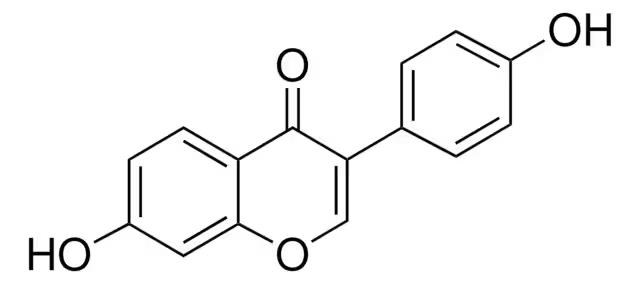
CAS Number486-66-8
Synonymsk251b; K 251-6; MFCD00016954; Tatoin; Soybean Extract; 7-Hydroxy-3-(4-hydroxyphenyl)-4H-chromen-4-one; 7-Hydroxy-3-(4-hydroxyphenyl)-4H-1-benzopyran-4-one (7-Hydroxy-3-(4-hydroxyphenyl)chromone; 4',7-Dihydroxyisoflavone; Daidzeol; 7-Hydroxy-3-(4-hydroxy phenyl) chromone; EINECS 207-635-4; 7,4'-dihydroxyisoflavone; isoaurostatin; Daizeol; Daidzein; Daidsein
Molecular FormulaC15H10O4
Molecular Weight254.24
Purity≥98%
Density1.4±0.1 g/cm3
Boiling Point512.8±50.0 °C at 760 mmHg
Melting Point>290 °C
Appearancepowder
EINECS207-635-4
Symbol
Signal WordWarning
| Chemical & Physical Properties | |
|---|---|
| CAS Number | 486-66-8 |
| Catalog No. | 2A-9008990 |
| Chinese Name | 大豆苷元 |
| Synonyms | k251b; K 251-6; MFCD00016954; Tatoin; Soybean Extract; 7-Hydroxy-3-(4-hydroxyphenyl)-4H-chromen-4-one; 7-Hydroxy-3-(4-hydroxyphenyl)-4H-1-benzopyran-4-one (7-Hydroxy-3-(4-hydroxyphenyl)chromone; 4',7-Dihydroxyisoflavone; Daidzeol; 7-Hydroxy-3-(4-hydroxy phenyl) chromone; EINECS 207-635-4; 7,4'-dihydroxyisoflavone; isoaurostatin; Daizeol; Daidzein; Daidsein |
| Molecular Formula | C15H10O4 |
| Molecular Weight | 254.24 |
| Purity | ≥98 |
| Density | 1.4±0.1 g/cm3 |
| Boiling Point | 512.8±50.0 °C at 760 mmHg |
| Melting Point | >290 °C |
| Appearance | powder |
| Water Solubility | insoluble |
| Storage Condition | 2-8°C Store in a sealed container in a ventilated |
| Application | Daidzein is a soy isoflavone that acts as a PPAR activator. |
| EINECS | 207-635-4 |
| PubChem ID | 24278030 |
| MDL Number | MFCD00016954 |
| SMILES | Oc1ccc(cc1)C2=COc3cc(O)ccc3C2=O |
| InChI | 1S/C15H10O4/c16-10-3-1-9(2-4-10)13-8-19-14-7-11(17)5-6-12(14)15(13)18/h1-8,16-17H |
| InChI Key | ZQSIJRDFPHDXIC-UHFFFAOYSA-N |
| Beilstein/REAXYS | 231523 |
| NACRES Code | NA.77 |
| UNSPSC | 12352202 |
| Hazard Symbols | Transport |
| MSDS | msds/8990_1_486_66_8.pdf |
| Bioactivity | Daidzein is a soy isoflavone, which acts as a PPAR activator. Related Catalog Research Areas >> Endocrinology Natural Products >> Flavonoids Target PPAR-α PPAR-γ In Vitro In 3T3-L1 adipocytes, Daidzein inverses the attenuation of adiponectin gene expression by co-culture, and these effects are inhibited by the PPAR-γ specific inhibitor. Daidzein attenuates the reduction of adiponectin expression in adipocytes, and a PPAR-γ specific inhibitor abrogated this effect. Direct activation of PPAR-α and-γ by Daidzein is confirmed by a luciferase reporter assay. In HEK293T cells, Daidzein significantly increases PPAR-α transcriptional activity in a concentration-dependent manner. Although an obvious dose-dependency is not observed in PPAR-γ transcriptional activity, Daidzein also significantly increases PPAR-γ transcriptional activity over a similar range of concentrations at which Daidzein enhanced PPAR-α transcriptional activity, with a maximum increase at 25 μM[1]. Daidzein is a soy isoflavone, which upregulates the expression of Abcg1, and it promotes axonal outgrowth in cultured hippocampal neurons via estrogen receptor signaling. Daidzein is a major component of soy with structural similarity to estrogen. It exerts an anti-inflammatory effect, lowers lipid levels, and increases mitochondrial biogenesis. As an activator of nuclear receptor peroxisome proliferator-activated receptors (PPARs), Daidzein enhances transcription of PPARs-dependent genes, including liver X receptors (LXRs, Nr1h gene family in mice). Incubation with different concentrations of Daidzein, from 5 to 100 μM, increases APOE transcriptional activity[2]. In Vivo Treating Apoe KO mice with Daidzein increases Lxr and Abca1 gene expression at 1 month after stroke, showing that the absence of ApoE does not interfere with other cholesterol homeostasis genetic programs. Therefore, the findings suggest that Daidzein-induced ApoE upregulation is a critical component in fostering functional recovery in chronic stroke[2]. Cell Assay HEK293T cells are plated on 24-well plates at a cell density of approximately 2.5×10⁴ cells/well and are grown to 70-80% confluence. Cells are then transiently transfected with a PPAR-α or PPAR-γ expression plasmid, and a plasmid containing the luciferase gene under the control of three tandem PPAR response elements (PPRE × 3 TK-luciferase) using an X-treme GENE HP DNA Transfection Reagent. Renilla luciferase control vectors are co-transfected to control for transfection efficiency. After transfection, cells are cultured for another 24 h in medium containing DMSO or various concentrations (6.25, 12.5, 25 μM) of Daidzein. Cells are lysed, and luciferase activity is measured and expressed as fold induction, that is normalized to the activity of the renilla luciferase control plasmid[1]. Animal Admin Mice[2] Experiments are performed in 10- to 11-week-old male C57 (C57 bl/6) and Apoe KO (C57 background) mice. For long-term stroke recovery, mice receive Moxifloxacin (100 mg/kg) for 3 d. The prophylactic antibiotic treatment is shown to effectively reduce mortality in an animal model of stroke by attenuating peripheral infection. In addition, saline is subcutaneously administered daily, and hydrogel (Clear H2O) is given to prevent dehydration. With the implementation of poststroke care (antibiotic regimen, rehydration, and feeding hydrogels with soft diet) during the acute period (<1 week), mice start to regain their body weight by day 5 and continue to recover from stroke. Animals are randomly selected for vehicle or Daidzein treatment. Vehicle or Daidzein (10 mg/kg) is administered subcutaneously within 30 min of reperfusion after confirming the reperfusion of blood flow, daily for 7 d and then every other day up to 1 month. References [1]. Sakamoto Y1, et al. The Dietary Isoflavone Daidzein Reduces Expression of Pro-Inflammatory Genes through PPARα/γ and JNK Pathways in Adipocyte and Macrophage Co-Cultures. PLoS One. 2016 Feb 22;11(2):e0149676. [2]. Kim E, et al. Daidzein Augments Cholesterol Homeostasis via ApoE to Promote Functional Recovery in Chronic Stroke. J Neurosci. 2015 Nov 11;35(45):15113-26. Chemical & Physical Properties Density 1.4±0.1 g/cm3 Boiling Point 512.8±50.0 °C at 760 mmHg Melting Point 315-323°C (dec.) Molecular Formula C15H10O4 Molecular Weight 254.238 Flash Point 201.2±23.6 °C Exact Mass 254.057907 PSA 70.67000 LogP 2.78 Vapour Pressure 0.0±1.4 mmHg at 25°C Index of Refraction 1.699 Storage condition 2-8°C Water Solubility insoluble |
| Use of | Daidzein is a soy isoflavone, which acts as a PPAR activator. Properties Articles157 Name daidzein Synonym More Synonyms Daidzein Biological Activity Description Daidzein is a soy isoflavone, which acts as a PPAR activator. Related Catalog Research Areas >> Endocrinology Natural Products >> Flavonoids In Vitro In 3T3-L1 adipocytes, Daidzein inverses the attenuation of adiponectin gene expression by co-culture, and these effects are inhibited by the PPAR-γ specific inhibitor. Daidzein attenuates the reduction of adiponectin expression in adipocytes, and a PPAR-γ specific inhibitor abrogated this effect. Direct activation of PPAR-α and-γ by Daidzein is confirmed by a luciferase reporter assay. In HEK293T cells, Daidzein significantly increases PPAR-α transcriptional activity in a concentration-dependent manner. Although an obvious dose-dependency is not observed in PPAR-γ transcriptional activity, Daidzein also significantly increases PPAR-γ transcriptional activity over a similar range of concentrations at which Daidzein enhanced PPAR-α transcriptional activity, with a maximum increase at 25 μM[1]. Daidzein is a soy isoflavone, which upregulates the expression of Abcg1, and it promotes axonal outgrowth in cultured hippocampal neurons via estrogen receptor signaling. Daidzein is a major component of soy with structural similarity to estrogen. It exerts an anti-inflammatory effect, lowers lipid levels, and increases mitochondrial biogenesis. As an activator of nuclear receptor peroxisome proliferator-activated receptors (PPARs), Daidzein enhances transcription of PPARs-dependent genes, including liver X receptors (LXRs, Nr1h gene family in mice). Incubation with different concentrations of Daidzein, from 5 to 100 μM, increases APOE transcriptional activity[2]. References [1]. Sakamoto Y1, et al. The Dietary Isoflavone Daidzein Reduces Expression of Pro-Inflammatory Genes through PPARα/γ and JNK Pathways in Adipocyte and Macrophage Co-Cultures. PLoS One. 2016 Feb 22;11(2):e0149676. [2]. Kim E, et al. Daidzein Augments Cholesterol Homeostasis via ApoE to Promote Functional Recovery in Chronic Stroke. J Neurosci. 2015 Nov 11;35(45):15113-26. Chemical & Physical Properties Molecular Formula C15H10O4 Exact Mass 254.057907 PSA 70.67000 Index of Refraction 1.699 Water Solubility insoluble |
| Transport Info | Shipping Name: UN |
| MSDS Transport Info | Module 14. Shipping information 14.1 UN dangerous goods number European Land Transport Dangerous Regulations: -International Maritime Dangerous Regulations: -International Air Transport Dangerous Regulations: - 14.2 United Nations shipping name European Land Transport Dangerous Regulations: Non-dangerous goods IMDG Code: Non-dangerous goods International air transport dangerous goods regulations: non-dangerous goods 14.3 Transport hazard categories European Land Transport Dangerous Regulations: -International Maritime Dangerous Regulations: -International Air Transport Dangerous Regulations: - 14.4 Package group European Land Transport Dangerous Regulations: -International Maritime Dangerous Regulations: -International Air Transport Dangerous Regulations: - 14.5 Environmental hazards European Land Transport Danger Regulations: No International Maritime Danger Regulations International Air Transport Danger Regulations: No Marine pollutants (yes/no): No 14.6 Special reminder to users No data available |
| Related Products in Specialty Chemicals | ||
|---|---|---|
| 3-Hydroxytyramine hydrochloride | 62-31-7 | 2A-9008983 |
| 3-methyl-2-cyclohexen-1-one | 1193-18-6 | 2A-9008985 |
| 3-Methylchromone | 85-90-5 | 2A-9008986 |
| 3-Morpholinosydnonimine | 33876-97-0 | 2A-9008987 |
| 4-(2-Amino-1-hydroxy-ethyl)phenol | 104-14-3 | 2A-9008988 |
| 4-Aminobenzoic acid isobuty ester | 94-14-4 | 2A-9008992 |
| 4-Aminobutyric | 56-12-2 | 2A-9008993 |
| 4-chloro-O-tolyloxyacetic acid, sodium salt | 3653-48-3 | 2A-9008994 |
| 4-Ethylmercurithiobenzenesulfonic acid | 5964-24-9 | 2A-9008995 |
| 4-Methyl-6,7-bis(sulfoxy)-2H-1-benzopyran-2-one,disodium salt,trihydrate | 29334-07-4 | 2A-9008997 |
| Browse all Specialty Chemicals products » | ||
Phone:
630-322-8886
630-322-8887
Email:
Office Locations:
Chicago, IL, USA
San Francisco, CA, USA


 EN
EN


 SDS
SDS