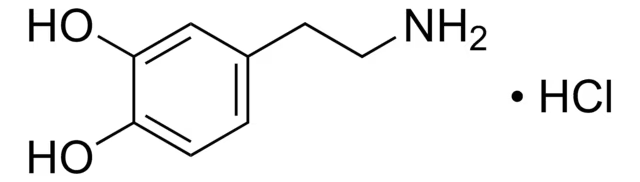
CAS Number62-31-7
Synonyms3,4-Dihydroxy-b-phenethylamine Hydrochloride; 4-(2-aminoéthyl)benzène-1,2-diol chlorhydrate; b-(3,4-Dihydroxyphenyl)ethylamine Hydrochloride; Tensamin; 4-(2-Aminoethyl)benzene-1,2-diol hydrochloride (1:1); Rascordin; Pyrocatechol, 4- (2-aminoethyl)-, hydrochloride; 1,2-Benzenediol, 4-(2-aminoethyl)-, hydrochloride (1:1); 4-(2-aminoethyl)benzene-1,2-diol,hydrochloride; 1,2-Benzenediol, 4- (2-aminoethyl)-, hydrochloride; 4-(2-Aminoethyl)-1,2-benzenediol hydrochloride (1:1); 4-(2-aminoethyl)-Pyrocatechol hydrochloride; 4-(2-Aminoethyl)benzol-1,2-diolhydrochlorid; EINECS 200-527-8; MFCD00012898; 4-(2-Aminoethyl)catechol, hydrochloride; β-(3,4-Dihydroxyphenyl)ethylamine hydrochloride; Dopamine (hydrochloride)
Molecular FormulaC8H12ClNO2
Molecular Weight189.64
Purity98%
Boiling Point337.7ºC at 760 mmHg
Melting Point248-250 °C(lit.)
Appearanceliquid
Symbol
Signal WordWarning
| Chemical & Physical Properties | |
|---|---|
| CAS Number | 62-31-7 |
| Catalog No. | 2A-9008983 |
| Chinese Name | 盐酸多巴胺 |
| Synonyms | 3,4-Dihydroxy-b-phenethylamine Hydrochloride; 4-(2-aminoéthyl)benzène-1,2-diol chlorhydrate; b-(3,4-Dihydroxyphenyl)ethylamine Hydrochloride; Tensamin; 4-(2-Aminoethyl)benzene-1,2-diol hydrochloride (1:1); Rascordin; Pyrocatechol, 4- (2-aminoethyl)-, hydrochloride; 1,2-Benzenediol, 4-(2-aminoethyl)-, hydrochloride (1:1); 4-(2-aminoethyl)benzene-1,2-diol,hydrochloride; 1,2-Benzenediol, 4- (2-aminoethyl)-, hydrochloride; 4-(2-Aminoethyl)-1,2-benzenediol hydrochloride (1:1); 4-(2-aminoethyl)-Pyrocatechol hydrochloride; 4-(2-Aminoethyl)benzol-1,2-diolhydrochlorid; EINECS 200-527-8; MFCD00012898; 4-(2-Aminoethyl)catechol, hydrochloride; β-(3,4-Dihydroxyphenyl)ethylamine hydrochloride; Dopamine (hydrochloride) |
| Molecular Formula | C8H12ClNO2 |
| Molecular Weight | 189.64 |
| Purity | 98 |
| Boiling Point | 337.7ºC at 760 mmHg |
| Melting Point | 248-250 °C(lit.) |
| Appearance | liquid |
| Water Solubility | soluble |
| Storage Condition | This product should be sealed, dry and protected f |
| Application | Dopamine hydrochloride is an agonist of dopamine D1-5 receptors and a catecholamine neurotransmitter widely present in a variety of animals. |
| HTC | 29222900 |
| MDL Number | MFCD00012898 |
| SMILES | Cl.NCCc1ccc(O)c(O)c1 |
| InChI | 1S/C8H11NO2.ClH/c9-4-3-6-1-2-7(10)8(11)5-6;/h1-2,5,10-11H,3-4,9H2;1H |
| InChI Key | CTENFNNZBMHDDG-UHFFFAOYSA-N |
| NACRES Code | NA.24 |
| UNSPSC | 41116107 |
| Hazard Symbols | Transport |
| MSDS | msds/8983_1_62_31_7.pdf |
| Bioactivity | Dopamine HCl is a catecholamine neurotransmitter present in a wide variety of animals,And a dopamine D1-5 receptors agonist.Target: Dopamine ReceptorDopamine (or 3,4-dihydroxyphenethylamine) is a neuroendocrine transmitter in the catecholamine and phenethylamine families that plays a number of important roles in the brain and bodies of humans. Several important diseases of the nervous system are associated with dysfunctions of the dopamine system. Outside the nervous system, dopamine functions in several parts of the body as a local chemical messenger. In the blood vessels, it inhibits norepinephrine release and acts as a vasodilator; in the kidneys, it increases sodium excretion and urine output; in the pancreas, it reduces insulin production; in the digestive system, it reduces gastrointestinal motility and protects intestinal mucosa; and in the immune system, it reduces the activity of lymphocytes. A variety of important drugs work by altering the way the body makes or uses dopamine. Dopamine itself is available for intravenous injection: although it cannot reach the brain from the bloodstream, its peripheral effects make it useful in the treatment of heart failure or shock, especially in newborn babies. L-DOPA, the metabolic precursor of dopamine, does reach the brain and is the most widely used treatment for Parkinson's disease. From Wikipedia. Related Catalog Signaling Pathways >> GPCR/G Protein >> Dopamine Receptor Signaling Pathways >> Neuronal Signaling >> Dopamine Receptor Natural Products >> Others Research Areas >> Neurological Disease Target Human Endogenous Metabolite References [1]. http://en.wikipedia.org/wiki/Dopamine Chemical & Physical Properties Boiling Point 337.7ºC at 760 mmHg Melting Point 248-250 °C(lit.) Molecular Formula C8H12ClNO2 Molecular Weight 189.639 Exact Mass 189.055649 PSA 66.48000 LogP 2.10130 InChIKey CTENFNNZBMHDDG-UHFFFAOYSA-N SMILES Cl.NCCc1ccc(O)c(O)c1 Stability Stable. Incompatible with strong oxidizing agents. Combustible. Water Solubility soluble |
| Use of | Dopamine HCl is a catecholamine neurotransmitter present in a wide variety of animals,And a dopamine D1-5 receptors agonist.Target: Dopamine ReceptorDopamine (or 3,4-dihydroxyphenethylamine) is a neuroendocrine transmitter in the catecholamine and phenethylamine families that plays a number of important roles in the brain and bodies of humans. Several important diseases of the nervous system are associated with dysfunctions of the dopamine system. Outside the nervous system, dopamine functions in several parts of the body as a local chemical messenger. In the blood vessels, it inhibits norepinephrine release and acts as a vasodilator; in the kidneys, it increases sodium excretion and urine output; in the pancreas, it reduces insulin production; in the digestive system, it reduces gastrointestinal motility and protects intestinal mucosa; and in the immune system, it reduces the activity of lymphocytes. A variety of important drugs work by altering the way the body makes or uses dopamine. Dopamine itself is available for intravenous injection: although it cannot reach the brain from the bloodstream, its peripheral effects make it useful in the treatment of heart failure or shock, especially in newborn babies. L-DOPA, the metabolic precursor of dopamine, does reach the brain and is the most widely used treatment for Parkinson's disease. From Wikipedia. Properties Articles206 Name 3-Hydroxytyramine hydrochloride Synonym More Synonyms Dopamine hydrochloride Biological Activity Description Dopamine HCl is a catecholamine neurotransmitter present in a wide variety of animals,And a dopamine D1-5 receptors agonist.Target: Dopamine ReceptorDopamine (or 3,4-dihydroxyphenethylamine) is a neuroendocrine transmitter in the catecholamine and phenethylamine families that plays a number of important roles in the brain and bodies of humans. Several important diseases of the nervous system are associated with dysfunctions of the dopamine system. Outside the nervous system, dopamine functions in several parts of the body as a local chemical messenger. In the blood vessels, it inhibits norepinephrine release and acts as a vasodilator; in the kidneys, it increases sodium excretion and urine output; in the pancreas, it reduces insulin production; in the digestive system, it reduces gastrointestinal motility and protects intestinal mucosa; and in the immune system, it reduces the activity of lymphocytes. A variety of important drugs work by altering the way the body makes or uses dopamine. Dopamine itself is available for intravenous injection: although it cannot reach the brain from the bloodstream, its peripheral effects make it useful in the treatment of heart failure or shock, especially in newborn babies. L-DOPA, the metabolic precursor of dopamine, does reach the brain and is the most widely used treatment for Parkinson's disease. From Wikipedia. Related Catalog Signaling Pathways >> GPCR/G Protein >> Dopamine Receptor Signaling Pathways >> Neuronal Signaling >> Dopamine Receptor Natural Products >> Others Research Areas >> Neurological Disease Human Endogenous Metabolite References [1]. http://en.wikipedia.org/wiki/Dopamine Chemical & Physical Properties Exact Mass 189.055649 PSA 66.48000 LogP 2.10130 InChIKey CTENFNNZBMHDDG-UHFFFAOYSA-N Stability Stable. Incompatible with strong oxidizing agents. Combustible. Water Solubility soluble |
| Transport Info | Shipping Name: UN |
| MSDS Transport Info | Module 14. Shipping information 14.1 UN dangerous goods number European Land Transport Danger Regulations: 3077 International Maritime Transport Danger Regulations: 3077 International Air Transport Danger Regulations: 3077 14.2 United Nations shipping name European land transport hazard regulations: ENVIRONMENTALLY HAZARDOUS SUBSTANCE, SOLID, N.O.S. (Dopamine hydrochloride) IMDG: ENVIRONMENTALLY HAZARDOUS SUBSTANCE, SOLID, N.O.S. (Dopamine hydrochloride) International air transport hazard regulations: Environmentally hazardous substance, solid, n.o.s. (Dopamine hydrochloride) 14.3 Transport hazard categories European land transport Dangerous Regulations: 9 International sea transport Dangerous Regulations: 9 International air transport Dangerous Regulations: 9 14.4 Package group European Land Transport Danger Regulations: III International Maritime Transport Danger Regulations: III International Air Transport Danger Regulations: III 14.5 Environmental hazards European Land Transport Dangerous Regulations: Yes International Maritime Transport Dangerous Regulations International Air Transport Dangerous Regulations: Yes Marine Pollutants (Yes/No): Yes 14.6 Special reminder to users No data available |
| Related Products in Specialty Chemicals | ||
|---|---|---|
| 2-Phenylchromone | 525-82-6 | 2A-9008976 |
| 2-Toluanilide | 7055-03-0 | 2A-9008977 |
| 3,5,4'-Tribromosalicylanilide | 87-10-5 | 2A-9008978 |
| 3,5-Diacetamido-2,4,6-tiiodobenzoic acid sodium salt; Diatrizoate sodium | 737-31-5 | 2A-9008979 |
| 3-hydroxy-10,13-dimethyl-17-(6-methylheptan-2-yl)-2,3,4,5,6,7,10,11,12,13,16,17-dodecahydro-1H-cyclopenta[a]phenanthren-15(9H)-one | 50673-97-7 | 2A-9008982 |
| 3-methyl-2-cyclohexen-1-one | 1193-18-6 | 2A-9008985 |
| 3-Methylchromone | 85-90-5 | 2A-9008986 |
| 3-Morpholinosydnonimine | 33876-97-0 | 2A-9008987 |
| 4-(2-Amino-1-hydroxy-ethyl)phenol | 104-14-3 | 2A-9008988 |
| 4',7-Dihydroxyisoflavone | 486-66-8 | 2A-9008990 |
| Browse all Specialty Chemicals products » | ||
Phone:
630-322-8886
630-322-8887
Email:
Office Locations:
Chicago, IL, USA
San Francisco, CA, USA


 EN
EN


 SDS
SDS